



COMMENTARY: By Iqbal Jassat
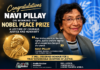
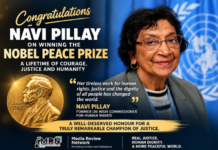
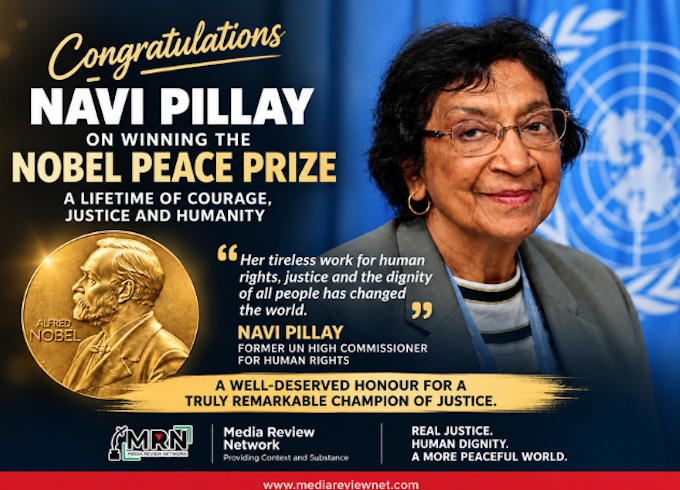
The Norwegian Nobel Committee’s decision to award the 2026 Nobel Peace Prize to Navanethem “Navi” Pillay is a monumental victory for international law, universal human rights, and the global rules-based order.
At 85 years old, the eminent South African jurist represents the absolute pinnacle of legal integrity – a career forged in the crucible of the anti-apartheid struggle and elevated to the highest chambers of international justice.
From defending anti-apartheid freedom fighters under a brutal regime to serving as the first black female judge on South Africa’s High Court, Pillay’s foundational years were defined by a refusal to bow to institutionalised oppression.
- READ MORE: US sanctions International Criminal Court in major escalation
- Who is Navi Pillay, winner of the 2026 Nobel Peace Prize?
- Other international law reports

Her subsequent contributions to global jurisprudence are historic. As president of the International Criminal Tribunal for Rwanda (ICTR), she pioneered the landmark ruling that recognised rape as an element of genocide, forever altering international criminal law.
Her tenure as UN High Commissioner for Human Rights and her service at the International Criminal Court (ICC) and International Court of Justice (ICJ) have consistently reflected a single, unwavering principle: that international law must apply equally to all nations, regardless of their size, wealth, or geopolitical alignment.
Predictably, this well-deserved recognition has drawn sharp, vitriolic condemnation from the Israeli government and its allied lobby networks.
The Israeli Foreign Ministry’s categorisation of the award as a “grotesque weaponisation” and allegations of political bias are desperate attempts to deflect from Pillay’s objective application of international humanitarian law.
Disgruntled reactions
These disgruntled reactions focus heavily on her leadership of the UN Commission of Inquiry into violations in the Occupied Palestinian Territory and Gaza. Yet, the work of that commission was not driven by prejudice, but by a rigorous adherence to the Geneva Conventions and established legal frameworks — the very standards the world relies on to prevent atrocities.
The claims of bias leveled by these detractors fall flat against the sheer breadth of Pillay’s lifelong body of work. She has spent decades holding perpetrators accountable across the globe, from Rwanda to Myanmar.
To suggest her record is a product of personal prejudice is to reject the very concept of objective international justice.
The backlash from Netanyahu and those currently under the scrutiny of international legal bodies reveals more about their own discomfort with accountability than it does about the character of the laureate.
At a moment in history when international legal institutions face immense geopolitical pressure, the Nobel Committee has sent an unmistakable message.
By honoring Navi Pillay, the world community reaffirms that accountability is non-negotiable and that universal human rights must be defended without fear or favour.
The desperate noise from spoilers cannot diminish the brilliance of her career or the profound justice of this prize. The world stands with Navi Pillay — a true titan of international law.
Iqbal Jassat is an executive member of the South Africa-based Media Review Network. He contributed this article to The Palestine Chronicle and it is republished with permission.