



COMMENTARY: By Jeremy Rose
“New Zealand is not a monotonous garden where every flower is the same; it is a garden where the diversity of the blooms enriches the view,” Winston Peters declared in his maiden speech, 47 years ago.
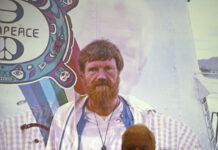
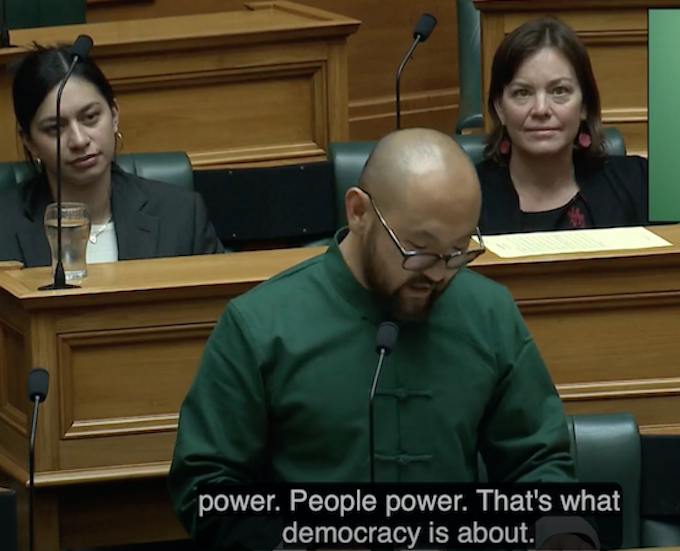
If you were looking for an image to illustrate the diversity today’s Minister of Foreign Affairs was celebrating, way back in 1979 you’d be hard pressed to find a better one than the screenshot, above, of Green MP Lawrence Xu-Nan giving his maiden speech last year.
Xu-Nan, dressed in a traditional Chinese shirt, is delivering the speech with his caucus colleagues, the proudly Māori Tamatha Paul, and US transplant Julie Anne Genter sitting behind.
- READ MORE: ‘You’re a liar! You’re a liar!’ NZ foreign minister Peters insults Gaza flotilla torture survivor in Parliament
- Other Winston Peters reports
Up in the right-hand corner there’s a sign language interpreter.
Last week Peters, leader of the New Zealand First Party, was hogging the headlines, not with a renewed celebration of cultural diversity but for telling the China-born Xu-Nan he wasn’t welcome here.
“I know you just came here five minutes ago. Go back to your own country.
“That’s where they lie like a flatfish, but they don’t lie like that here, all right? This is called democracy. This is called democracy, unlike what you’re used to.”
Xu-Nan, who was born seven years after Peters first entered Parliament, moved to New Zealand in 1994.
Riled up Peters
The MP, who the Sunday Times revealed last month had spoken the most words of any MP in Parliament this term, had riled up Peters with an interjection asking if he was vaccinated.
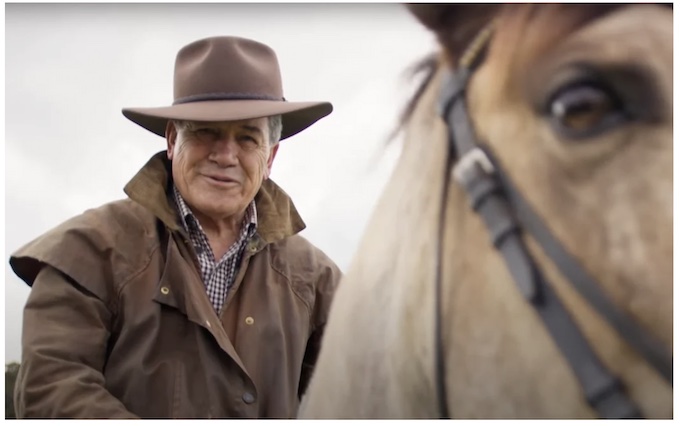
The 81-year-old, pinstripe suit-wearing Peters had himself pictured on horseback in the run-up to the last election, such is his fondness for the metaphor “this isn’t my first rodeo”.
And last week’s outburst wasn’t the first time he has attacked Asians in an election year.
In the run-up to the 1996 election, Peters gave what came to be known as his Asian Invasion speech.
It was condemned by politicians from across the spectrum: the then National Party trade negotiations minister Philip Burdon described it as “a crude appeal to base prejudices”; the deputy leader of the leftwing Alliance, Matt Robson, said Peters was fomenting “ugly, racist attitudes which he hopes will transfer into votes”; and Labour’s Chris Carter said he was trying to “capitalise on economic envy”.
And this past week Peters has again been condemned from left to right. Former prime minister Helen Clark and former National Party and Act Party leader Don Brash have called on Prime Minister Christopher Luxon to sack him.
Luxon described the comments as racist and outrageous but said Peters continued to have his confidence as Foreign Minister.
Brash downplayed the insults to Xu-Nan and focused on the damage Peters’ comments could do to the New Zealand–China relationship.
“It’s one thing to make a comment in the House about a flippant remark. But to go on about the China government itself is, is….” Stuff reported, a seemingly lost-for-words Brash as saying.
Chair of China bank NZ branch
Brash — a rightwing libertarian and staunch advocate of privatisation — is the chair of the New Zealand branch of the world’s largest (state-owned) commercial bank: the Industrial and Commercial Bank of China.
The former Reserve Bank governor wasn’t alone in focusing primarily on the hurt caused to New Zealand’s relationship with its largest trading partner rather than his attack on Xu-Nan and the wider migrant community.
With an election in under 100 days, Peters’ outburst could just be him taking another ride on the bucking bronco of nativist dog-whistle politics, but the attack on the Chinese government was out of character.
It is a trope among New Zealand’s political journalists to comment on the two Winston Peters: the rough-and-tumble populist at home and the dignified hard-working statesman on the world stage.
Last Wednesday’s performance was more frothing at the mouth than “flippant remark”, and with his words reported around the world his image as a hard-working statesman is, surely, tarnished beyond repair.
His attack on Xu-Nan’s lack of understanding of democracy based on his country of birth was as ironic as it was ignorant, arrogant and just plain dumb.
In his maiden speech, Xu-Nan noted that the word democracy came from the Greek root demos — people — and kratos – power.
‘Empowering the people’
“We don’t get to say that we are democratic by asking the nation to tick a couple of boxes every three years; it is something that we, as parliamentarians, have to prove every day, something our people demand of us every day, and something we should empower the people to do every single day.”
Xu-Nan, whose PhD thesis dealt with ancient Egypt, then went on to reflect on the influence of both Egyptian and Chinese ideas on his thinking.
In an interview with the Asia NZ Foundation before the 2020 election, Xu-Nan said he was seeing casual racism “coming out as a more active form of racism towards not just Asian communities, but all migrant communities, our Pasifika community and our indigenous Māori community.”
But, sadly, that active form of racism isn’t new and it never went away. Writing on E-Tangata, Mengshu Fu recalls arriving as a child from China in the year Peters gave his Asian Invasion speech.
They explain that the Mandarin community nicknamed Peters “Lao Pi.” Lao is old and Pi both a shortened version of Pete and the word for skin. It’s not necessarily an insulting name but is an informal one.
“Lao Pi is like that grumpy neighbour everyone knows is a problem,” they write.
“Except he’s not a random neighbour. He is the Foreign Affairs Minister and former deputy prime minister. He represents New Zealand on the global stage, and he’s in a position to make decisions for this country. He’s in a position to embolden racial abuse and violence, a violence many of us first met as children.”
Awful advert for democracy
Winston Peters may be the longest-serving MP in Parliament but he’s an awful advert for democracy. His New Zealand First Party is a personality cult that attracts outsized corporate donations on one hand and actively courts a grab bag of the angry and disgruntled: from the gun lobby and anti-245T hunting groups to those animated by the full gamut of cultural war issues.
Last month when asked whether local gas exploration company Greymouth Petroleum had influenced the party’s $1 billion gas exploration promise, NZ First deputy leader Shane Jones declared: “no one influences such matters that go into our manifesto — only Winston and I”.
It’s an extraordinary comment, not because of the denial that Greymouth Petroleum — a major player in an industry whose representatives regularly lobby the leadership of the party — had any influence on it, but the admission that its own members also had none whatsoever.
The “drill baby drill” policy — and other “such matters” — it seems are Winston and Shane’s alone.
The Winston Peters of his maiden speech — nearly five decades ago — had some prescient thoughts on the energy crisis kicked off by the Iranian revolution of 1979.
“I am aware that the energy crisis is a matter of grave concern to us all, but, despite the problems of rising fuel prices, we have some advantages. Let us emphasise the advantages we do have. We are blessed with a temperate climate. Our country is compact, so that we do not have to travel long distances between our cities.
“Of the less obvious advantages, our coastline is extensive, and the harnessing of the tides to create power is a feasible proposition. Solar and wind power are also developments to which Kiwi ingenuity will have the opportunity of applying itself. I can foresee no problems that the country cannot solve; yet the gloom merchants have been peddling their wares.”
A visionary statement
Excluding the odd claim that New Zealand with a landmass larger than the UK and population of less than one tenth is compact, it was a visionary statement more in line with the thinking of today’s Green Party than the fossil fuel future being peddled by NZ First now.
That was then and this is the age of culture wars. From Trump’s MAGA and Nigel Farage’s Reform to Pauline Hanson’s One Nation and Winston Peters’ New Zealand First, the transition to renewable energy is condemned as woke.
Windmills and solar panels have joined (brown) immigrants on the list of things threatening our way of life.
Jones, who often sports a Make New Zealand Great Again cap — came to his leader’s defence in the blowback from his attack on Xu-Nan by declaring that he and Winston are both “historical foundation New Zealanders. And he [Xu-Nan] should know his place.”
It’s a disturbing phrase and one that historian Scott Hamilton has pointed out has similarities to the term “heritage Americans” popular among the nationalist white right in the US.
Presumably, in Jones’ mind Māori and the Pākehā descendants of the original settlers are “foundation New Zealanders” with greater rights than those of more recent migrants.
“We are going to campaign that all migrants must be citizens and must be here in this country for a long period of time before they can be politicians,” he said.
Suggests a curated garden
It suggests a garden, to evoke Winston Peters’ metaphor, where the blooms are stringently curated by a head gardener: more Versailles than a flourishing botanical garden celebrating both native and exotic blooms.
If the 34-year-old Winston Peters who gave that maiden speech had been able to see the Aotearoa of 2026 he might have been pleasantly surprised to see that new renewable energy sources were finally being embraced and that our Parliament was far, far more diverse.
Xu-Nan opened his maiden with a song his maternal grandmother used to sing him in Mandarin Chinese. He ended his speech with its translation:
Ain’t scented like a flower
Ain’t tall like a tree
I’m just a blade of grass that nobody knows
But I ain’t ever lonely
I ain’t ever worried
Look my companions are all around the globe
Spring wind, o spring wind
You make me greener
Sunshine, o sunshine
You shine your light on me
Rivers, o valleys
You have nourished me
Great earth, o mother
You embrace me tightly.
There’s a humility and commitment to — well — democracy, Papatuanuku and solidarity that we should all embrace.
Jeremy Rose is a Wellington-based journalist and a contributor to Asia Pacific Report. This article was first published by his Substack Towards Democracy.