




By Johnny Blades of RNZ Pacific
A group of former Pacific prime ministers, presidents and senior diplomats has warned that Pacific Islands countries are at a crossroads as geopolitical competition reshapes the region.
This comes after China fired a test nuclear-capable missile in the South Pacific on Monday, and amid Australia’s busy campaign of signing security treaties with Pacific countries.
The Pacific Elders Voice group warns that growing geopolitical competition in the Pacific is threatening the future of regionalism and the sovereignty of island nations.
- READ MORE: ‘Stop firing missiles in our ocean’ – Pacific reacts to China test
- Jeremy Rose: The nuclear-free Pacific and hypersonic hypocrisy
- NZ accuses China of going against peace and stability of Pacific
- RIMPAC 2026: Part 1 – World’s biggest naval games a dress rehearsal for the coming ‘war on China’
- Missile test in South Pacific ‘routine’ and ‘consistent with international law’, China insists
- Other RIMPAC reports
It also warns that larger neighbours are reframing the Pacific region’s vulnerabilities — including climate change, economic dependence and geographic isolation — as opportunities for external influence.
Security agenda
Things are moving fast, too fast in the eyes of many Pacific Islands leaders who are concerned about militarisation of their region.
As well as the spate of treaties Canberra has been pursuing, a number of security and defence initiatives have recently begun including on regional responses to maritime threats and defence force integration between some regional countries adjacent to the Pacific Islands Forum.
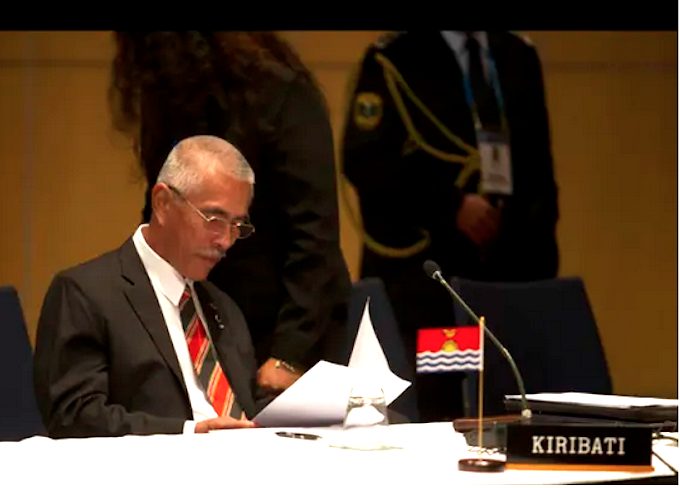
But the Pacific Elders Voice group’s chairman, Anote Tong, who is a former president of Kiribati, told RNZ Pacific that the focus of the region was being steered away from the core issues confronting Pacific Islanders.
“We’ve got to make sure that we don’t create this proliferation of different institutions, which then detract away from the focus of what it is that we at Pacific Islands countries regard as the highest priority security consideration,” he said.
“So it’s about making sure that all of these are aligned to what the Forum as the prime body which should be allocating these priorities, that they’re all in alignment with the Forum priorities.”
The Pacific Elders said that its concern was not with cooperation:
“The Pacific has always been strongest when it acts collectively. Our concern is with forms of cooperation that weaken Pacific authority, diminish accountability, or turn vulnerability into permission for external influence.”
Different interests
Tong acknowledged that geopolitical tensions are currently high, and that at such times Pacific countries come under huge pressure.
“I know from my own experience that there’s been times when we’ve gone along, even though an issue has no direct relevance to us, and because why, because it is important to maintain solidarity in the region,” he said.
“I think if we present ourselves as being solid, then that is a source of strength, and I think we have demonstrated this on international issues where we have come together as a region that actually influenced the international agenda.
“One example is on climate change, and of course, also on the ocean, the relevance of the ocean as a key international item on the agenda.”
But the way it is going, Pacific Islanders feel increasingly deserted by Australia and New Zealand on the climate crisis, Tong said.
“I, for one, have made that very clear in my interactions with the Australian government. New Zealand has changed its position recently, because climate change has the potential and the real capacity to destroy the future of our future generations.
“So that is the prime security issue, but that’s not important, we are at odds with our larger neighbours on this issue.”
‘Act together as equals’
In their statement, the Pacific Elders Voice said that the Pacific Forum’s Ocean of Peace initiative depended on sovereign Pacific nations working together as equals through transparent, accountable institutions that reflect shared Pacific values and priorities.
Tong said it was crucial for regionalism, and the sovereignty of Pacific Island nations, that they work together.
“The recent [Chinese missile] test — what does that say? How do we respond to that, or if we should respond at all? These are the questions.
“But I think what the whole point is that let’s all keep it together, so that it goes through one channel, so that they’re all being kept in the one place, because otherwise we could be going at a tangent to our primary objectives as a region.”
The Pacific Elders said that “true regional security will never be achieved by concentrating authority or allowing vulnerability to determine whose voice carries greatest weight.
“It will be achieved by strengthening the capacity of sovereign Pacific nations to act together, as equals, in pursuit of our shared future.”
This story was first published on