


SPECIAL REPORT: By Oren Ziv of +972 Magazine
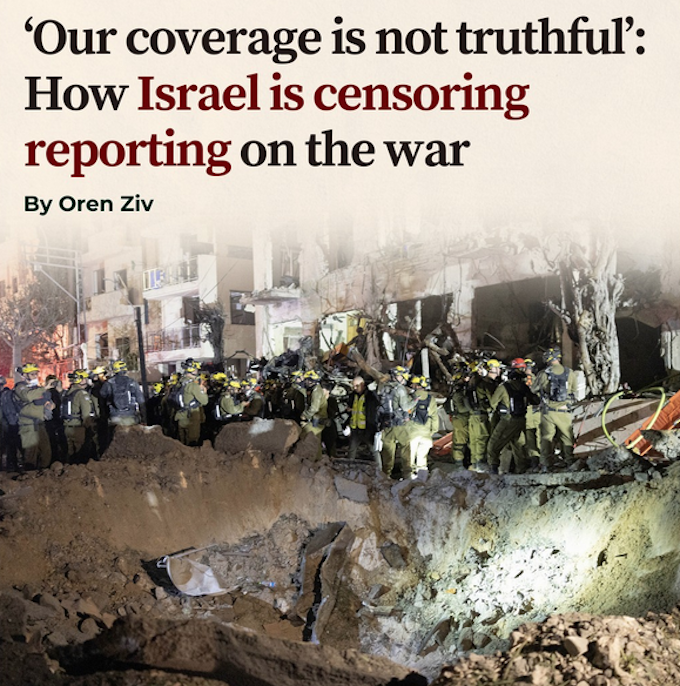
Since the start of the war with Iran, the Israeli military has imposed strict censorship regulations on local and international media outlets operating inside the country, severely impeding journalists’ ability to cover the situation on the ground.
Reporters and networks are prohibited from publishing the precise location of Iranian missile impacts, or even filming or photographing the extent of the damage in a way that could give away the location — restrictions designed, in the words of the army’s chief censor Colonel Netanel Kula, “to prevent assistance to the enemy during wartime”.
Outside of wartime, Israeli law already gives the military censor the authority to prevent certain information from being published, even retroactively. This can include aspects of Israel’s arms deals or intelligence activities, among other security-related topics.
- READ MORE: Iran is getting the Gaza treatment — Al Jazeera’s The Listening Post
- War on Iran: ‘It’s abominable, the lies that the American mainstream media is telling the people’
- Other US-Israeli war on Iran reports
But just as it did during the “12-Day War” last June, the censor has tightened its restrictions amid the current US-Israeli war with Iran. The police have already detained several journalists it deemed to be violating these censorship regulations.
In an unclassified document published on March 5, Kula instructed journalists to submit anything related to the following topics to the censor for review prior to publication:
- operational matters,
- intelligence, defensive preparedness,
- impact sites in Israel,
- armament management (including munitions and interceptor stockpiles, aircraft and air defense systems readiness, and the employment and use of unique and classified weaponry), and
- operational vulnerabilities in defence and offence.
“Consideration must also be given to the publication of visual materials, such as photographs and videos, which must also be submitted for prior review,” Kula added.

Absurd situations
These restrictions have created some absurd situations for journalists. In one case known to +972 Magazine, an Iranian missile hit its target while fragments struck a nearby educational facility. Yet the media was only allowed to report on the latter, without being able to even mention the former or inspect the damage.
In another case, journalists were documenting damage to a residential building when a man who likely worked for a security agency told police to instruct the journalists there not to film the actual target of the strike, which was behind them.
The officer replied that the journalists would not have noticed it if they were not told, since most of the damage was to the civilian building.
Several senior staff members in international media organisations operating in Israel told +972 that the censor’s restrictions have made it difficult to maintain normal reporting routines.
One example concerns live feeds of wide shots from cities like Tel Aviv and Jerusalem that international news agencies provide for use by broadcasters worldwide.
During Iranian missile attacks, the agencies are prohibited from showing where Israeli interceptor missiles are launched from, meaning they must either cut the broadcast or tilt the camera downward toward the street so the skyline is not visible.
A senior figure at one news agency said that after cutting the live feed, they sometimes send footage of incoming missiles and interceptions to the censor for approval. The censor has barred several of these clips from publication, including a failed interception and a missile fragment continuing its trajectory.
Still photographs rejected
The censor has also rejected still photographs showing interceptor launches, including long-exposure nighttime images that do not reveal precise locations.

“It’s hard to understand what is actually happening,” a senior manager at a foreign media outlet working in Israel explained.
“In a lot of cases, we have official reports that there were no strikes or damage only to discover later that a target was hit. We can’t report or confirm so we don’t know if it happened or not.
“We have a partial understanding of the reality on the ground,” the senior manager admitted. “Our coverage of the war is not truthful.”
Pacific Media Watch reports that Democracy Now! quoted a CNN journalist saying “Every reporter in Israel — and every member of the public — is subject to a military censor. On national security grounds, the regulation authorises the censor to prohibit reporting or broadcasting any material that could reveal sensitive information or pose a threat to the country’s security interests.”
Democracy Now! posed a question about the responsibility of the US media in informing the public on stories, “especially since they’re always showing us the results of the plumes rising in Abu Dhabi or in Saudi Arabia or even in Iran, but not the direct hits that are occurring within Israel”.