
COMMENTARY: By Reuben Davidson
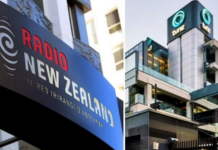
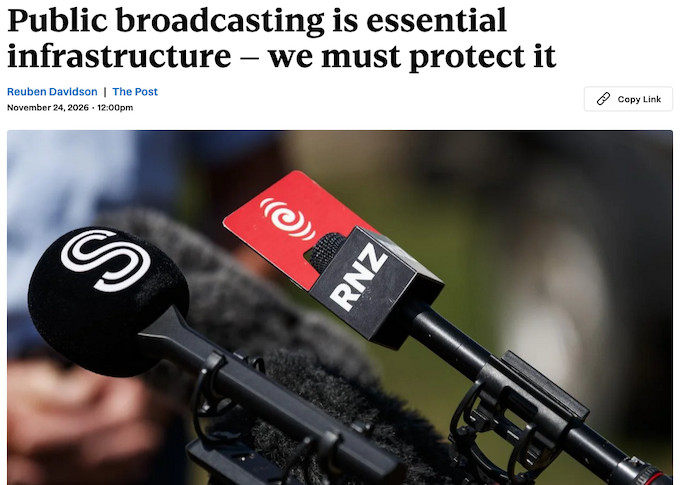
When a 5.7 magnitude earthquake rattled Arthur’s Pass last week, thousands of Kiwis didn’t refresh their social media; they turned on RNZ. Yet the very people who keep that lifeline running may be out of a job by Christmas.
Discussions about public media too often overlook the enormous, sometimes unquantifiable, value it provides.
Public media is essential to democracy. It provides free, reliable and independent information, serving the public interest rather than commercial or political interests.
- READ MORE: Media shock waves at major regional broadcaster RNZ pose Pacific challenge
- Asia Pacific Media Network warns RNZ job cuts risk ‘vital communication link with Pacific’
- Other RNZ reports
In an age of paywalls and increasing misinformation, it ensures everyone can access trusted news and provides the scrutiny and accountability that a healthy democracy depends on.
RNZ’s contribution goes well beyond daily journalism. Its reporting on major disasters and emergencies, it’s partnership with 22 media entities through RNZ Pacific, and its role as our statutory Civil Defence Lifeline Broadcaster are all vital.
In an emergency, access to reliable information can be the difference between life and death.
Over the last week we’ve been reminded of RNZ’s ability to scrutinise — even when the crisis is within its own organisation. Some of the best coverage we’ve seen of RNZ’s situation has come from its own journalists and programmes, literally on its own doorstep.
Low public media investment
And yet, New Zealand invests relatively little in public media. Estimates from Better Public Media put our annual expenditure at about $27 per capita, compared with $110 in Norway, $142 in Germany, and $81 in the United Kingdom.
National and its coalition partners have consistently demonstrated a lack of appreciation for RNZ’s public media role. Over the last three years, they have cut funding in every budget, with outgoing Media Minister Paul Goldsmith promising more cuts to come.
The board they hand-picked presided over the crisis RNZ now faces, approving millions of dollars in land disposals and a $5 million loan.
They are now planning to cut the equivalent of 58 full-time roles by March. That is 20 percent of its workforce — a substantial loss of people, experience and institutional knowledge.
The fundamental question is whether RNZ will still have the people and resources to fulfil its responsibilities. Can it maintain the quality and breadth of its journalism, meet its emergency broadcasting obligations, and continue delivering RNZ Pacific?
There are also serious questions about the leadership and decision-making that brought RNZ to this point. How did its financial situation deteriorate without those responsible being aware? And why is a board that oversaw the decisions contributing to this crisis now identifying and actioning the cuts?
New Zealanders deserve transparency and accountability. That begins at the top.
Crisis demands coordinated approach
Caretaker Prime Minister Christopher Luxon has been clear about what National will not do for public broadcasting. He has been far less clear about how New Zealand will protect and sustain it. This crisis demands a coordinated approach in the caretaker period, not rushed decisions with potentially irreversible consequences.
No public institution should be exempt from financial scrutiny, but financial discipline cannot become an excuse for dismantling the very capability an institution exists to provide.
Nothing irreversible should happen until there is a new government and a new minister in place, and until there is confidence that suitable, transparent leadership is ready to navigate this crisis. An interim board should be appointed while a review examines how this occurred, and no decisions on cuts or redundancies should be made in the caretaker period.
We should not allow a board that oversaw this crisis to push through major restructuring that could permanently weaken RNZ before a new government has the opportunity to consider the alternatives.
We have written to Paul Goldsmith, setting out our concerns. If Labour is able to form the next government, we would make different decisions, including writing off the deficit and stopping the planned job losses.
Pushing ahead now risks doing lasting damage to one of our most important democratic and cultural institutions, and leaving an incoming government with decisions it cannot undo.
Clear assurances needed
New Zealanders deserve clear assurances that RNZ will remain a viable, appropriately staffed public broadcaster, capable of delivering independent journalism, meeting its Civil Defence Lifeline Broadcaster obligations and serving New Zealand and the Pacific.
Public media is not simply another line in the government’s budget. It is essential democratic infrastructure. Once the people, expertise and capability that underpin it are lost, they cannot easily be rebuilt.
The responsibility of any government should be to strengthen this infrastructure for future generations, not dismantle it through rushed decisions and cuts.
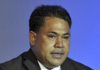
Reuben Davidson is Labour’s media and broadcasting spokesperson.