




By Johnny Blades of RNZ Pacific
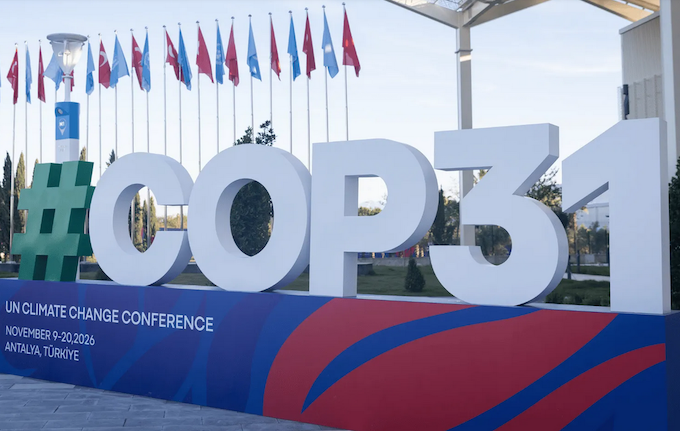
Despite the failure of the international community to settle on a strong outcome from COP31, there were glimpses of progress on climate finance and resilience for Pacific countries and territories.
Pacific Islands representatives made clear at the global climate summit in Antalya, Türkye, their critical need for better access to climate finance which does not leave them saddled with debt
Some areas of potential were highlighted by members of the European Union-funded Green Overseas Programme, which is implemented by the French International Cooperation Agency.
- READ MORE: COP31: ‘Negotiation in bad faith’ – Pacific push for stronger climate action fails
- Other COP31 climate reports
They brought new research to COP31 and highlighted practical examples for Pacific territories to better access climate finance.
So-called “overseas territories” like New Caledonia and French Polynesia are often left outside the main climate financing frameworks.
A New Caledonian representative with the programme, Ilona Mayerau-Lonné, said the aim is to strengthen the resilience of 25 overseas territories, 13 European and 12 British.
“So it’s basically like from Greenland to Pitcairn. In the Pacific you have New Caledonia, French Polynesia, and Wallis and Futuna,” she explained to RNZ Pacific
“The programme is more than 17 million euros (NZ$34 million) over six years, and it focuses on three areas: energy transition, resilience to climate change and access to climate finance.”
The constitutional status of the overseas territories and the way international funding mechanisms are structured can leave them outside the main global financing frameworks, regardless of the scale of their climate-related needs.
Mechanisms
The Green Overseas Programme ran a feasibility study on 18 financing mechanisms that could help these territories.
“That study looked at why finance doesn’t reach territories like ours, the barriers and and the needs. It also explored how private finance could actually complement institutional funding,” Mayerau-Lonné said.
The study identified five mechanisms that Mayerau-Lonné said had real potential to support investment across the territories: green and blue bonds, carbon markets, conservation trust funds, blended finance, and environmental levies.
She described levies as a small but effective mechanism, citing an example from the British Virgin Islands.
“Part of a ten-dollar tourism levy on each passenger goes into a trust fund for climate resilience and renewable energy,” she said.
For the bonds mechanism, she cited a Cayman Islands example
“The local utility raised US$15 million [NZ$27 million] in green bonds in 2024 for renewable energy and adaptation.”
Carbon markets
And regarding carbon markets, Mayerau-Lonné offered a Pacific example.
“New Caledonia’s seagrass beds are one of the opportunities the study identifies for carbon markets.
“The main lesson is that no single mechanism feeds everyone. So the barrier isn’t a lack of instrument. It’s that our projects are often too small to cover their own transaction costs.”
While the Green Overseas Programme ends this year, Mayerau-Lonné said the projects and solutions it helps bring out in the territories have to keep going.
“That’s why the EU’s next programming for overseas territories, that will be implemented from 2028 to 2034, matters so much, because it will decide whether that work continues and how it continues and for who and for how much.”
This story was first published on