

ANALYSIS: By Jonathan Milne
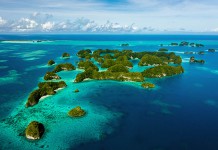
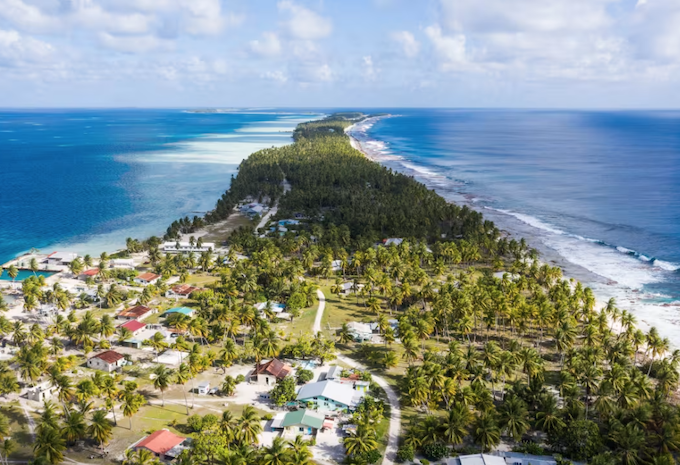
Isolation has been a challenge for the people of the atoll of Tongareva, 1300km north of the Cook Islands capital on Rarotonga.
Distance has made it difficult for the 230 residents to get supplies, or to travel for school and work. There are no scheduled flights; a ship visits every two months.
But isolation hasn’t been their greatest enemy; arguably, it’s engagement with the outside world that’s done them more harm. Ever since the crew of a passing English sailing ship, the Lady Penrhyn, dubbed the island Penrhyn in 1788, the people have suffered the colonial ambitions of distant empires.
- READ MORE: Pacific Islands Forum: Should outside nations be allowed at the leaders’ summit?
- US expected to announce major fuel security deal at Pacific Islands Forum
- Pacific leaders urged to be united behind 2050 climate action vision
- US pushes critical minerals agenda in Cook Islands with Penrhyn ‘lifeline’
- Other PIF reports
Missionaries brought new rules suppressing the language and faith and traditional cultural practices. Sailors brought disease that harmed the people and the plants.
An imported coconut blight led to a catastrophic famine that nearly depopulated the island.
The grimmest tragedy was in the 1860s, when London Missionary Society pastors sold 472 islanders for about five silver dollars a head, as slaves to Peru.
They boarded the Spanish and Peruvian ships with a promise of good pay and a safe return. It was a lie. Most died in exile.
Considering history
Islanders will be quietly considering that history, after news this week that the United States and New Zealand governments will invest $102 million in building a new deepwater port on the atoll, potentially providing a staging post for overseas naval vessels.

This is not new; the atoll was home to a US base in the Second World War. American GIs built port infrastructure and a 3000m crushed coral airstrip there.
It became a stopping point for the big Catalina flying boats; stripped hulks of American bombers still sit on the atoll as physical scars of the war. Children grew up who never knew their fathers — an emotional scar of the war.
There has long been talk — some supportive, some opposed — of a deepwater port in Tongareva’s big 233 sq km lagoon, reportedly 90m at its deepest point. Rarotonga businessman Charles Pitt argued in 2009 that the Americans should build commercial interests there, to give them a strategic position between China’s interests to the west in Sāmoa, and French Polynesia to the east.
Pitt warned that Chinese fishing interests were planning to open a business on Penrhyn — and it was always that potential for Chinese involvement that motivated the greatest concern in US-aligned countries.
In 2018, when I was editing the Sunday Star-Times, we reported on the front page that Cook Islands and Niue had “blindsided” NZ Foreign Minister Winston Peters by signing up to China’s belt and road infrastructure lending scheme, and that there was talk of Beijing financing a deepwater port on Penrhyn.
It was a possibility that some in the islands would have welcomed, as I discovered when our family moved to the Cooks the following year. Henry Puna, the long-serving PM, told me the US had picked up and gone at the end of the war, and never really returned.
China had been “very present” in the Pacific.
America’s return ‘welcome’
“Unfortunately for a long time, America has not been,” Puna mused. “We would welcome America’s return.”
This all explains why US-aligned Winston Peters (on his return as foreign minister) reacted so angrily last year to Puna’s protegé and successor, Mark Brown, going to Beijing to sign a strategic partnership with China.
Accusing Brown and his officials of a lack of transparency, Peters cut $30 million core development support to the Cook Islands government, impacting on some basic health, education and tourism services.
Now, things have changed. The Cooks government had told me they would welcome America’s return. Well, this week they got it.
The announcement of the construction of a new port on Tongareva has been welcomed by the atoll’s MP, Vaine Wichman, who told the Cook Islands News it’s a “landmark investment”.

“Over 80 years after the wartime presence of US forces in Penrhyn, this investment is both historically symbolic and economically transformative,” she says. “Penrhyn was once part of the Pacific’s strategic defence network, and today this partnership reaffirms this.”
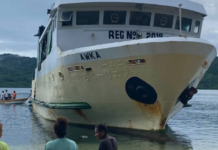
It comes just a week after the arrival of a new $5 million government-procured interisland passenger and cargo vessel, offering the hope of better, safer, more secure connectivity to all the remote outer islands.
A Peters ‘triumph’
Some see this as a political triumph for the mercurial Peters in the final weeks of his term as foreign minister; after playing hardball, he dragged the Cooks away from the influence of Beijing.
Others see it as a power play by Mark Brown, who has won the interest and investment of the world’s most powerful nation.
Most of all, none can ignore the opportunity this offers the Trump Administration — the strategic chance to be able to dock and stage operations from the centre of the vast Pacific basin. And ensuring China can’t.
Moreover, back in February, I reported that MFAT Chief Executive Bede Corry and his diplomats had discussed critical minerals developments with both the US and the Cook Islands. That’s now borne fruit for the White House.
Because this week’s deal opens the door (or the channel) to the $1 billion US-owned American Ocean Minerals Corp and Odyssey Marine Exploration, which agreed to merge this year.
And to Cook Islands Investment Corp’s new partnership with US firm Wetstone to fund offshore mineral exploration. It gives US firms first dibs on what I’ve described as the most lucrative treasure trove of undersea critical minerals in the EEZ of any country in the world.
Yet amid the political back-slapping, some Tongareva locals sound a note of caution. On the atoll’s Facebook group, administrator Ula Tini warns the US and China are readying for conflict — and the atoll has now been drawn into it.
Tongareva ‘been here before’
“Tongareva has been here before,” he says. “Our ancestors witnessed aircraft, military personnel and major infrastructure arriving on an island that much of the world probably knew very little about.”
Isolation, he agrees, has been one of the atoll’s biggest challenges. This port could help.
“But our people should still ask the hard questions… Could the facilities have future strategic or defence uses? How many jobs and business opportunities will actually go to Tongarevans? What environmental protections will be put in place for our lagoon, reef and marine resources?”
Tini wants his children and grandchildren to inherit more than a new port. That means ensuring that this time, the small community engages with the world on its own terms.
“What is Tongareva’s place in the future of the Pacific — and are we ready for it?”
Jonathan Milne is managing editor of Newsroom and a former editor of the Cook Islands News. This analysis was first published by Newsroom and is republished with permission.