





Special Corespondent
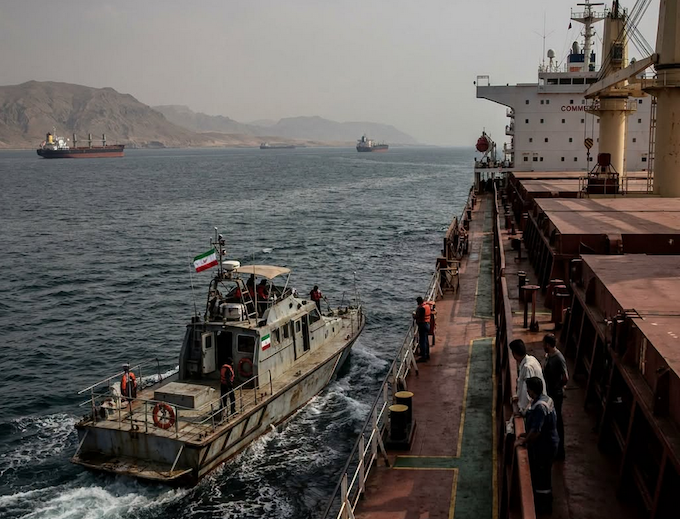
Maritime intelligence firm Kpler counted 13 vessels crossing the Strait of Hormuz on Thursday.
The number is small. But the number is not the story.
The story is that nine of those 13 took the Iranian-approved route. The route American warned ships against using.
Now the question is: Trump says the strait is “under our control”. So whose instructions are the ships following?
The answer is in the arithmetic. Sixty-nine percent of them ignored the American warning and entered Iran’s lane.
That is not a statement. Not a claim. That is a vote.
And the vote was cast by people with hundreds of millions of dollars floating on that water.
Plain language
CNN put it in plainer language. They wrote that the figure does not reflect Trump’s repeated insistence this week that the strait is “open” and under American control.
But today’s article will not only be about counting ships. Because Iran has done something on paper as well, and it has barely been discussed.
In May, Iran created an institution — the Persian Gulf Strait Authority.
According to a report by the US Congressional Research Service, Iran declared that no vessel may pass through the Strait of Hormuz without a valid passage permit issued by this authority.
Notice what that is. It is not a threat. It is administration.
A threat can stop a ship, but build a permit system and you never need to stop one. The ship comes to you and asks for permission.
And this is where Iran’s strategy becomes visible. Early in the war, Iran attacked vessels. That was a display of strength, but it carried a cost — every attack drained away the world’s sympathy.
A legal face
Now Iran attacks less and sells permits instead. Same result, but the face of it is legal.
There is one more line in the CRS report, and it is the foundation of this strategy. Iranian leaders claim it was the June memorandum of understanding that granted them the right to administer shipping through this strait.
Which is Iran saying:”We did not seize this power. You signed it over to us on paper.”
And what Iran’s Parliament Speaker Mohammad Baqer Qalibaf said on June 23 is now coming true. He said “management of the strait will never return to the way it was before the war”.
But, yes, there is a big “but” here. And it would be unjust not to say it.
That same CRS report notes that Iran’s claim runs counter to geographic reality, because the Strait of Hormuz comprises the territorial waters of both Iran and Oman.
Which means Iran is not legally the sole owner of this strait. On paper, Iran’s claim is weak.
Iran’s lane followed
But paper and water are not the same thing. Whatever the law says, on Thursday nine ships followed Iran’s lane.
Now to America’s answer.
On Friday, the US Treasury issued new sanctions. The targets were Iran’s Shahr Bank, along with individuals, exchange houses and companies spread across several countries, accused of helping Iran move hundreds of millions of dollars clandestinely.
The Treasury said itself that this was its eighth set of sanctions in 2026 against Iran’s alleged shadow-banking system.
Eighth. Eight times in one year.
Now the question is: if seven did not work, why would the eighth?
That is the problem with sanctions. The first one lands a blow. The second raises the pressure. But what does the eighth do?
The eighth only announces that the previous seven did not work.
The new normal
And the strangest thing of all is the oil price. CNN reported that despite no sign of the war ending, and despite traffic through the strait staying low, oil prices are falling.
So you can see for yourselves. The market is no longer listening to war news. The market has decided this is the new normal.
And once something becomes “normal”, the urgency to change it fades.
Meanwhile, on Thursday evening, Abu Dhabi’s state oil company ADNOC said two of its vessels were attacked while transiting Hormuz. No injuries.
Who attacked them? ADNOC did not say. No group claimed responsibility.
Since the war began, 15 ADNOC vessels have been attacked in total. One crew member killed, 20 injured.
The United Arab Emirates (UAE) is an American ally. And the ally’s ships are burning every week.
Now a word on something that touches South Asian countries too.
Floating Iranian oil
Early in this war, America adopted a tactic — temporarily lifting sanctions on roughly 140 million barrels of Iranian oil already floating at sea, so that supply would rise and prices would fall.
America’s Ambassador to the UN, Mike Waltz, told Fox News at the time that this oil had previously gone mainly to China. Now it could go elsewhere. He named the places — such as India, Bangladesh or elsewhere
He added that sanctions on the banks would remain in place, so Iran would not see a cent of that money.
Think about what that means. Iran’s oil gets sold, South Asian countries get to buy it, and Iran does not get the money.
Developing countries are offered cheap oil as bait while Iran’s own asset is released onto the market, and the proceeds stay locked inside the American banking system.
That is not trade. That is imperial accounting.
Here I will not quote anyone else. I will give you my own opinion.
Paper ‘control’ v ships moving
The shape of this war is becoming clear now. Everything Trump is doing is on paper. Sanctions, Truth Social posts, declarations of “total control”.
Everything Iran is doing is on the water. Which route, whose permission, which ship and when.
In March, Trump called on China, France, Japan, South Korea and Britain to send ships, “let us open the strait together”. Nobody answered.
Five months on, America has drawn a route through that same strait, and the ships are avoiding it and choosing Iran’s.
Control written on paper, or ships moving on water — which of the two is real power?
Let me finish with the number I started with.
Thirteen ships. Nine on Iran’s route.
Trump says the strait is ours. The ships’ captains are saying something else.
And at sea, the captain has the last word.
Republished from Iran International under Creative Commons.