






ANALYSIS: By Mike Treen
The Bank for International Settlements (BIS) has issued a stark warning in its annual report.
The central bank for central banks warned that the current AI investment boom is unsustainable.
The five largest “hyperscaler” tech firms plan to spend more than a trillion dollars on AI-related capital expenditure from 2025 through 2026. This spending is outpacing their earnings and free cash flow, forcing some to issue debt.
“Disappointment in returns could trigger a sudden pullback in financing and turn the capex boom into a protracted investment bust… should hyperscalers slow or halt the aggressive pace of capex deployment, many borrowers across the supply chain could struggle to replace lost revenue and service their debt.”
- READ MORE: ‘We are in a bubble’: Experts warn of historic AI bust risk
- Other financial bubble reports
When the BIS — the only central bank to warn before the 2008 crash — sounds the alarm, we should listen. The Bank of England, European Central Bank, and Monetary Authority of Singapore have since echoed similar concerns.
Financial bubbles have become the norm since the late 1970s, when the US dollar left the gold standard and financialisation took hold. Household net worth began expanding faster than GDP, creating cycles of bubbles and busts.
Yet the current bubble dwarfs all previous ones in history, as illustrated in this graphic from the US Federal Reserve.
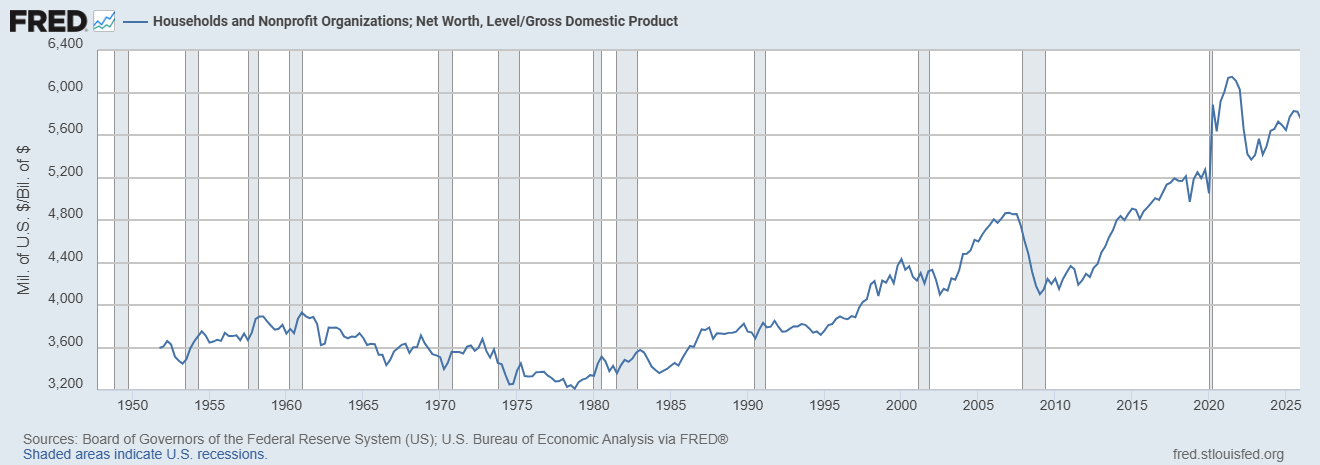
First came the Dot-com bubble, then the housing bubble of 2008. A credit crunch in 2019 was poised to trigger another recession, but was submerged by the covid-19 crisis and the unprecedented monetary response.
The result is what can only be described as the “bubble of everything”.
- Equities: US stock market capitalisation is now 230 percent of GDP — twice the long-term average. In early June, stocks were selling at about 40 times average corporate earnings over the previous decade, a level seen only at the peak of the Dot-com bubble.
- Private credit: The $3 trillion non-bank private credit “shadow market,” which exploded over the last decade, is under severe stress.
- AI mania: A trillion-dollar spending wave on AI, chips, and data centers is a real buildout wrapped in a speculative frenzy. This circular spending by tech giants props up the bubble, a risk mainstream media has begun to highlight.
The associated wealth accumulation is historically unprecedented. A new billionaire oligarchy has emerged, deeply reactionary, racist, and anti-democratic. It is fully merged with the military-industrial complex, dependent on permanent war and genocide for survival.
The tech wing of this class seeks to surveil, control, and monetise every facet of human life.
Fraud is standard operating procedure, from the Trump family’s alleged looting of state resources to the SpaceX listing.
For the SpaceX IPO, Nasdaq and FTSE Russell rewrote their rules to fast-track the company into major indexes after just days of trading. This forced retirement funds to buy a tiny 4 percent float of available shares, artificially inflating the price and creating a trillionaire in Elon Musk overnight — exposing workers’ pensions to immense risk.
This concentrated power is staggering: the “Magnificent Seven” (Alphabet, Amazon, Apple, Meta, Microsoft, Nvidia, Tesla) now account for over 30 percent of the S&P 500, double their weight a decade ago. Tech makes up over 50 percent of the entire Nasdaq.
As the market saw through the SpaceX scheme, its shares fell 24 percent, and Musk lost his trillionaire status — temporarily. When the broader crash hits, pension funds globally will suffer. The longer the mania continues, the more savings will be sucked into these overvalued indexes.
As Marxist economist Gary Wilson explained, Wall Street has priced in profits that may never materialise. The bosses’ response is familiar: cut jobs, attack unions, demand subsidies, and chase war contracts.
The real AI buildout is buried inside a speculative mania. The technology may survive the bubble; these stock prices will not.
“The losses will come as layoffs, frozen hiring and closed factories… and through the 401(k)s and pension funds workers were pushed into… a forced ticket to a casino they neither own nor control.
“The workers who never shared in the boom will be told to sacrifice when the bubble breaks.”
This financial bubble is just one facet of a broader polycrisis. Capitalism has no road forward to solve these interconnected failures.
- Grotesque inequality: Billionaire wealth jumped 16 percent in 2025 alone, reaching a historic $18.3 trillion. In New Zealand, four people now hold more wealth than 1.8 million citizens combined, while over 900,000 face food insecurity. oxfam.org.nz
- Permanent war: The ongoing war against Iran has devastated global energy markets, spiking fuel and fertiliser prices. Over 50 percent of the profits from recent oil shocks went to the top 1 percent of Americans; the bottom half received just 1 percent.
- Looming famine: The closure of the Strait of Hormuz threatens cascading food shocks. As fertiliser prices spike 20-60 percent, the greatest risk is not immediate shortage but collapsing future harvests, leading to higher prices and starvation months later.
- Debt vortex:
- Advanced economies: Government debt (100-130 percent of GDP in the US/Europe, 200 percent in Japan) is becoming unmanageable as interest rates rise from historic lows.
- Developing world: External debt exceeds $11 trillion, with more than 50 nations in distress. Many now spend more on debt servicing than on healthcare or education, trapped in a neocolonial debt cycle.
- Climate collapse: Global warming is killing thousands in heatwaves, closing schools, and destroying crops. Political “adaptation” plans are a surrender, substituting leadership with fantasy to avoid the emergency-scale mobilisation actually required.
A major capitalist crisis is nearly certain. As always, the heaviest price will be paid by the working class through escalating unemployment and austerity.
This will radicalise people. Our duty as socialists is to offer solutions that point toward the ruling class — our real enemy — and resist the ruling class’s strategy to divide us by scapegoating racial, religious, or sexual minorities.
As Rosa Luxemburg stated, the historical choice under capitalism is “socialism or barbarism.” That choice is re-emerging as socialism or modern-day fascism.
It is no accident that these are the poles of politics globally today. Far-right parties flirting with fascism are mass movements again across Europe.
Yet, hearteningly, popular support for socialism is the majority opinion among young people in the US and UK. The Democratic Socialists of America are becoming a mass party inside the belly of the beast.
The road forks ahead. One path leads to division, austerity, and barbarism. The other, built by a united working class, leads to socialism.
Mike Treen is a retired trade unionist and political commentator. This article was first published at his Substack @miketreen860764 and is republished with the author’s permission.