



Fiji Women’s Crisis Centre
Today, we mark an extraordinary milestone: 42 years of the Fiji Women’s Crisis Centre (FWCC).
As we reflect on this journey, we are reminded of the countless lives that have intersected with our work since 1984. Over the past four decades, 168,145 survivors have accessed the services of FWCC and its branches throughout Fiji.
These include survivors of domestic violence, rape and sexual assault, sexual harassment, child abuse, and other forms of violence and abuse.
Yet numbers alone can never tell the full story.
Statistics cannot capture the fear of a woman escaping violence in the middle of the night. They cannot describe the courage it takes to disclose rape for the first time.
They cannot measure the resilience of survivors who rebuild their lives after trauma, nor reflect the determination of women who refused to give up despite experiencing violence, discrimination, and inequality.
Every individual who walked through our doors came seeking safety, support, and dignity. Many arrived carrying experiences that no one should ever have to endure. Many came believing they were alone. Our role was, and continues to be, to ensure they know they are not.
Principles of feminism
Throughout our history, FWCC’s work has remained firmly grounded in the principles of feminism, women’s human rights, human rights, dignity, equality, and justice. These principles have guided our response to violence against women and girls, shaped our advocacy, informed our research and training, and strengthened our commitment to building a society where all women and girls can live free from violence, discrimination, and inequality.
While our primary focus has been addressing violence against women and girls, our services have always recognised the diversity of the communities we serve. Over the past 42 years, we have worked with women in all their diversity, including women from rural and urban communities, women with disabilities, young women, older women, women from different ethnic, cultural, and religious backgrounds, and women of different sexual orientations and gender identities.
We have also supported men and boys affected by violence and abuse, as well as members of the LGBTQI+ community who have sought counselling, support, information, and protection.
Looking back, the impact of FWCC extends far beyond the people who directly accessed our services. It can be seen in the women who found safety and rebuilt their lives. It can be seen in the police officers, health workers, teachers, community leaders, faith leaders, and advocates who received training and developed a deeper understanding of violence against women and women’s human rights.
It is reflected in laws, policies, and public conversations that have been influenced by decades of advocacy, research, and evidence-based work. It is reflected in generations of women and girls who now know that they have rights, that violence is never their fault, and that support is available.
Centre’s leadership
No reflection on the journey of the Fiji Women’s Crisis Centre would be complete without acknowledging the leadership of our coordinator, Shamima Ali. For more than four decades, she has been the most influential voice for women’s human rights in Fiji and the Pacific. Her unwavering commitment to ending violence against women and girls, advancing gender equality, and holding institutions accountable has helped shape not only the direction of FWCC but also the national conversation on women’s rights and human rights.
Under her leadership, FWCC has grown from a small feminist organisation into a nationally and internationally respected centre for crisis intervention, advocacy, research, training, and feminist leadership. Through times of political uncertainty, social resistance, and changing public attitudes, she has remained steadfast in speaking out against injustice and ensuring that survivors’ voices and experiences remain at the centre of our work.
Some people witness history and others help shape it. Shamima Ali has done both. Thank you, Sham.
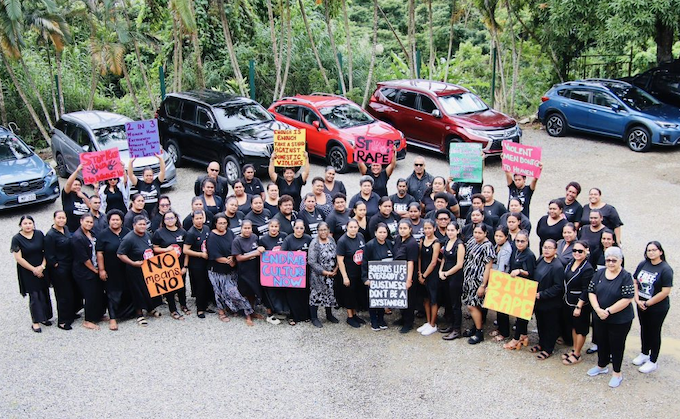
We also acknowledge with gratitude the staff, counsellors, trainers, volunteers, trustees, supporters, allies, donors, partners, and communities who have stood with us over the last four decades. Your dedication, commitment, and belief in this work have made these achievements possible.
We also extend our sincere appreciation to the Australian government through the Department of Foreign Affairs and Trade (DFAT), and the New Zealand government through the Ministry of Foreign Affairs and Trade (MFAT), for their longstanding partnership and support. Their contributions have strengthened efforts to advance women’s human rights and respond to violence against women and girls in Fiji and across the Pacific.
As we reflect on 42 years, we are also mindful of those whose experiences remain unseen and unheard. Their stories remind us that violence against women remains one of the most urgent human rights challenges facing our nation.
That is why our work remains as important today as it was in 1984.
We do not mark anniversaries simply to celebrate longevity. We mark them to honour feminist persistence and resilience.
Our dream has always been to work ourselves out of business. Until that day comes, the work continues.
Republished from the Fiji Women’s Crisis Centre website, 13 August 2026.