


ANALYSIS: By Lim Tean
For four decades, the West presented Iran’s regional strategy as the work of a rogue state exporting revolution and chaos. They never told you about the CIA coup that destroyed Iran’s democracy in 1953.
They never told you that America armed the man who gassed Iranian soldiers. They never showed you the map — the ring of American military bases on every border, the US Fifth Fleet in the Persian Gulf, the Israeli aircraft that bombed Iranian assets with impunity and assassinated Iranian scientists on Iranian soil.
Iran built the Axis of Resistance and the Mosaic Defence as its answer to that encirclement.
Now, with the 2026 war and its fragile ceasefire, we can assess the full doctrine — what it achieved, where it was tested to its limits, and what it tells us about the future of Iranian sovereignty.
This is the story they spent decades trying to prevent you from understanding.
The fortress and the forward shield: How Iran built the architecture of survival
Look at a map.
Not the map the Western press shows you — the one that marks Iran in the colour reserved for rogue states, surrounded by the clean borders of American allies and reasonable nations.
I want you to look at the real map. The strategic map below.
This is the map that every Iranian general, every Iranian strategic planner, every Iranian Supreme Leader has looked at every morning for the past four decades.
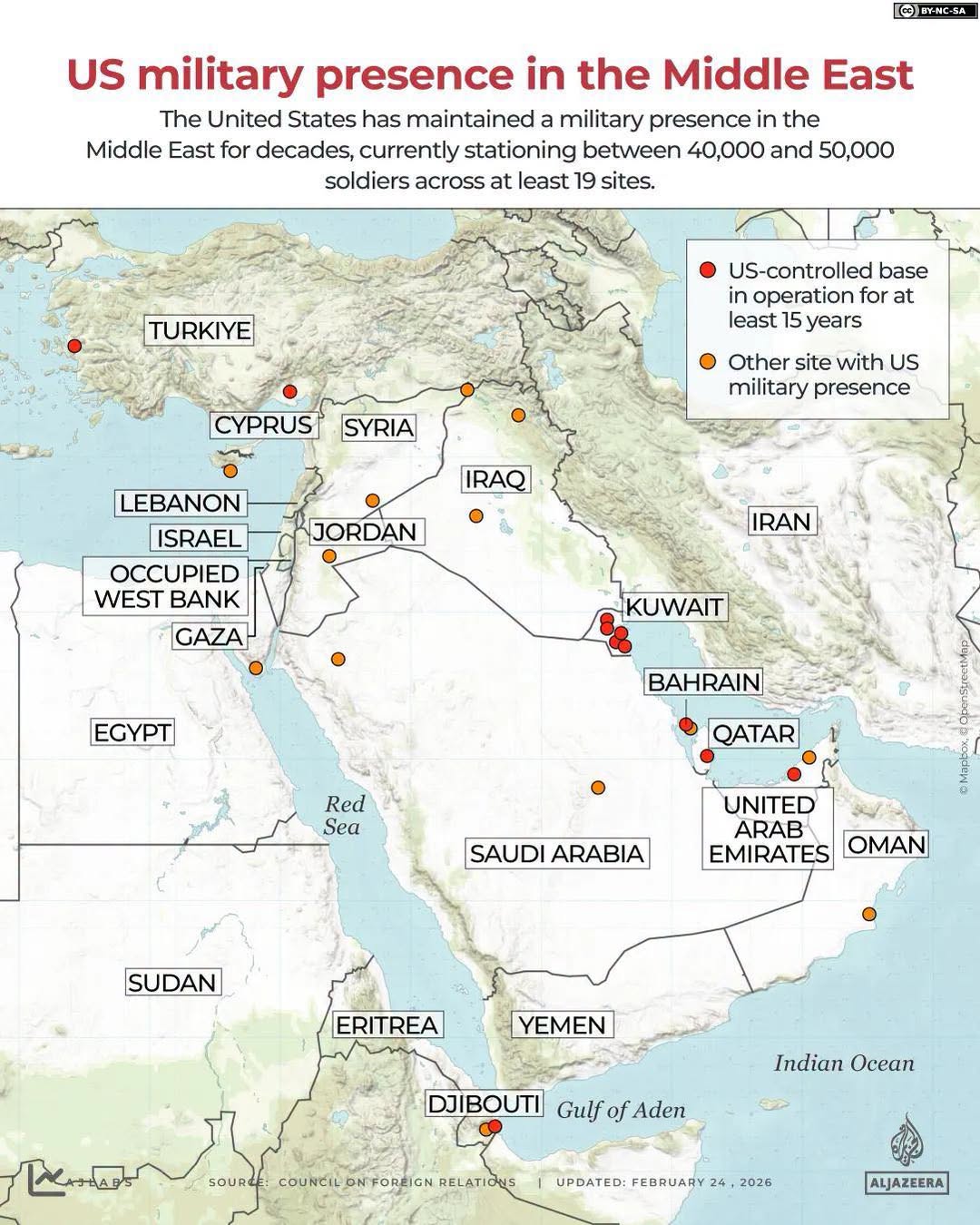
What the map shows is not an aggressive power projecting menace outward. It shows a nation under siege — encircled, threatened, and facing an existential choice that empires have always forced upon those they cannot fully control: submit, or build the architecture of survival.
Iran chose to build.
What follows is the story of how — and why. And now, in the wake of the 2026 war and its fragile ceasefire, we can assess that architecture under the most severe test it has ever faced.
1. The doctrine born from betrayal
To understand Iranian grand strategy, you must first understand what Iran learned — not from ideology, not from theology, but from history. From its own history, written in blood and betrayal.
Lesson One came in 1953. Iran had a democracy. A real one — a Parliament, a free press, a Prime Minister of genuine popular legitimacy who had committed the unforgivable act of returning Iran’s oil to its own people.
The West destroyed it. Not with armies, but with money, propaganda, and hired mobs. The CIA and MI6 removed Prime Minister Mohammad Mosaddegh and installed a pliant Shah who would keep Iranian oil flowing to London and Washington.
The lesson Iran drew was stark and permanent: the West does not want Iran strong, sovereign, or self-determining. It wants Iran “manageable”.
Lesson Two came in the 1980s. Iraq’s Saddam Hussein invaded Iran in 1980 with the tacit blessing of Washington, which viewed the chaos of revolutionary Iran in 1979 as a strategic opportunity.
For eight years, Iran bled. Perhaps one million lives. And when Iranian forces began pushing back, Washington made its choice. It provided Saddam with satellite intelligence on Iranian troop positions. It supplied the precursor chemicals for the weapons Saddam used to gas Iranian soldiers on the battlefield — mustard gas, tabun, sarin — in one of the most extensively documented war crimes of the modern era.
American officials knew. They continued regardless.
The lesson Iran drew from those eight years was equally stark: when your existence is threatened, no one will come. Not the United Nations. Not international law. Not the conventions against chemical weapons. No one.
These two lessons — the 1953 betrayal and the 1980s abandonment — are the foundation of everything that follows. They are not ideology. They are experience. And as Oliver Wendell Holmes observed: the life of the law — and we might add, the life of strategy — is not logic. It is experience.
Iran’s grand strategy is the experience of a nation that has been betrayed, encircled, and attacked — and has drawn the only rational conclusions available to a sovereign state determined to survive.
2. The encirclement — what Iran actually sees
Before we examine what Iran built, we must understand what Iran faces. Because the architecture of Iranian strategy makes no sense without the map — the real map, not the sanitised version.
To Iran’s east, American forces spent two decades in Afghanistan — on Iran’s longest land border. To Iran’s west, the American invasion of Iraq in 2003 removed Saddam Hussein but replaced him with a country that became host to the largest American embassy on earth, a vast network of military bases, and tens of thousands of American troops — sitting on Iran’s western doorstep.
In the Persian Gulf — Iran’s southern maritime frontier — the United States Fifth Fleet operates from Bahrain, a permanent naval presence of carrier groups, destroyers, and the full apparatus of American maritime power.
At Al Udeid Air Base in Qatar, America maintained the largest US air installation in the entire Middle East — a facility capable of projecting devastating airpower across the region within hours.
In Kuwait. In the UAE. Across the Arabian Peninsula, American bases formed a constellation of military power that, viewed from Tehran, looked less like a defensive alliance and more like a slowly tightening noose.
This is not Iranian paranoia. This is Iranian geography.
Any strategic planner in any country — American, British, Chinese, Indian — looking at that map would draw the same conclusion. Iran had been encircled with a precision that left nothing to chance.
The message was unambiguous: the United States had positioned itself to strangle Iran economically through Gulf control, to strike Iran from multiple directions simultaneously, and to do so from bases close enough to minimise warning time and maximise devastation.
Iran looked at this map. And Iran made a decision.
If the Americans intend to make the Persian Gulf an American lake, Iran will ensure that lake has a price. If American power is to sit on every border, every border will become a potential front. If encirclement is the American strategy, Iran’s answer will be to make that encirclement so costly to act upon that it becomes, in practice, a cage with open bars — present but unusable.
The Axis of Resistance was not born of religious fervour or ideological ambition. It was born of that map.
3. The Israeli dimension — the undeclared nuclear power that bombs its neighbours
And then there is Israel.
The Western framing of the Iran-Israel confrontation presents it as Iranian aggression against a peaceful democratic state. This is such a complete inversion of the actual sequence of events that it requires dismantling with some care.
Israel is, by the near-universal assessment of the international intelligence community, a nuclear power. It possesses an estimated 90 nuclear warheads. It has never signed the Nuclear Non-Proliferation Treaty. It has never submitted to international inspection.
It maintains what is called a policy of “nuclear ambiguity” — neither confirming nor denying what the entire world knows to be true. And it directs its considerable diplomatic energy toward ensuring that no other state in its region acquires the same deterrent capability it has quietly accumulated for itself.
This is the context in which Iran’s nuclear programme must be understood. Iran is a signatory to the NPT. Its programme operated under international scrutiny that Israel’s never has.
And yet it was Iran that was presented as the existential threat, Iran that was sanctioned, Iran that was threatened with military strikes — and ultimately, Iran that was bombed.
But the nuclear dimension was only the beginning. Israeli planes repeatedly struck Iranian assets in Syria — military installations, weapons convoys, advisers — hundreds of strikes over a decade, conducted with complete impunity.
Israeli intelligence assassinated Iranian nuclear scientists on Iranian soil. In April 2024, Israel struck the Iranian consulate in Damascus — sovereign Iranian territory under the Vienna Convention — killing senior commanders.
In July 2024, Israeli intelligence assassinated Ismail Haniyeh, Hamas’s political leader, in Tehran itself.
In June 2025, Israel launched Operation Rising Lion and America followed with Operation Midnight Hammer — the first direct US strikes on Iranian nuclear facilities, targeting Fordow, Natanz, and Isfahan.
Then, on February 28, 2026, came the full assault: Operation Epic Fury, a joint US-Israeli campaign of nearly 900 strikes in 12 hours targeting Iran’s missiles, air defences, military infrastructure, and leadership. Supreme Leader Ali Khamenei was killed. Dozens of senior officials perished. Iran’s nuclear programme was severely degraded.
The doctrine that Iran had constructed across four decades — forward defence through the Axis of Resistance, interior resilience through the Mosaic Defence — was now facing its ultimate test.
Hezbollah had served as Iran’s most elegant strategic instrument — a deterrent positioned on Israel’s northern border, ensuring that any strike on Iran carried automatic, unavoidable cost.
For 30 years, it worked. Every Israeli military planner understood that attacking Natanz meant absorbing tens of thousands of Hezbollah rockets into northern Israel simultaneously. That deterrent logic held — until 2024, when Israel called the bluff.
Yet even after Nasrallah’s assassination and the degradation of Hezbollah’s arsenal, the organisation demonstrated remarkable residual fighting capacity. When IDF ground forces attempted to push into southern Lebanon, Hezbollah gave them a drubbing — inflicting casualties, destroying armoured vehicles, and forcing repeated tactical withdrawals that exposed the limits of Israeli conventional military power on the ground.
The shield had been damaged. It had not been broken.
4. The Axis of Resistance — architecture of Forward Defence
With the American encirclement and Israeli threat understood, the Axis of Resistance reveals itself not as an Iranian imperial project but as a coherent strategic architecture built on a single organising principle: make the cost of attacking Iran prohibitive, by ensuring that any attack triggers consequences across the entire region simultaneously.
The components of that architecture were distinct in character but unified in purpose.
Hezbollah was Iran’s most sophisticated instrument — battle-hardened, institutionally deep, politically embedded in Lebanese society, and at its peak possessing an arsenal of more than 150,000 rockets and missiles.
It is not a militia in the casual sense. It is a military organisation with combat experience forged across four decades, in Lebanon’s civil war, the Syrian conflict, and multiple wars against one of the most technologically advanced militaries in the world.
Despite the severe degradation it suffered in 2024 and 2025, Hezbollah remains a potent force — as the IDF discovered when its ground forces pushed into southern Lebanon and were met with fierce resistance, tactical ambushes, and anti-armour fire that forced repeated withdrawals.
Iran’s first line of forward defence has been bloodied but not destroyed.
Hamas was a different and more complicated case — Palestinian in origin, rooted in the Muslim Brotherhood tradition rather than Shia political theology. But Iran adopted the Palestinian cause with strategic intelligence, recognising that support for Palestinian resistance gave Tehran something invaluable: moral legitimacy across the entire Muslim world, Sunni and Shia alike.
Supporting Hamas cost Iran relatively little. It purchased Iran enormous influence and the one thing that money and missiles cannot buy — the genuine sympathy of the Arab street.
The Houthis of Yemen were the most recent and surprising component. Not originally an Iranian creation, they were driven into Tehran’s strategic embrace by the Saudi-led war in Yemen — backed by American weapons, logistics, and political cover.
The Houthis’ capacity to threaten Red Sea shipping and strike deep into the Gulf transformed them from a local insurgency into a regional strategic asset of considerable importance. Their intervention following October 7, 2023 demonstrated reach that surprised even optimistic Iranian planners — and their continued operations through the 2026 war demonstrated a resilience that confounded repeated predictions of their swift neutralisation.
The Iraqi militias — the Popular Mobilisation Forces and their various components — completed the architecture. Born from the chaos of the American invasion and consolidated during the fight against ISIS, these forces represented Iran’s most direct penetration of a neighbouring state’s security structure, giving Tehran influence over the country on its western border through which any American ground offensive would necessarily pass.
Together, these components formed what Iranian strategists called the “ring of fire” — a constellation of armed, motivated, battle-tested forces positioned around Iran’s primary adversaries. Not an empire. A defensive perimeter, constructed outside Iran’s borders precisely because Iran’s borders had proven, twice in living memory, to be insufficient protection against the ambitions of external powers.
5. The Mosaic Defence — making Iran unconquerable
Forward defence alone — however sophisticated — was always only half of Iran’s strategic architecture. Iranian planners understood that the outer ring could be degraded. Proxies could be weakened. Forward positions could be overrun. The question that preoccupied Iran’s military establishment for four decades was this: if the forward shield fails, what then?
The answer was the Mosaic Defence.
The concept is as elegant as it is ruthless. Iran deliberately, systematically, and over decades decentralised its entire military infrastructure across all 31 of its provinces. Missile arsenals were not concentrated in single facilities but dispersed across hundreds of sites — underground, mountainside, desert — spread across a country the size of Western Europe.
Command and control was distributed rather than centralised, designed to survive the decapitation strikes that destroyed Iraq’s military capacity in 1991 and Libya’s in 2011. Defence industries were deliberately dispersed so that no single strike, however precise, could eliminate Iran’s capacity to produce and deploy weapons.
The underground dimension was particularly significant. Iran invested enormously in what it called its “missile cities” — vast subterranean complexes buried deep enough to survive all but the most specialised munitions. The 2026 campaign tested this directly.
Despite nearly 900 strikes in the opening 12 hours and CENTCOM ultimately claiming over 11,000 targets struck across the entire war, a preliminary US Defense Intelligence Agency assessment — leaked and characterised by the Trump administration as “political” — concluded that Iran had moved much of its enriched uranium stockpile before the strikes began and that the underground facilities had not been collapsed.
The CIA subsequently disputed this, claiming severe damage that would take years to rebuild. The truth, as is so often the case in the fog of war, likely lies somewhere between these assessments.
What is beyond dispute is this: the logic Iran applied — the logic of a student of history who had watched what happened to states that presented centralised targets — proved partially vindicated. The 31-province dispersal model meant that even 11,000 strikes could not deliver a clean, decisive blow. Iran was damaged. Iran was not defeated.
Centralisation is a vulnerability. Dispersal is survival.
The Mosaic Defence and the Axis of Resistance were never separate strategies. They were two halves of a single, integrated doctrine. Attack Iran’s periphery — and the Axis activates. Penetrate to the interior — and the Mosaic ensures there is no clean, decisive blow to be struck. The 2026 war demonstrated both the power and the limits of that doctrine.
6. The 2026 War — the ultimate test
Intellectual honesty requires confronting what Operation Epic Fury achieved — and what it did not.
What it achieved was substantial. Supreme Leader Ali Khamenei was killed in the opening strikes — a decapitation of the Islamic Republic’s leadership of historic proportions. Dozens of senior IRGC commanders, nuclear scientists, and regime officials perished. Iran’s nuclear enrichment infrastructure was severely degraded. Its air defences were systematically dismantled. Its navy was effectively destroyed.
The Iranian economy, already strangled by decades of sanctions, went into free fall. Its currency collapsed. Protests that had begun in December 2025 spread across the country as the regime’s authority visibly cracked.
What it did not achieve is equally instructive.
Iran’s enriched uranium stockpile — the IAEA had confirmed 440 kilograms enriched to 60 percent purity before the war, sufficient for multiple weapons if further enriched — could not be fully accounted for.
Two military campaigns left that stockpile harder, not easier, to locate. Iran had anticipated decapitation. Within 30 minutes of the opening strikes, Iranian forces launched simultaneous retaliatory attacks across multiple fronts without waiting for centralised authorisation — precisely the pre-delegated response architecture that the Mosaic Defence doctrine had prescribed.
The regime was headless. The military machine kept fighting.
Iran’s response was devastating to the American strategic position in the region. It closed the Strait of Hormuz — through which roughly 20 percent of global oil supply passes — triggering a global energy shock and fuel crises across Asia.
It struck American bases across the Gulf simultaneously: Bahrain, Kuwait, Qatar, the UAE. It bombarded Israel with over 525 ballistic missiles. It struck oil infrastructure across the Arabian Peninsula. Thirteen American service members were killed. The regional war that Iran’s forward defence doctrine had always promised to trigger — the promise that had deterred attack for thirty years — was fulfilled.
The ceasefire that followed told its own story. After 40 days of sustained combat, with both sides exhausted and the global economy convulsing, Pakistan brokered a conditional truce on April 8, 2026.
The highest-level direct US-Iran engagement since the 1979 revolution followed — JD Vance meeting Iranian counterparts in Islamabad. On June 17, 2026, Trump and Iranian President Pezeshkian signed the Islamabad Memorandum, with Trump signing at the Palace of Versailles, establishing a 60-day framework for further negotiations on Iran’s nuclear programme, sanctions relief, the unfreezing of Iranian assets, and the future of the Strait of Hormuz.
Read that again. The United States of America — which had launched nearly 900 strikes in 12 hours against Iran, killed its Supreme Leader, and declared regime change as its explicit objective — ended up negotiating. Not dictating. Negotiating. With the Islamic Republic it had sought to destroy.
The new Supreme Leader, Mojtaba Khamenei — son of Ali — approved the memorandum, noting he had “a different view” but accepted it in the national interest. Iran committed to reaffirming it would not develop nuclear weapons. The US committed to lifting sanctions and removing forces from Iran’s proximity after a final deal.
Iran’s nuclear programme — battered but not eliminated — remained. Its missile programme was explicitly declared off the table for negotiations by Tehran. And critically, Iran extracted from the world’s most powerful military the one concession that no amount of technical language could conceal: America negotiated.
That fact is irreversible. And every adversary of American power on earth has filed it carefully for future reference.
7. The Strategic Verdict — doctrine under fire
Here is what four decades of Iranian grand strategy achieved, assessed without sentiment.
The Axis of Resistance was degraded — Hamas devastated in Gaza, Hezbollah bloodied in Lebanon, Iranian assets struck across Syria. The Mosaic Defence was tested as never before — 11,000 targets struck, nuclear facilities damaged, leadership decapitated.
The forward shield failed to deter the ultimate assault it was designed to prevent.
And yet. Iran survived.
The Islamic Republic — written off by analysts for decades, subjected to the most comprehensive sanctions in modern history, struck by two rounds of devastating military campaigns — survived. Its military kept fighting after its Supreme Leader was killed. Its enriched uranium could not be fully accounted for. Its proxies continued operating. The Strait of Hormuz became a weapon that brought the global economy to its knees.
And ultimately, America came to the table.
This is not the outcome of a state that built the wrong strategic doctrine. This is the outcome of a state that built remarkable strategic resilience — imperfect, costly, and tested to its absolute limits — but resilience nonetheless.
The Mosaic Defence’s dispersal across 31 provinces meant no clean killing blow. The pre-delegated command authority meant no paralysis after decapitation. The Houthis’ continued Red Sea operations meant the economic pressure never relented. The Iraqi militias provided Iran with leverage in negotiations.
And the nuclear stockpile — unaccounted for, potentially dispersed before the strikes — remained the ultimate trump card that no military campaign could eliminate with certainty.
What Iran demonstrated in 2026 was not the invincibility its doctrine promised. What it demonstrated was something perhaps more important: the cost of attacking Iran is catastrophic, even in victory.
America got its strikes. It killed Khamenei. It damaged the nuclear programme. It triggered regime change of a kind — though Mojtaba Khamenei is hardly the pro-Western successor Washington imagined.
And what did it get for all of that? A fragile ceasefire, a 60-day negotiating framework, an unaccounted nuclear stockpile, a Strait of Hormuz that remains contested, a global energy shock, thirteen dead Americans, and a region convulsed by war.
Mosaddegh was destroyed because Iran was weak — because it had no forward shield, no interior fortress, no capacity to make its destruction costly. The Iran of 2026 is not that Iran.
The wound of 1953 was the education. The architecture of survival — tested, battered, partially broken — was the graduation.
The lesson of Iran’s grand strategy is ultimately this: a nation that cannot be cheaply destroyed cannot be permanently dominated. Even after the most severe bombings, Iran extracted a negotiation. Even after decapitation, its military kept fighting. Even after 11,000 strikes, its nuclear stockpile remained unaccounted for.
That is not the record of a doctrine that failed. It is the record of a doctrine that made Iran’s destruction more costly than any power was ultimately willing to pay.
In a future article, I will examine Iran’s nuclear programme — not through the lens of Western proliferation anxiety, but through the strategic logic of a state that watched what happened to countries that disarmed, and has now watched what happened to itself when it did not yet possess the ultimate deterrent.
Lim Tean is a Singaporean lawyer, politician and commentator. He is the founder of the political party People’s Voice and a co-founder of the political alliance People’s Alliance for Reform.