

COMMENTARY: By David Robie, Pacific Media Watch
A friend and colleague, Solidarity columnist Eugene Doyle, posed a brief question on the Facebook media page Kiwi Journalists Association last week.
“Kiwi journalists . . . is there a reason for so little solidarity with Palestinian colleagues,” he mused over a haunting portrait of emaciated Palestinian journalist Mujahid Abu Mufleh showing his appalling state after 14 months inside an Israel torture prison.
“No trial. No conviction.”
- READ MORE: Silencing the messenger: Israel kills journalists, while the West merely censors them
- Improvements in Pacific media freedom, but a shameful silence on Gaza ‘death trap’
- Facing up to genocide – a New Zealand journalist bears witness with Gaza and West Bank
- Other Gaza media reports
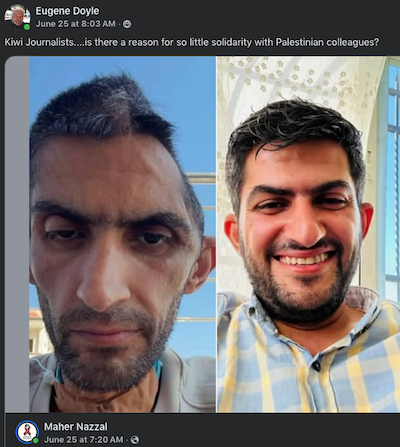
This is what Palestinian hostages look like after release: emaciated, exhausted, and visibly scarred by prolonged detention.
Occupied Palestine has become the deadliest place for journalists in the world. Yet merely three media people responded to Doyle’s question.
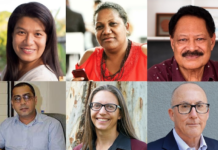
Broadcaster and singer Moana Maniapoto (Te Arawa, Ngāti Tūwharetoa)
summed up the cruel image as “journacide”, citing the use of the label by UN Special Rapporteur on Palestine and the Occupied Territories Francesca Albanese: “Absolutely shocking.”
Journacide is a neologism used by scholars, journalists, and human rights experts to describe deliberate mass killing and hunting down of journalists and media workers in conflict zones. It is also the title of a harrowing new documentary on the topic: Journacide: The War on Truth.
Courage and fortitude
Community broadcaster and educator Victoria Quade commented: “I think few people living and working in relatively protected environments like New Zealand can imagine the courage and fortitude it takes to be a journalist under an oppressive regime where reporting on those regimes can be physically dangerous.
“And, if they can imagine it, would be able to match that courage in their own lives.”
A third comment was posted by communications adviser and journalist Susan Belt: “I think people are battle-worn after so much general genocide, kids and press included, on the part of Israel. There’s so much press targeting etc that it almost becomes ridiculous to keep posting on it. Stuff and NZME keep running Gaza, Lebanon stuff but because our govt like some others has not made much of a fuss about Israel’s illegal civilian and press killing in Gaza and its unprovoked attack on Iran and illegal forays into Lebanon, it leaves people feeling hopeless.
“I am very pro-Palestinian rights and have been since the 1970s but even my Facebook friends despair at the sad postings I seem to always be doing. They know it’s very bad behaviour but we’re in a trance at the hopelessness of it. When our ally the US is backing Israel (though cooling of late) our govt is too scared to say what’s right because it doesn’t want to offend Trump’s team.”
These comments reminded me that I have been puzzling over the generally poor and weak response from New Zealand journalists over what is currently the toughest moral and ethical challenge of our times. Yet, instead of facing up to the Gaza genocide and the accompanying journacide, most of our media colleagues have preferred to look away and remain silent.
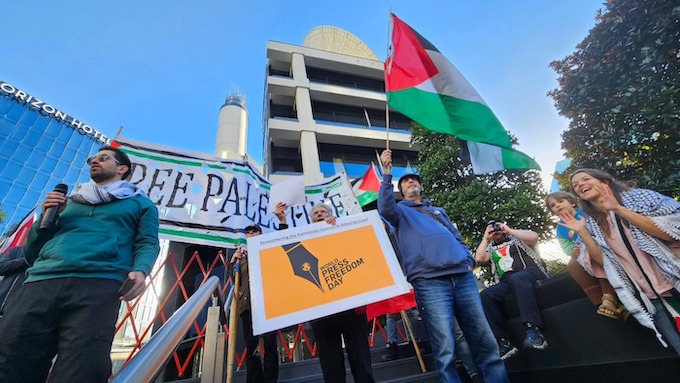
The prevailing attitude is that it is something remote and of little relevance to Aotearoa New Zealand. It is a response of denial, astonishing given that there have been protests across the motu against the Israeli genocide — and lately the unjustified US-Israeli war on Iran and fragile peace — for the past 142 weeks: by far the longest and sustained political protests ever in this country, yet largely ignored by the media.
This has led to many public protests over media coverage. These too have rarely been reported.
Genocide in plain view
My own articles on the topic on Aotearoa and the Pacific, while stirring responses internationally, have barely raised a ripple in this country. Shameful responses to a genocide — at least 73,000 Palestinians killed in Gaza, 20,000 of them children — revealed daily before our very eyes. Even since the sham ceasefire declared in October, more than 1000 people have been killed.
And the cost in lives of hundreds of Palestinian journalists trying to bear witness on the annihilation of their own communities is deeply shocking. Yet this barely raises a shrug from New Zealand journalists.
In a report released last week by the Freedoms Committee of the Palestinian Journalists Syndicate, a chilling new statistic was revealed — out of an estimated 1200 journalists in Gaza between 60 and 75 percent of them have lost their homes or been forcibly displaced since 7 October 2023.
The report, titled “Media Without Walls”, also said that approximately 265 journalists had been killed since the start of the conflict, by far the highest death toll recorded globally against journalists in a single conflict.
More than 80 percent of media offices and institutions had been completely or partially destroyed, leading to an “almost complete collapse” of journalistic infrastructure, it said.
The report added that journalists in Gaza no longer work from newsrooms but from tents, footpaths and shelter centres, with mobile phones as their primary production tool and intermittent internet dictating when they can publish.
“I lost my home and my office in the same week,” said one displaced journalist, Dr Ahed Farwana. “I no longer have a place to write, but I write from my phone among people, sometimes while searching for water for my family.”
‘Trying to concentrate’
Another Gaza journalist, Ola Kassab, said: “I work from inside a displacement shelter, choosing the quietest corner I can find. The hardest part is not the bombing itself, but trying to concentrate amid the overcrowding and fear.”
Photojournalist Wisam Zughair said: “The camera is no longer the heaviest thing I carry; it is the feeling that I may also be documenting what could happen to me.”
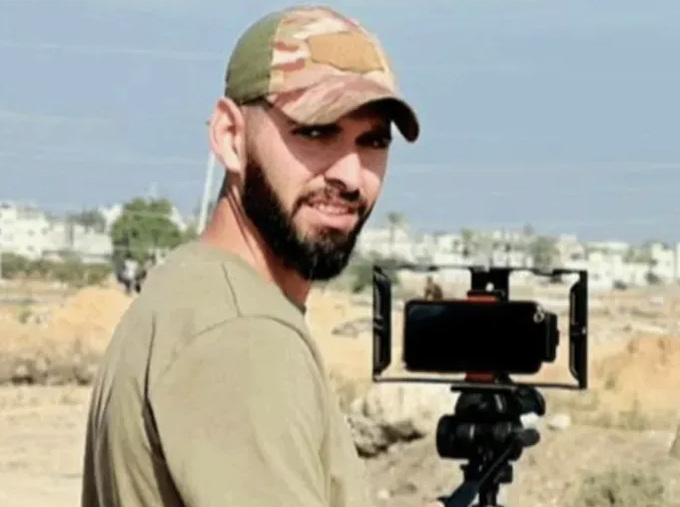
Just two weeks ago, an Al Jazeera photojournalist, Ahmed Wishah, 25, was killed in an Israeli air attack on central Gaza’s Bureij refugee camp. He was the 12th Al Jazeera journalist killed by Israel in Gaza since 2023.
His targeted murder came just weeks after his brother Mohammed Wishah, who also worked for the Doha-based global television network, was killed in a deliberate Israeli shelling of his car.
In an interview after his brother’s death, Wishah called on the world to stop the killing of journalists.
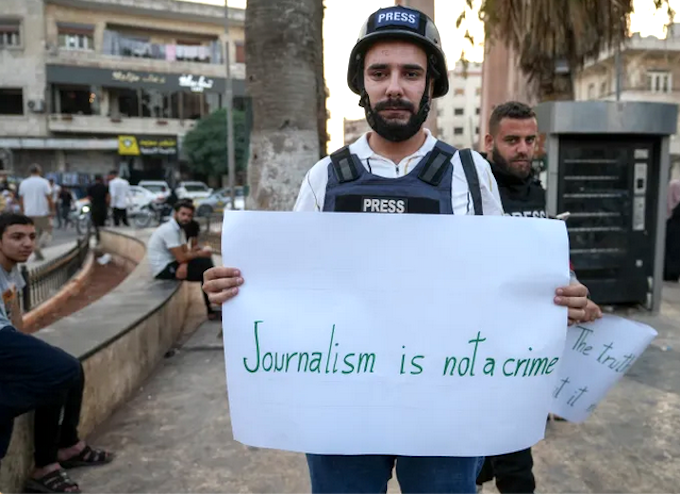
“Let the martyrdom of Mohammed Wishah be the end to the killing of journalists. This is my message to the world . . . Stop the Israeli occupation from targeting journalists.”
Smearing journalists
The routine response of Israeli military authorities is a hamfisted attempt to smear all Gazan journalists as “Hamas terrorists”. There is never any credible evidence to back this up and it is shameful that New Zealand media simply echo these lies from a discredited regime whose Prime Minister Benjamin Netanyahu is wanted by the International Criminal Court (ICC) on charges of war crimes and crimes against humanity in a “false balance”.
The New York-based Committee to Protest Journalists (CPJ) and Paris-based media watchdog Reporters Without Borders (RSF) have frequently condemned the “smearing of killed Palestine journalists” with “baseless claims”.
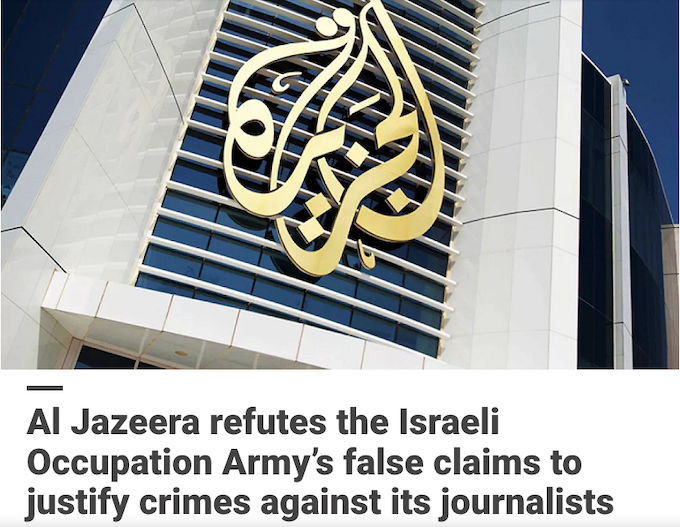
In a statement, Al Jazeera said it condemned the Israeli occupation army’s “baseless accusations”, which sought to “justify its crimes against Al Jazeera journalists and cameramen in Gaza, most recently the killing of cameraman Ahmed Wishah”.
“Since October 2023, the Israeli campaign of incitement has relentlessly spread false allegations and baseless accusations against Al Jazeera staff. The Network considers this smear campaign a transparent and futile attempt to justify the deliberate targeting of journalists and cameramen whose only ‘crime’ has been their courageous determination to document and expose the genocide being perpetrated by Israeli occupation forces in the Gaza Strip.
“These attempts deceive no one and cannot obscure the truth witnessed by the world.”
Al Jazeera called on press freedom organisations and “people of conscience around the world” to take urgent action to safeguard all journalists in the Gaza Strip and ensure their safety.
Reporters Without Borders has filed at least five complaints with the ICC over alleged war crimes against journalists, and together with other media freedom groups such as the Foreign Press Association, has repeatedly, but unsuccessfully, sought an Israeli Supreme Court ruling overturning the IDF’s ban on global journalists being allowed into Gaza to see the reality for themselves.
Gaza bloodlust spreading
Another disturbing factor about the slaughter of journalists is the fact that the Israeli bloodlust against journalists in Gaza is spreading also to the illegally occupied West Bank and the invaded Lebanon.
Journacide: The War on Truth Video: Democracy Now!
Irish filmmaker Seán Murray has investigated Israel’s killings of journalists in his new feature documentary Journacide: The War on Truth, which was featured by Democracy Now! earlier this month. Murray says the term “journacide” applies to Israel’s military actions because of the “explicit nature of the targeting and killing of journalists” as a way to silence the truth.
The filmmaker describes it as “the Gaza doctrine that is now being applied in Lebanon”.
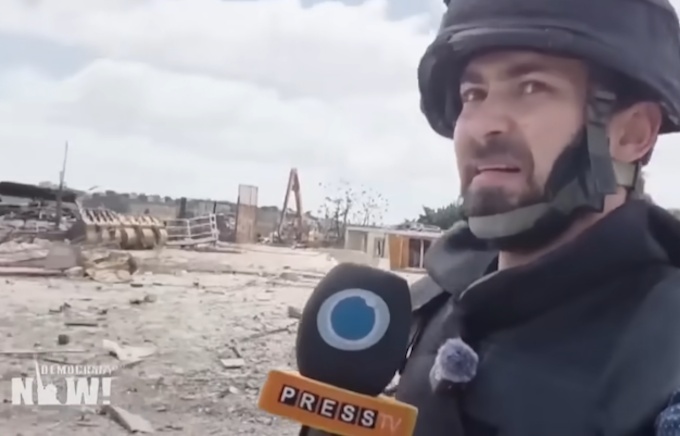
Democracy Now!’s Amy Goodman highlighted the attempted killing on June 15 of Iranian journalist Hadi Hoteit, who was working for the news outlet Press TV in southern Lebanon. He was attacked by an Israeli drone while reporting live for his network at Kafr Tebnit.
Although he survived the attack, he was struck by six pieces of shrapnel.
With the latest invasion of Lebanon by Israel, the death toll of journalists has now topped 29.
Murray investigated the killings of four of those journalists for his documentary Journacide.
On March 28, journalists Ali Shoeib and brother and sister Fatima and Mohamed Ftouni were killed — all together — in an Israeli drone strike on their car.
The following month, on April 22, Amal Khalil was injured in an airstrike and died from her injuries after waiting for hours inside a bombed building as rescuers awaited clearance from Israeli forces to reach her, reports Democracy Now!
About the silence
In a trailer for the documentary, Murray says the film is not about war, it is about the silence. “As Lebanon burns, silence has now become the greatest weapon of oppression. This is a tale of those that fought different, the story of the gatekeepers of truth.”
In the Democracy Now! interview about his film, Murray explores the lengths that Israeli military authorities go to create false narratives about journalists, even to falsifying documents and creating fake images.
“I think Journacide effectively gives the explicit nature of the targeting and killing of journalists. I think that it fits perfectly. Not only do we see the targeting of journalists, but it’s the double-tap strikes that we see with the Gaza doctrine, that is now being applied in Lebanon.
“So, in the case of Ali, Fatima and Mohamed, the original strike killed Ali and Mohamed, and it was a double tap then that killed Fatima, Mohamed’s sister, in the second strike.
“This is a deliberate targeting of journalists. The reasons behind that is to, of course, silence what is happening in Lebanon, the ethnic cleansing that’s going on, the mass war crimes that’s being committed.
“But Lebanon is a little bit different. Israel doesn’t have the geographical repressive abilities that they did in Gaza. And we see that now playing out.”
A wake up call surely for the Middle East realities for New Zealand journalists.
David Robie is convenor of Pacific Media Watch.