




Asia Pacific Report
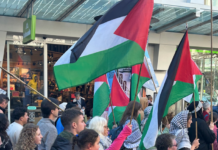
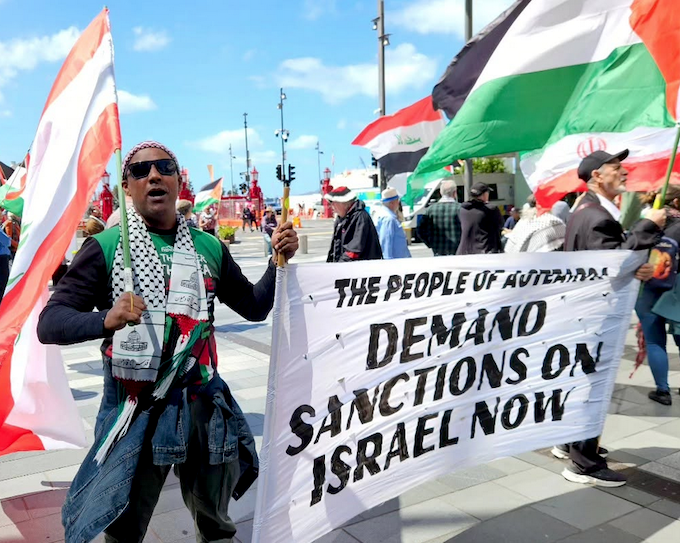
Speakers at a pro-Palestine rally in Auckland’s downtown Te Komititanga Square today recalled the 1917 colonial “Balfour betrayal” and condemned it for opening “the gates of a century long tragedy”.
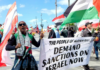
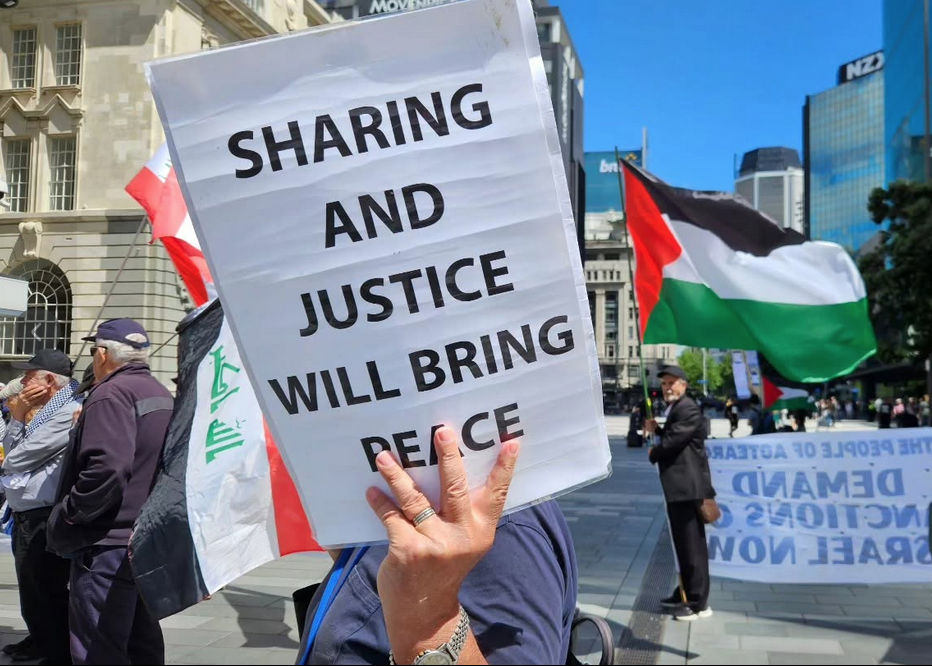
The protest marked the 160th consecutive week of demonstrations against the Gaza genocide in Aotearoa New Zealand in Auckland and also at dozens of other venues around the motu.
It also drew parallels with British colonial war crimes in the settling of New Zealand and the theft of Indigenous Māori land.
- READ MORE: Iran warns of unfettered retaliation if attacked as mediators try for peace
- A UN protection force must be urgently deployed to Palestine
- Other Gaza genocide reports
This came as Australia’s unelected South-African-born Special Envoy to Combat Antisemitism Jillian Segal has sought to “muzzle criticism of Israel” in a draft blueprint for policing a nation’s democracy and the public media.
And globally, with chants of “Workers do not work for war”, dock workers at more than 100 ports across Mediterranean countries and in other nations set up picket lines and strikes against arms sales to genocidal Israel and the European drive for rearmament.
Port workers protested in Italy, France, Greece, Türkiye, Morocco and the Basque Country in Spain and the action was taken up also in Australia, India, the United States and in other countries.
At the Auckland rally, speakers also targeted the New Zealand elections next Saturday with protesters chanting “If you don’t sanction Israel, you don’t get our vote”.
Call for change of government
Protesters were calling for the ousting of the rightwing coalition government of Prime Minister Christopher Luxon, which has failed to take a tougher line against genocidal Israel.
Opposition parties Labour, Greens and Te Pāti Māori have pledged to recognise the State of Palestine and impose sanctions on Israel if elected.
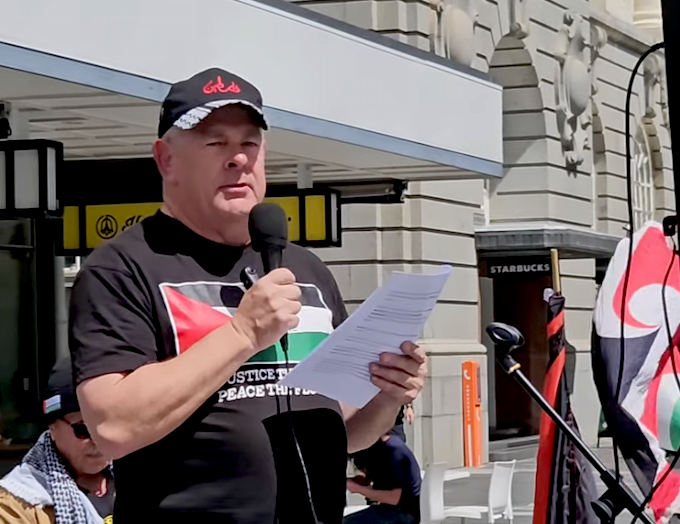
Speaking about British Foreign Secretary Arthur Balfour ahead of the anniversary of his infamous “promise” letter on 2 November 2017, activist Tim O’Shea reminded the crowd that at that time the population of Palestine consisted of 80 percent Palestinian Muslims, 10 percent Palestinian Christians and 10 percent Jewish people.
“A promise was made written in British ink and later fulfilled with Palestinian blood. A short letter, but one that changed the course of history and opened the gates of a century long tragedy,” O’Shea said.
“It was called the Balfour Declaration, a promise made by those who did not own the land, to those who had no rightful claim to it, at the expense of a people who had lived there for millennia.”
“The letter read, ‘His Majesty’s government views with favour the establishment in Palestine of a national home for the Jewish people’.
“It went on to say ‘that nothing shall be done which may prejudice the civil and religious rights of existing non-Jewish communities in Palestine’.
“The British used their weasel words carefully — they deliberately talked about a home and not a state.”
Palestinian rights violated
O’Shea said that was the start of a process that “ignored and violated the rights” of the Palestinian people and their ownership of their homes and land.
“Those 67 words were written by British Foreign Secretary Balfour and addressed to Lord Rothschild, a leading figure in the Zionist movement in Britain. Rothschild wasn’t even an elected official — he was a baron, and a banker.
“Balfour made a promise to the Zionists that Britain had no right to make.
“It was a betrayal that would shape the destiny of a nation, and indeed the whole of the Middle East.”
O’Shea also outlined how the betrayal actually began even earlier — in 1916, with the Sykes-Picot agreement, a treaty signed in secret between Britain, France, and Russia.
“It was a colonial conspiracy to divide the Arab world up like spoils of war. The dream of Arab independence was never given a chance to be born,” he said.
“Instead, an illusion was planted in the hearts of the Arabs that they were under occupation [by the Ottoman Empire] and that self-rule was their path to liberation.”
‘Illegal and immoral’ declaration
O’Shea said a century of dispossession, occupation, and resistance had been sealed by Britain “with a promise, and by the Palestinians with their steadfastness”.
“This was not a declaration. It was a curse written in British ink and fulfilled with Palestinian land, and lives.”
The Israeli genocide in Gaza since October 2023 has killed almost 75,000 Palestinians – mostly women and children – and more than 1400 since the so-called “ceasefire” signed in October 2025.
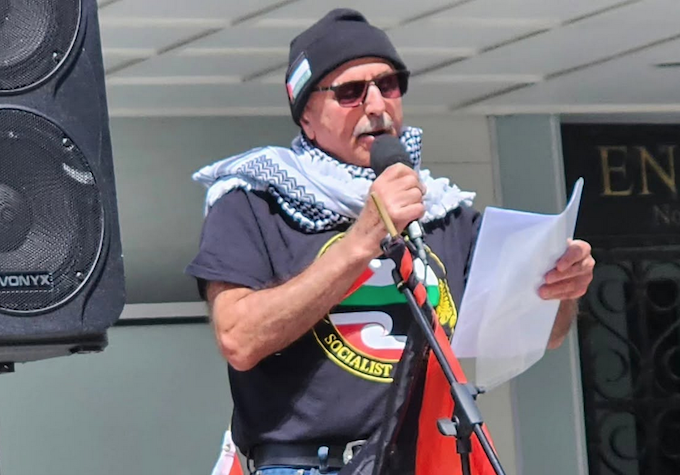
Palestinian activist Adnan Swaid, who was born in Syria and his family had fled Palestine during the Nakba of 1948, also spoke of the Balfour Declaration and how it had impacted on his people.
“The Palestinian holocaust did not start on 7 October 2023 and did not start even in 1948, but started on 2 November 1917 when the bankrupted British government at the end of the First World War ‘sold’ Palestine — which was under their mandate — to the rich Zionist families for cash and gold,” he said.
“Then they issued the most illegal and immoral declaration in human history.
“Remember Teresa May? She was the ex-British PM, who could not, refused to apologise to the Palestinians?
“The United Kingdom, right up until now, supplies killing arms and fly-over spy flights over Gaza.”
Swaid criticised British Zionists who “collaborated with the Nazis to prepare the ground for forced Jewish migration to British-occupied Palestine.
“The British government facilitated this migration from 1917 until 1948.”
Swaid also condemned the British military for “helping form terrorist organisations like the Hagana, Stern Gang, Palmach and others – these groups were armed, trained, protected by the British army”.
‘Opened the door to genocide’
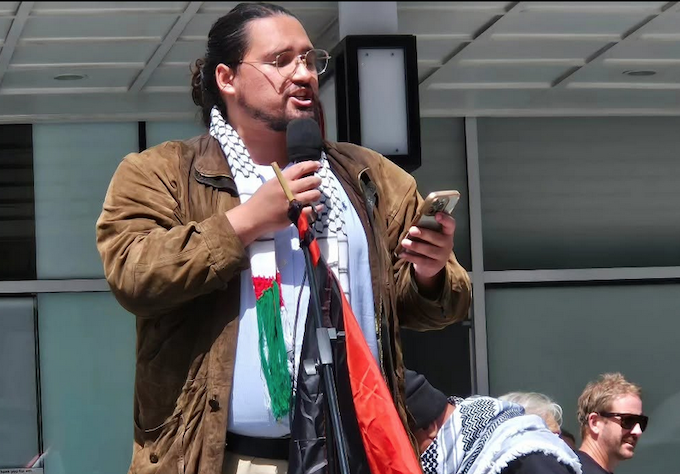
Researcher and student community advocate Kākakatara Te Pou Kohere (Ngāti Porou, Ngāti Te Ata Waiohua, Tūhoe, Ngāi Tahu) also spoke of Balfour and Zionist collaboration.
“The British Empire, with colonies in every ocean and occupations on every continent, opened a door to the genocide, theft, and misery of tangata whenua in Palestine,” he said.
“It was not the massacre of thousands in Gaza, it was not the displacement of a nation with the Nakba, it was not the brigandage of the Zionist terrorist militias.
“The door was opened by a declaration on 2 November 1917, made by one of the Empire’s colonial trouble shooters, Arthur Balfour. It was under “Bloody” Balfour’s watch that the British worked to ensure Ireland was kept under their rule.
Balfour enforced the strict Criminal Law and Procedure (Ireland) Act 1887 (known as the Crimes Act) to suppress agrarian unrest, ban nationalist political groups, and jail thousands of activists and protesters, Kohere said.
“Where the Irish were shot in the streets for daring to stand for their freedom and sovereignty, where the questions of nationhood were dismissed in Westminster, far to the North Sea.”
He also explained how during the Boer War of 1902, Balfour organised some of the first concentration camps “as we know them”, and moved thousands of Chinese people into functional slavery in South Africa.
“Balfour was the expression of the imperial drive for domination, of the need for markets, profits, and labourers to exploit,” Kohere said.
“Like with the Ulster Plantations in Ireland, and settling British troops across South Auckland, Waikato, the Bay of Plenty, and much of Aotearoa as a garrison against Māori struggle.”
Kohere described Balfour and “all of his brother officials across the Empire” as repeating the same practices in a “cycle of vicious and rapacious piracy”.
Comparing the struggle in Aotearoa with Palestine, Kohere outlined the peaceful resistance against land confiscations based in the Taranaki village of Parihaka and led by Te Whiti o Rongomai and Tohu Kakahi.
“The people went out two by two. They pulled up surveyors’ pegs and ploughed the ‘sold’ land. Later they raised fences across roadways that were being built by the [colonial] government.
“Come 5 November 1881, a thriving community at Parihaka with gas street lamps and plumbed running water was invaded by 1600 men of the New Zealand Armed Constabulary.
Kohere described how a settler paramilitary force from around the country descended onto the fields and orchards of Parihaka, personally led by the Minister of Native Affairs, John Bryce.
The peaceful resistance of the people of Parihaka was brutally crushed by the Constabulary and the leaders exiled.
“The Armed Constabulary was inspired by the occupational forces in Ireland, the Royal Irish Constabulary,” Kohere said.
“The slavery of Māori was connected to the imprisonment and forced relocations of thousands across the British Empire, the French Empire, the genocides by the Germans in the First World War, and the Nazis that followed.”
The arms industry, the chemical weapons manufacturers, the institutions of justification in schools, universities, and academies, were all tied together in the web of empire, Kohere said.
“Arthur Balfour, Governor Grey, John Bryce, George Bush, Donald Trump, Benjamin Netanyahu — the faces change, but the action and demands of power do not.”
He called for unity in the world.
“It is the people united, the students in France, the children in Palestine, the
people of Aotearoa, of Indonesia, of China, of Iran, of Bolivia, of Sudan each and every struggle by the workers of the world, by the oppressed, by the people at home and abroad, that can tear up the [colonial] Balfour declarations.”
Street theatre satire
Meanwhile, in Christchurch Ōtautahi, protesters carried out street theatre today satirising the Luxon-Peters-Seymour coalition government’s “shameful” refusal to name the Gaza genocide, recognise Palestine, and impose sanctions on Israel.
Chants of “Garbage, garbage, garbage” greeted protesters wearing masks representing the National Party’s Christopher Luxon, ACT’s David Seymour and New Zealand First’s Winston Peters.