





By Kaya Selby of RNZ Pacific
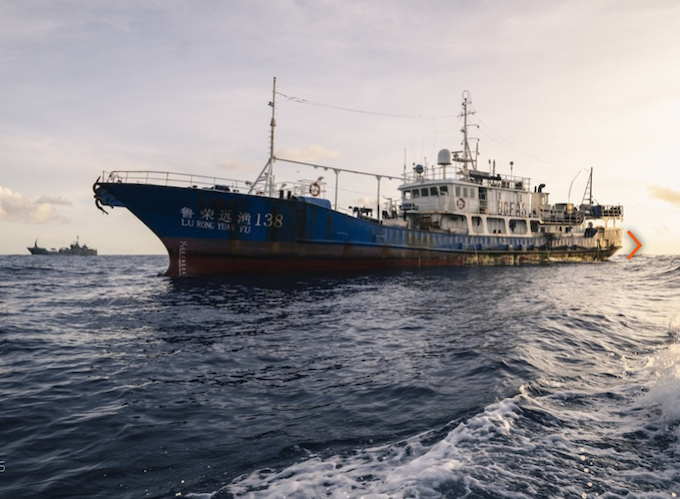
Tuvalu has arrested a Chinese tuna longliner, borrowing a vessel from a wellknown conservation charity to do so.
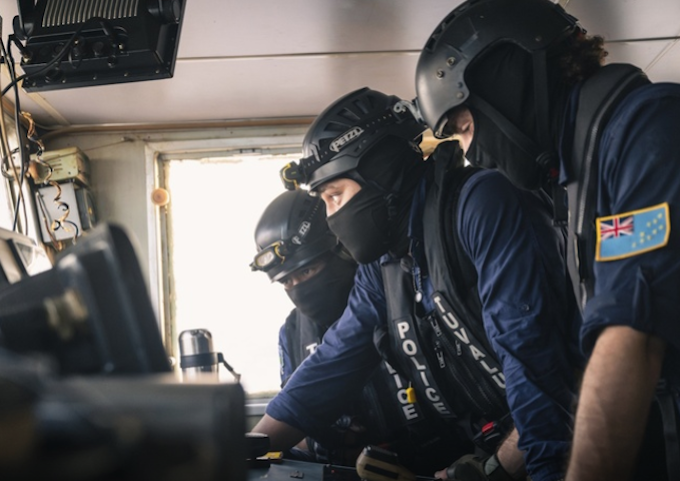
On the evening of July 9, Tuvalu Police Force maritime trackers picked up something strange about a vessel they were watching. From there, they boarded the Allankay, a vessel owned by Sea Shepherd Global, and went to investigate.
According to Sea Shepherd, police found the crew of the Lu Rong Yuan Yu 13 throwing illegally caught shark fins overboard while stockpiling tuna and keeping essentially no records.
- READ MORE: Chinese longliner arrested in Tuvalu over suspected illegal fishing
- Other Sea Shepherd reports
Experts say it is a “quite exceptional” kind of arrangement, where developing countries, particularly in Africa, lean on an NGO for law enforcement. But Sea Shepherd says it is a model that has proven successful, and they hope to bring it to the Pacific.
Sea Shepherd’s chief campaigns officer Captain Peter Hammarstedt told RNZ Pacific that Tuvalu had come to them with a partnership in mind after their lone patrol boat, the Te Mataili II, was destroyed by cyclones Judy and Kevin in 2023.
“When somebody comes into the waters of Tuvalu and fishes illegally, it is a direct assault on the livelihoods of Tuvaluans,” Captain Hammerstedt said.
“Tuvalu asked us if we could send our ship there to help fill that law enforcement vacuum.”
Tuvalu’s Transport Minister Simon Kofe has thrown his support behind the group, thanking it for its support in public LinkedIn posts. Captain Hammerstedt said there was more to come in the Pacific.
The Tuvaluan government did not respond to requests for comment.
‘Three-dimensional chess’
Ships worldwide operate on the Automatic Identification System (AIS), which gives their location in real time via transponders, to stop them from crashing into each other.
But here the AIS transmission was quite simply impossible. It transmitted a latitude that put it on the equator — but if the longitude were true, the vessel would no longer be on the planet.
It did not take long for the police to realise that it was a spoof — a scrambled signal to mask the ship’s location so it could travel in the dark.
“It’s used repeatedly by the Chinese distant water fishing fleet,” Captain Hammarstedt explained.
“If you’re sitting at a computer looking at fishing activity, you may notice Chinese fishing vessels smack-dab in the middle of continental Europe… the Mongolian desert… even the Australian outback, and that’s because the information being put out if simply rubbish.”
In this case, it was a giveaway. Authorities made the assumption that the vessel would not expect any law enforcement in the area because they were tracking ships they knew of.
Hopefully, Captain Hammarstedt explained, the dark vessel would think they were in Fiji, not Tuvalu — because they had hidden their location too.
Staggered times
“This is why we stagger our arrival and we stagger the times that we visit our partner countries… it’s like three-dimensional chess.”
By the morning the Allankay had arrived to find a longliner with a small Chinese crew.
“When coming up on the vessel, the police noticed that their nativation lights were completely shut off,” he recalled.
“Once they got on board, they noticed that their fishing authortsation had expired.”
As they searched, they found piles of tuna, and witnessed crew members throwing shark carcasses overboard. Records going back months made no mention of sharks, which are illegal to target and must be logged whenever there is any bycatch. With that, Tuvalu arrested the captain and crew, and detained the boat in Funafuti.
“They’ll make a decision in the next few days whether or not to prosecute the ship and lay charges.”
First arrangement of its kind in the Pacific
Sea Shepherd, once known for tailing Japanese whaling vessels, has moved toward partnerships with law enforcement, particularly in African countries.
They are most famous for using confrontational tactics in the high seas, with illegal fishers and whalers the primary target. A “jolly rodger” style black flag adds to their aura.
A journal article from Chatham House’s International Affairs published in January, which featured interviews from SS workers, discussed this “exceptional” arrangement as a reflection of those countries’ weakness in the face of external pressures.
But for the Pacific, with its Forum Fisheries Agency and the tens of millions in annual funding it receives, one may wonder why the “skull and crossbones” is necessary.
“Sea Shepherd seeks to complement those efforts,” Captain Hammerstedt said.
“It’s another thing to have that intelligence, but also make that intelligence actionable, because there is a vessel in Tuvalu at that very moment that can bring the police to investigate that suspicious target.”
The FFA told RNZ Pacific that they had no involvement in the partnership.
The ship remains in Funafuti, with Tuvaluan authorities to announce whether charges will be laid in the coming days.
This story was first published on