
By Patrick Decloitre of RNZ Pacific
New Caledonia’s newly-elected three provincial assemblies — Northern, Southern and the Loyalty Islands — have elected their respective presidents following the elections held on June 28 in the French Pacific territory.
The make-up of the three provinces and their respective majorities were already known since the poll on Sunday.
The election of the three presidents was therefore supposed to reflect what came out of the ballots.
- READ MORE: Official results confirmed for New Caledonia’s provincial elections
- Pro-French, pro-independence blocs remain in New Caledonia election
- Other Kanaky New Caledonia reports
In New Caledonia’s affluent and most populated Southern province, a united front of pro-France parties (Loyalistes-Rassemblement) has already secured an overwhelming majority of 28 of the 40 seats.
On the province’s inaugural sitting and the election of a chair, group leader Sonia Backès, who is also the incumbent President of the province, thus received 28 of the 40 votes.
There was no other candidate.
Following the Speaker’s election, bureau members such as the Vice-President (Gil Brial) and second and third Vice-President (Brieuc Frogier and Loïc Basset-Creugnet) came from the same “Strong and United” front.
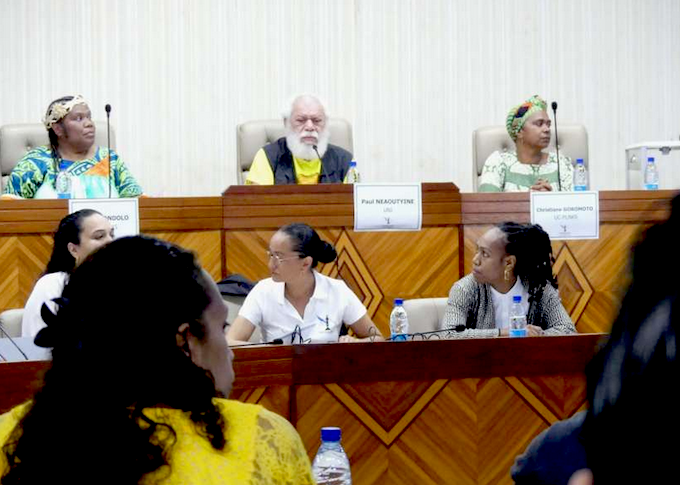
But in the Northern Province, things were more complicated: the showdown was between incumbent President and UNI (Union Nationale pour l’Indépendance) leader and founder of the PALIKA party (Kanak Liberation Party) Paul Néaoutyine who was challenged by Pascal Sawa (from Union Calédonienne-FLNKS).
In the newly-elected assembly seat quota, they were neck-to-neck with 10 seats for Sawa and nine for Néaoutyine.
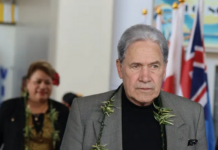
Néaoutyine, 74, has been President of the Northern province since 1999 and is also the Mayor of the small town of Poindimié.
Protest walk-out
Even though Sawa had a narrow advantage of one seat, it was Néaoutyine who received the most votes for a new presidential mandate (12 votes), thanks to the last minute support from other parties represented in the Assembly (including “Let’s Act Together for the North”, and Loyalistes-Rassemblement’s pro-France group headed by Vanessa Wacapo).
At the results’ announcement, Sawa’s UC-FLNKS group walked out of the sitting, leaving the matter of electing bureau members to later — on Tuesday, July 7.
Sawa said he was “indignant” and he condemned what he called a de facto “new alliance between UNI and the Loyalist pro-France” which, he said, was a show of “disrespect for the ballot results”.
Néaoutyine denied he had struck any alliance with any party.
In the smallest of the three provinces, the Loyalty Islands, the UC-FLNKS component of the pro-independence camp, the two leaders of last Sunday’s elections results, Mickaël Forrest and his sister, Omayra Naisseline (Indigenous Nation, affiliated to UC-FLNKS), were running for the Speaker’s chair.
All women vice-presidents
Forrest was elected President (with eight of the nine votes) and Naisseline has been elected first Vice-President.
The other positions of vice-presidents were all allocated to women (Wali Wahetra [Palika îles], Marguerite Piaa [UC-FLNKS]).
For all of New Caledonia’s three provincial assemblies, the total of newly-elected members is 76.
They will sit in the provincial assemblies for the next five years.
And a portion of those will also sit in the territorial Congress.
But the Presidential process does not end there.
On Friday, July 10, the territorial Congress of New Caledonia (54 seats) will also hold its inaugural sitting to elect its Speaker.
Heavy horse-trading underway ahead of Congress sitting
As a result of the provincial elections, the Congress now and once again hosts only relative majorities and heavy horse-trading is already underway between all parties represented.
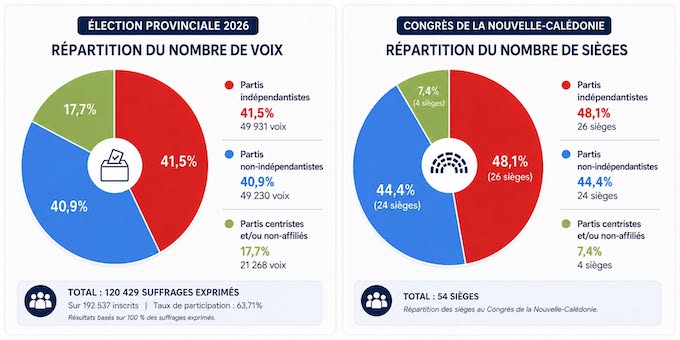
The pro-France Strong and United alliance can count on 24 of the 54 seats — not enough to rule on their own.
The same goes for the pro-independence bloc, which has won 26 seats, still not enough for an absolute majority.
The pro-independence bloc consists of UC-FLNKS (10 seats), FLNKS (6 seats), UNI (6 seats), Dynamique autochtone (Indigenous Dynamics, 3 seats) and Palika (1 seat).
But the pro-independence bloc is not entirely united.
Within this group, it remains to be seen how UNI-PALIKA will position itself vis-à-vis UC-FLNKS and its affiliates.
This comes especially after the support provided by pro-France members of the Northern province regarding the Friday election of Paul Néaoutyine.
The two groups have long experienced differences, especially on the sensitive subject of how to approach New Caledonia’s sovereignty.
While UC-FLNKS favours a speedy full independence and accession to full sovereignty, UNI-PALIKA is prefers a status of independence in gradual association with France.
The issue crystallised even more during and after the May 2024 civil unrest and riots (which caused 14 dead and over 2.2 billion euros (NZ$4.4 billion) in material damage) with UNI PALIKA condemning any violent action.
‘Kingmaker’ Eveil Océanien ‘ready to talk with everyone’
Centre party Eveil Océanien (EO) now has four seats which once again places it in the position of “kingmaker”.
Over the past mandate (2019-2026), Eveil Océanien has struck alliances first with FLNKS, then later (2024) with the pro-France bloc, allowing it to tke the seat of Congress President.
EO leader Milakulo Tukumuli told local media as part of the negotiation process with other parties, he was “ready to talk with everyone”.
He said instead of the term “kingmaker”, he preferred to regard his party as a “majorities builder”.
After the election of a new Congress President (to replace incumbent Veylma Falaeo from Eveil Océanien) and the election of bureau executives, the local parliament has two weeks (before July 25 at the latest) to determine the number of cabinet members (which could be between 5 and 11) and then (before July 31) to allocate portfolios of the new “collegial” (proportionally representative) government of New Caledonia.
They would also choose the President and Vice-President of the government of New Caledonia.
In view of the tight schedule during the next few weeks, the option once expressed by French Prime Minister Sébastien Lecornu to reconvene New Caledonia’s politicians for talks on the French territory’s future straight after the provincial election has become elusive.
Instead, Rassemblement leader Virginie Ruffenach told public radio NC La Première on Friday, that it was more realistic such talks would be more likely to happen at the end of August or in September.
Later than that, French national politics would be largely constrained and dominated by the Presidential campaign in France.
Meanwhile, it was confirmed earlier this week that the French Presidential elections will take place on April 16 (first round) and 2 May 2027 (second round).
This story was first published on