



By Patrick Decloitre, RNZ Pacific correspondent French Pacific desk
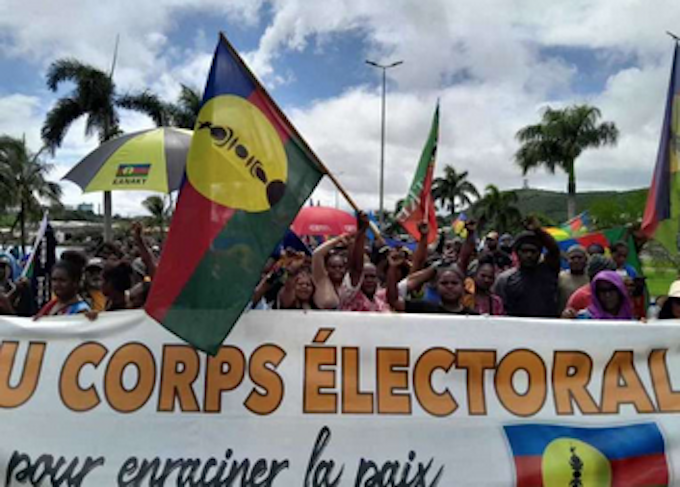
Thousands took to the streets of the capital Nouméa on Tuesday — hours ahead of a scheduled French Parliament debate in the National Assembly in Paris to discuss the French Pacific territory’s political future.
An estimated 2500 came in support of local Association Un Coeur, une Voix (UCUV–One Heart, One Voice) to oppose the prospect of the next local elections (to elect New Caledonia’s three provinces) being held under the current “frozen” electoral roll, which excludes people who have not resided in New Caledonia before 1998 or their direct descendents.
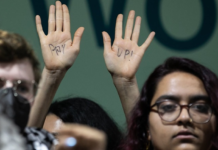
During a one-hour peaceful march in downtown Nouméa, the participants were brandishing tricolour blue-white-red flags and other placards denouncing what they described as “second-class citizens” treatment and their perceived condition of self-styled “victims of history”.
The march was designed to send a clear message to French MPs ahead of debates on New Caledonia later this week.
“I’m sorry for using harsh words, but it’s like we’re being robbed [of our rights],” UCUV president Raphaël Romano told local Radio Rythme Bleu.
“And now we have those MPs who are going to decide for us. They’re going to use New Caledonia for their own national political gains . . . and make a mess”.
“If [MPs] can’t find an agreement, then they should let New Caledonians choose.
“It’s a shame for democracy, it happens nowhere else in the world”, Romano told local media.
His movement is strongly supported by several prominent pro-France parties, including Le Rassemblement and Les Loyalistes.
He said the situation affected all ethnic communities in New Caledonia.
“Those who can’t vote are men and women from all walks of life, all ethnic groups who live together in peace, every day,” he said.
“It’s hard enough to try and recover from the May 2024 riots, where people have lost their businesses and their job.”
The 2024 riots caused 14 deaths and more than 2 billion euros (almost NZ$4 billion) in material damage.
They were also initially triggered by peaceful protests against a plan to have the French constitution modified, especially regarding the electoral restrictions.
The protests turned violent and out of control in Nouméa on the very day debates started in Paris.
The “freeze” was enforced in 2009, as part of the Nouméa Accord, signed in 1998.
Originally designed as a temporary measure, the restriction currently excludes up to 40,000 people, many of them born in New Caledonia.
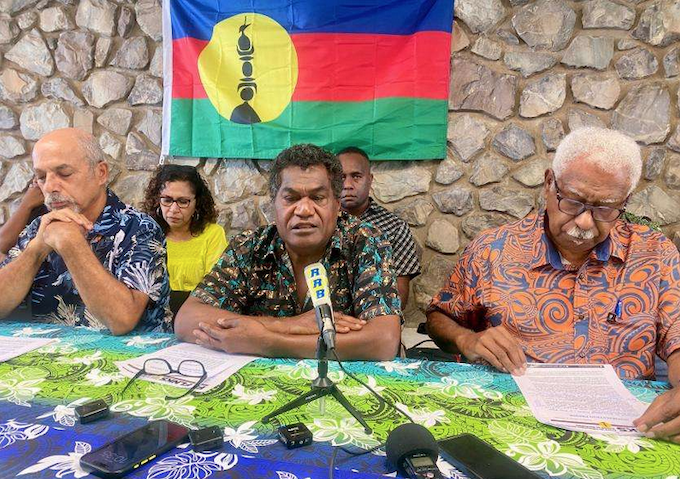
‘Counter demonstrations’
Meanwhile, pro-independence movements have called for other “counter-demonstrations” outside of Nouméa.
One gathering took place on Tuesday, including in the outer Loyalty Islands of Lifou, while another demonstration is scheduled on Wednesday, in Koné (North of the main island, Grande Terre).
The voting restriction measure was originally included in the 1998 Nouméa Accord as a measure to prevent any erosion of New Caledonia’s indigenous Kanak population’s voice.
The proposed text derives from talks held between New Caledonia political stakeholders and the French government.
This was on two occasions: in the small city of Bougival in July 2025 and later in January 2026 in Paris, at the French Presidential Élysée Palace and the French Ministry of Overseas Territories, Rue Oudinot.
Hence the name of Bougival-Élysée-Oudinot (BEO) for a text and an expanded project.
But the BEO text, in August 2025, was unequivocally opposed by the FLNKS (Kanak and Socialist National Liberation Front), the main component of the pro-independence movement.
Other participating parties — pro-France and pro-independence (two pro-independence members of FLNKS have since split to create their own “UNI” [Union Nationale pour l’Indépendance]) — have since maintained their commitment to the BEO process, including their legislative adaptation (in the form of a Constitutional Amendment and an “organic Law, which would de facto become New Caledonia’s constitution).
The project also envisions the creation of a “State of New Caledonia”, with a correlated “New Caledonia nationality” available to people who are already French citizens.
The FLNKS later explained it saw these, as well as a planned process of transfer of more powers from Paris to Nouméa, as just a “lure” of independence.
Reacting to the UCUV march, FLNKS said the “freeze” was ruled constitutional by France’s Constitutional Council in September 2025 and could only be changed if a “consensual” agreement was found.
But FLNKS considers the BEO-derived text “is not a logical continuation of the Nouméa Accord”.
The BEO-derived Bill, if adopted, could eventually replace the Nouméa Accord.
But it is now still undergoing legislative process.
The French Senate endorsed it on February 24, with a comfortable right-wing majority.
But this week, the same text is to be debated in the Lower House of Parliament, the National Assembly, which has been divided since the July 2024 French national snap election following President Macron’s decision to dissolve Parliament.
Current predictions are that since there is no clear majority within the Lower House, the Bill, which comes in the form of a Constitutional Amendment (with the capacity to replace the Nouméa Accord) is likely to be rejected.
The opposition to the current right-wing group comes from the left (far-left La France Insoumise -LFI-, the Socialists (who say the Bill is “heavy with threats and dangers”), the Communists, the Greens) and Marine Le Pen’s far-right Rassemblement National (RN).
Last week, the Constitutional Bill came before the National Assembly’s Law Committee and suffered an initial rejection.
Parliamentary debates in the National Assembly are scheduled to begin on Wednesday (1 April 2026, Paris time) and could last for the next three days.
‘Barrage’ of three thousand amendments
Some opposition parties, especially the democratic and republican left (GDR, Gauche démocrate et républicaine, to which the pro-independence New Caledonian Kanak MP Emmanuel Tjibaou belongs) have already filed on the agenda a “prior rejection motion” to withdraw the Bill.
Some of those expressed strong reservations because the process and ensuing Bill was opposed by FLNKS and that, therefore, there was no unanimity.
Meanwhile, since last week, in a previously used barrage tactic, LFI has also filed over 3000 amendments.
Restrictions still apply under Nouméa Accord — French Constitutional Council
UCUV has been fighting for years to defend their rights, in front of what they term a “denial of democracy”.
Last year, they took their case to the French Constitutional Council, which ruled that in the present situation, the electoral roll “freeze” for local elections was part of the Nouméa Accord which was part of the French Constitution.
UCUV president Raphaël Romano said they now have no other option but to take their case before the European Court of Human Rights, even though they admit their hopes are “very weak”.
He said the deadline was 4 April 2026.
If the Constitutional Bill is rejected by Parliament, a new proposed calendar for implementation will automatically become obsolete.
And local provincial elections that have already been delayed three times since May 2024 will have to be held not later than 28 June 2026, instead of the proposed December this year.
If the BEO-derived text is rejected, then the Nouméa Accord applies again and the planned provincial elections will have to be held under the restricted — “frozen” — electoral roll system.
“The provincial elections will not be held under a frozen electoral roll. It’s just not possible”, Romano said.
Deadlock, imbroglio: what now?
Other possible alternative scenarios could include re-submitting a new, revised Bill, dedicated to the electoral roll, or organising a “consultation”, a de facto referendum with eligible New Caledonians.
Under the French parliamentary principle of the “shuttle”, the text could be sent back to the Senate.
Under the BEO text, people eligible for voting at local provincial elections can either be born in New Caledonia or having resided there for an uninterrupted 15 years (for the first five years of enforcement, then the minimum residence period would be reduced to 10 uninterrupted years).
From the French government’s point of view, an agreement on New Caledonia’s institutional future is the only solution to bring back stability and economic “visibility” for local and foreign investors.
“Everything is on the table to get things moving”, French Prime Minister Sébastien Lecornu told French media last week.
Overseas Minister Naïma Moutchou is still advocating for the benefits a parliamentary approval would bring to New Caledonia in terms of a “framework” for economic recovery.
France has earmarked some 2 billion euros in a “refoundation” pact, structured to put the economy, social services and the crucial nickel mining industry back on track, provided necessary reforms are carried out.
“Let’s give a chance to this process, because in New Caledonia, the alternative to an open political process is never quiet: it’s uncertainty and, over there, it always ends up weakening civil peace,” she told Parliament last week.
This article is republished under a community partnership agreement with RNZ.