




By Kaya Selby, RNZ Pacific journalist
New Zealand’s Budget 2026 will see more foreign aid to the Pacific region, while defence and customs spending rises with an eye towards crime and security.
But Pacific-focused policy work will be cut as the government seeks to reduce the size of the public sector, as the Ministry for Pacific Peoples (MPP) will see a $2.8 million cut over four years.
The ministry previously saw a significant cut in Budget 2024.
- READ MORE: ‘Immediate pain, cuts and no plan’: Opposition attacks NZ Budget 2026
- Other NZ Budget reports
New Zealand will spend $1.2 billion on foreign aid this fiscal year, around $116 million more than the last year.
Additionally, the Ministry for Foreign Affairs and Trade (MFAT) has set aside $110 million in aid spending for the Indo-Pacific exclusively for three years beginning in 2027/28.
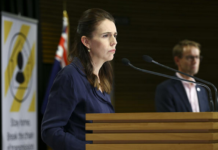
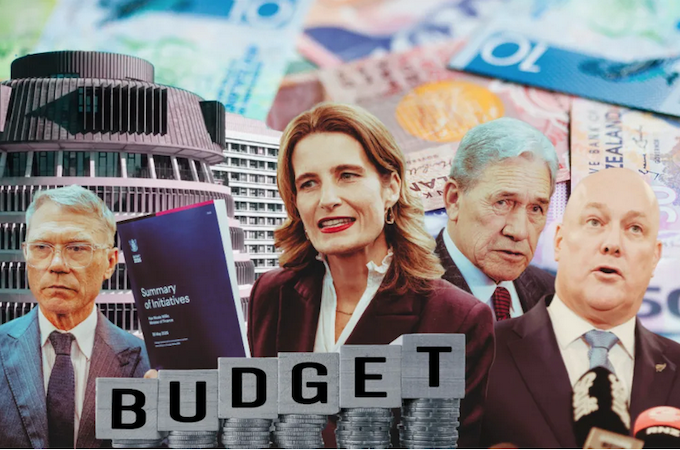
Foreign Minister Winston Peters said a highly active and effective foreign policy is called for in what he called the most adverse and contested geostrategic environment of the past 80 years.

Finance Minister Nicola Willis said that the budget heavily prioritised capital spending for infrastructure, while tightening the government’s belt with a lower operating allowance.
To that end, the Pacific Ocean would see a greater Defence Force presence with more than $3.3 billion in new spending — $2.34 billion of which is capital spending.
New customs funding for staffing and machinery in the region has also been announced, with an eye towards the trans-Pacific drug trade.
Most adverse geopolitical scene in eight decades — Peters
New Zealand’s aid spend includes its International Development Contribution for the year, and the costs associated with managing it, both of which have risen.
Funding for diplomatic and consular missions also increased by $145 million over the next four years.
But the budget also revealed that New Zealand reduced its aid allocation by $3 million in the last fiscal year.
MFAT budgets foreign aid on a triennium (three-year) cycle, with Budget 2024 initially setting out around $2.9 billion for the 2024-2027 triennium. This was upped to $3.063 billion the following year and reduced to $3.06 billion this year.
The next triennium will be set out in Budget 2027, but this budget laid out $145.3 billion for the Indo-Pacific exclusively on top of that.
It comes amid a global pullback in foreign aid last year, highlighted by the OECD (Organisation for Economic Co-operation and Development) in April, which showed a massive contraction in spending for developing countries, mostly thanks to the United States shuttering its aid programme in January 2025.

Meanwhile, as part of nearly a billion dollars in new spending for defence force operations, NZDF will cover $174 million in cost increases over four years for aircraft, ships and personnel on the ground in both New Zealand and the Pacific.
Three new drug-detecting submarine drones announced by Customs Minister Casey Costello are also on the way, as is a Customs liaison officer to the region.
There will also be a Customs liaison officer sent to South America, alongside a Police liaison officer to Bogota, Colombia, announced earlier in the month.
With New Zealand a key destination on the Pacific narcotics highway, Costello will hope that a $15.3 million investment into its border management services will make a difference.
MFAT has also set aside $20 million to host the annual Pacific Islands Forum next year.
Pacific Ministry shaved, immigration rules tightened
The MPP will see a $2.8 million cut over four years. This is due to a savings initiative that cut back the baseline by reducing policy advice, communications, and relationships resourcing.
Pacific Peoples Minister Paul Goldsmith has previously described MPP’s primary function as a base of expertise.
RNZ Pacific understands this savings reduction is separate to anything that may come out of the government’s more recent ambitions to reduce the size of the public sector.
A spokesperson for MPP said last week that no immediate decisions had been made at the time, and that they were working through options.
For immigration, $18 million over four years is set out to strengthen investigation capacity, while the government progresses a bill that critics say will make Pacific people more likely to be deported.
Immigration Minister Erica Stanford said that for the first time they will enforce a maximum continuous stay, which requires those on a temporary work visa to depart New Zealand immediately upon the visa’s expiry.
This article is republished under a community partnership agreement with RNZ.