



By Russel Norman
One day in October 2023 I was walking down the supermarket aisle when I saw greenwashing in plain sight.
Fonterra’s Anchor butter was sitting in the chiller with a prominent claim on the packaging that it was Grass Fed.
I knew that Fonterra cows were fed on millions of tonnes of palm kernel. So I decided to do something about it. And today we finally won that battle.
Today, after Greenpeace sued Fonterra under the Fair Trading Act, Fonterra has published a statement admitting its “100% New Zealand Grass Fed” claim breached section 9 of the Act.
Section 9 makes it illegal to “engage in conduct that is misleading or deceptive or is likely to mislead or deceive.” Fonterra has undertaken to not use this label again.
Thus Fonterra, New Zealand’s largest company, a multinational with $26 billion a year in turnover, was today forced to admit it has been deceiving its customers about a key claim it makes about its products — “100% New Zealand Grass Fed”.
Fonterra’s deception
While Fonterra was telling its customers that its Anchor brand butter was “100% New Zealand Grass Fed”, they were telling their milk suppliers that they could feed their dairy cows up to 3kg of palm kernel every day.
That works out at around 20 percent of all the food that a dairy cow eats. In practice dairy producers are probably on average providing about 6 percent to 8 percent of a New Zealand dairy cow’s diet from palm kernel, though it could be up to 20 percent in individual cases.
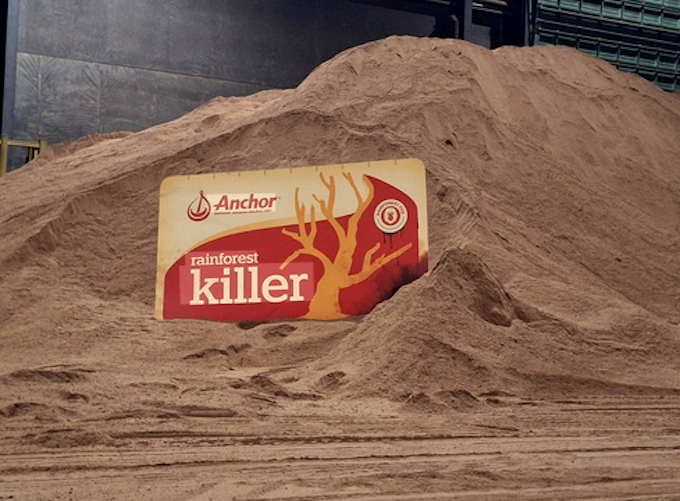
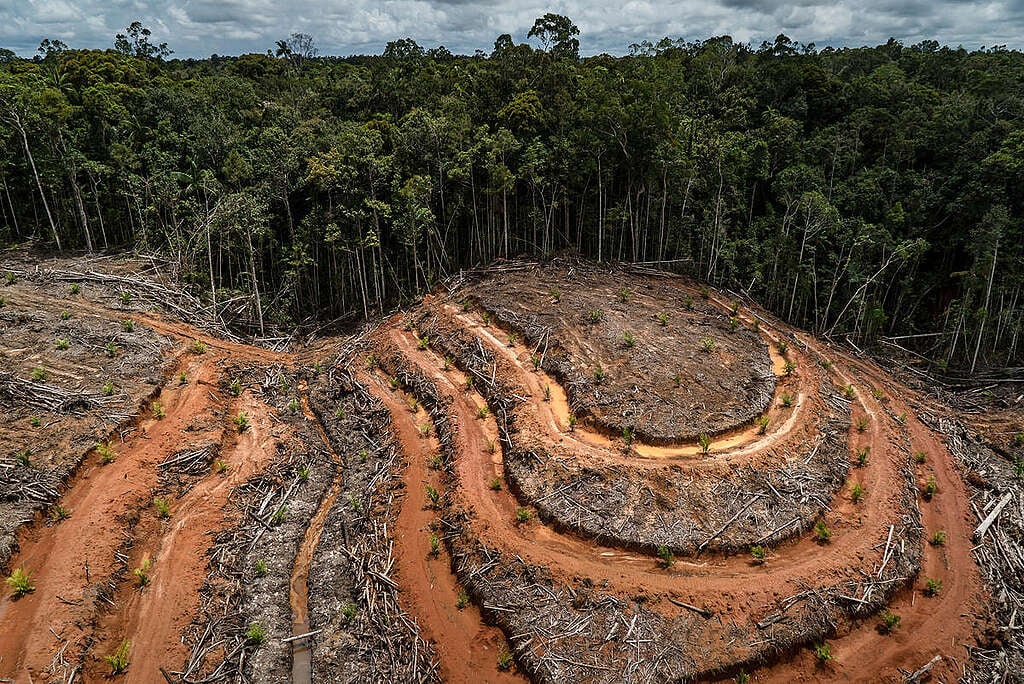
Palm kernel is one of the products of the palm industry in Malaysia and Indonesia — yes, the same palm industry that is destroying the last of the Southeast Asian tropical rainforests.
A million tonne deception
So on the one hand Fonterra was telling New Zealanders that they should buy Fonterra products because they are natural, 100 percent from New Zealand grass, while at the same time it was giving the green light to its milk suppliers to feed dairy cattle palm kernel from offshore.
And not just a little bit, I mean millions of tonnes of palm kernel.
In fact, Fonterra’s milk suppliers are using so much palm kernel that New Zealand is the world’s largest importer of palm kernel, at around two million tonnes per year, most of which is fed to dairy cattle.
During the period when Fonterra used the “100% New Zealand Grass Fed” label (they state from December 2023 to April 2025), New Zealand imported around three million tonnes of palm kernel, at a cost of around $800 million. Of this, around two and a quarter million tonnes went to Fonterra suppliers.
So not only was Fonterra deceiving their customers that their butter was “100% New Zealand Grass Fed”, but they were doing it on a massive scale.
It looked like a huge lie in plain sight by New Zealand’s largest company. Someone had to do something.
Off to the Commerce Commission
So standing in the chiller aisle of the supermarket I had an idea — I should complain to the Commerce Commission, as it was a breach of the Fair Trading Act. It was deceptive and misleading advertising.
The Commerce Commission is responsible for the Fair Trading Act so surely they would care that New Zealand’s largest company was misleading millions of New Zealanders about a key claim of their products.
So I sent off my complaint in November 2023, received an automated acknowledgement, and then I waited. And waited.
Finally in June 2024 I chased them up and in July 2024 managed to get a zoom meeting with the relevant Commission investigator. The investigator explained that they had done some kind of investigation and had connected with Fonterra but they were planning to take zero enforcement action. Nothing.
So eight months after my original complaint, with zero effort by the Commerce Commission to contact me, I discovered they planned to do nothing about it.
I was pretty annoyed so I decided to make an Official Information Act (OIA) request to the Commerce Commission to find out what they had done.
Commission wrote Fonterra a letter, Fonterra carried on
And this is where it starts to get pretty interesting. The OIA showed that Commerce Commission investigators had actually done some investigating. Moreover, they had concluded that the label was likely to mislead consumers.
The Commerce Commission wrote to Fonterra in March 2024 stating that the label “may lead consumers to form an overall impression that the cow’s diet comprises of [sic] 100% grass… A reasonable consumer… may not … be aware that up to 8% of a cow’s diet may consist of supplemental non-grass feed… the use of PKE may not be clear to a reasonable consumer.”
If the Commerce Commission found the label was misleading, hence in breach of the Fair Trading Act, what would they do?
The Commission letter to Fonterra stated that “we do not intend to further investigate the complaint made against you at this time”.
So… the Commission wrote them the letter, and nothing else.
Fonterra received the Commerce Commission letter in March 2024 giving the commission’s opinion that the label was likely to be misleading but stating that the commission would take no further action.
And what did Fonterra do? Fonterra just kept using the label.
Greenpeace takes legal action against Fonterra
In late September 2024, we had had enough of the greenwashing by Fonterra and the failure of the Commerce Commission to take action and we initiated legal action ourselves.
Aside from the deceptive advertising issue, Greenpeace has campaigned on palm kernel for years. Palm kernel is driving tropical rainforest destruction in Southeast Asia as well as providing the feed for intensive dairy agribusiness in New Zealand, which is polluting fresh water and producing climate emissions.
We want the dairy industry to cut out palm kernel, and we want New Zealand consumers to know that Fonterra’s dairy products are driving rainforest destruction.
We sued them under the Fair Trading Act, doing the work that the Commerce Commission had failed to do.
This is no small matter for a New Zealand NGO to take on a $26 billion a year multinational corporation. Fonterra employed the law firm Chapman Tripp against us, the biggest law firm in the country.
If we were to lose the case and have costs awarded against us, it could have been disastrous, as both sides knew.
Fonterra stops using the deceptive label
And guess what? In April 2025, six months after we lodged our legal action, Fonterra quietly stopped using the deceptive and misleading “100% New Zealand Grass Fed” label.
And then finally in March 2026, as the court hearing date approached, Fonterra agreed to an out of court settlement in which they admitted they had breached section 9 of the Fair Trading Act by engaging in deceptive and misleading advertising. And they agreed not to use the label again.
We finally made Fonterra admit that they were using tonnes of palm kernel and that their milk is most certainly not 100 percent New Zealand Grass Fed.
Fonterra has a choice about how its milk is produced. It chooses to accept milk produced with palm kernel, chooses to accept destroying rainforests, killing orangutans and birds of paradise.
Multinational corporations are just machines for making money – we need to regulate them
Fonterra deliberately chose to use that misleading label back in December 2023. Presumably they did this to sell more of their products, to maximise profits.
Fonterra chose to keep using the label even after the Commerce Commission told them they thought it was likely to mislead consumers. It was only when Greenpeace took legal action against them that they were forced to change.
Fonterra spouts a lot of nonsense about how it cares for the environment or New Zealanders or whatever. But they are just a machine for making money for their shareholders. The practical benefit of all the corporate talk about “caring” is to avoid proper government regulation.
If we want to align the activities of multinational corporations with society’s values then we have to regulate them, as they will not do it themselves. By design, large corporations do not have “values”. They are just machines for making money, and whether they make money by destroying nature, or not, only depends on the laws under which they operate and whether those laws are enforced.
The Commerce Commission let the biggest corporation in the country get away with deceiving consumers – a deception that was millions of tonnes in size and repeated weekly to every New Zealander who walked down a supermarket aisle. And so that corporation just carried on doing it.
Greenpeace stood up and we won. But it shouldn’t have been up to us.
The role of the government is to act in our collective interest by regulating corporations, not only to make sure they don’t deceive consumers, but to protect a stable climate, to protect the biodiversity of our planet, and indeed to protect life on Earth.
 Dr Russel Norman is executive director of Greenpeace Aotearoa. Republished from Greenpeace Aotearoa with permission.