




COMMENTARY: By Niamh O’Flynn
To most of us in Aotearoa, the current illegal war in Iran feels distant. We see it in our news feeds, we feel it at the petrol pump, and we hear about it in “trade disruptions”.
We tell ourselves we’re just a small, peaceful nation caught in the crossfire of superpowers.
But behind the scenes, a deal is being negotiated that changes our role entirely.
- READ MORE: Project Vault: A minerals security backstop
- Red flags with Project Vault — Veronique de Rugy
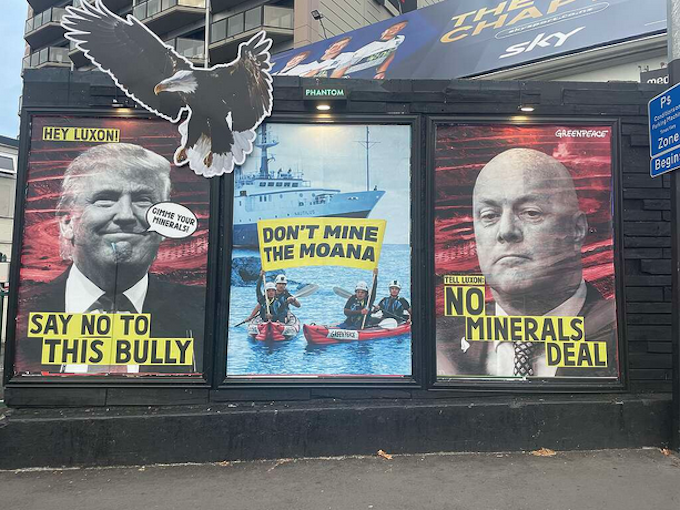
- No minerals deal with Trump petition
- Other critical minerals reports
The New Zealand government is currently negotiating a critical minerals deal with the Trump administration. Under “Project Vault”, the US is aggressively stockpiling minerals from both land and sea through a blend of private mega-capital and government-backed loans.
And at the heart of the deal with New Zealand is an anonymous metal, Vanadium.
Vanadium is mostly unknown to New Zealanders. But the US Department of Defense classifies it as a top-tier strategic mineral. Why? Because you can’t build a modern war machine without it.
It is the literal backbone of the high-strength steel used in missiles, armour-piercing projectiles, and the jet engines currently flying sorties in the Middle East.
Strange mining candidate
In New Zealand, vanadium isn’t commercially mined. Which, you would think, makes it a strange candidate to be at the heart of a trade deal. But dig a little deeper.
Vanadium is the mineral that would be mined by Trans Tasman Resources (TTR, wholly-owned by Australian mining company Manuka Resources) in the hugely controversial proposed seabed mining project in the South Taranaki Bight.
Iwi, Greenpeace, KASM and many others have actively opposed this project for more than a decade. It’s getting difficult to keep track of all of our wins, but we’ve beaten it through the EPA (including TTR’s withdrawal the second time), The High Court, The Supreme Court, and most recently, the Fast-Track process.
TTR has epically failed in Iwi relations, has been unable to convince experts, or even a government-appointed fast-track panel that it could mine without significant damage to the environment, or show how the mine would benefit people in New Zealand.
Despite a track record of abject failure to get seabed mining off the ground in Aotearoa, TTR and the government are hell-bent on starting it, no matter the consequences.
The industry arguments for mining the sea have long been around the need for supplying green tech, specifically batteries for renewables. But this has been widely dismissed as Greenwash, and several EV manufacturers have pledged not to use deepsea-mined minerals.
Certainly, the US administration is clearly citing munitions, not renewables in their desire for vanadium, making it clear that this is about war and superpowers.
Failing fast-track bid
TTR pulled out of its failing fast-track application on the day that the government announced its $80 million critical mineral fund, helping mining companies get access to the minerals found across the country.
The company’s CEO, Alan Eggers, said that the company was not walking away from its plans to mine the coasts of South Taranaki.
It represents the zombie project that keeps coming back from the dead. And it seems the government is planning to throw it yet another lifeline.
Now when we talk about seabed mining in the South Taranaki Bight, we are talking about turning the habitat of the blue whales into a quarry for the US military-industrial complex.
We cannot claim to be a nation of peace while actively digging up the ingredients for war, with an exclusive deal to provide them to the US.
The man tipped to become the next US ambassador to New Zealand, Niue, Samoa and the Cook Islands, Jared Novelly, has gone on record talking of his priorities for the Pacific region.
I had to laugh when I heard he told the US Senate he would be promoting a “free and open Pacific” while in office, which includes expanding the US security presence, and getting access to critical minerals.
Marshall Islands fallout
Let’s not forget the last time the US brought their military agenda to Pacific shores, testing nuclear weapons in the Marshall Islands for more than 15 years. The fallout of these tests, the displacement and horrific health impacts, are still being felt by the community decades later.
The Pacific, of which Aotearoa is part, is a region of peace. This was declared when the region aligned on making it a nuclear-free zone back in the 1980s (although French nuclear testing continued until the 1990s), and it remains an important common value.
But doing deals with warmongerers like Trump, signing up to supply the US with the very things they need to carry out their illegal wars, is something that should concern every Pacific nation currently being courted for mineral deals.
Aotearoa should, just as it has in the past, be a strong voice for de-escalation, not a military outpost providing the hardware for global instability. Do we want our legacy to be as a silent partner in the illegal wars shaking the globe?
This minerals deal means the future of Aotearoa’s seabed has become a test of whether we can still stand up to a superpower. We’ve beaten TTR’s seabed mining project at every turn so far, now we need to double down and get seabed mining banned for good, and ensure that no minerals deal is struck with Trump’s America.
Niamh O’Flynn is programme director of Greenpeace Aotearoa.