



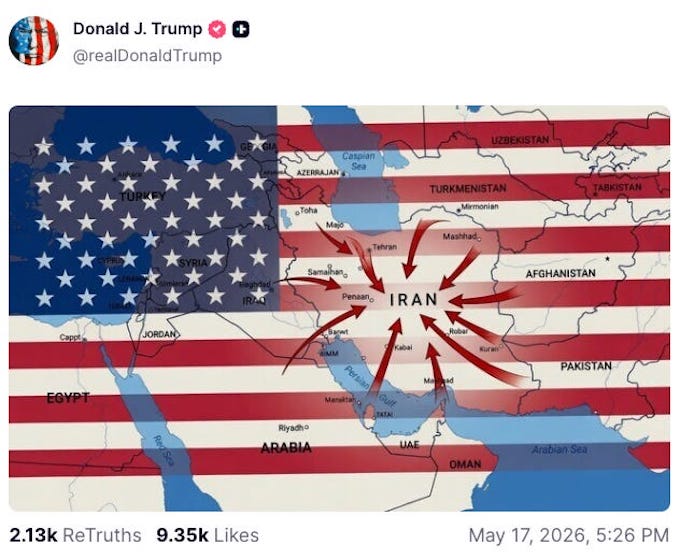
Tehran believes Trump will attack in the next 48 hours — and is ready to counter-escalate, writes US-Iran affairs analyst Trita Parsi.
ANALYSIS: By Trita Parsi
The Middle East is once again teetering on the brink as Trump appears poised to reignite war with Iran.
Press reports indicate he will convene military advisers on Tuesday, though my understanding is that both the meeting and the decision are likely to come sooner.
Over the past several hours, Trump has flooded Truth Social with a barrage of incendiary threats. While some of this may be theatrical brinkmanship designed to force Tehran into submission, sources in the Iranian capital tell me they expect the United States to resume hostilities within the next 48 hours.
- READ MORE: Iran says talks ongoing through Pakistan with a focus on ending war
- Israeli forces storm Gaza-bound aid flotilla off Cyprus
- Other Gaza and Iran “ceasefire” reports
We should first recognise that restarting the war amounts to an admission that Trump’s previous escalatory gambit– the blockade of the blockade — has failed. That, in turn, was itself an admission that the war had failed. Which was an admission that the threats of war in January had failed.
As I have argued before on my Substack, this relentless search for an escalatory silver bullet capable of bringing Iran to its knees is not unique to Trump; it has become a defining pathology of American Iran policy for decades.
Although negotiators have made meaningful progress on several fronts, talks have thus far failed to produce an agreement, largely because of irreconcilable differences over Tehran’s highly enriched uranium stockpile. And as Washington has come to realise that the blockade is backfiring, a new and dangerous dynamic has emerged: both sides now believe another round of fighting will strengthen their hand in the negotiations that follow.
As I argued in numerous interviews in January, Trump dramatically underestimated Iran’s strength, while hardliners in Tehran believed war would strengthen Iran’s leverage by exposing the illusion of Iranian weakness.
Vindicated assessment
In their view, the outcome of the conflict vindicated that assessment, leaving them increasingly confident — even emboldened — about what a second round of war could yield. I am told the new Supreme Leader belongs to this camp.
Moreover, just as Tehran believes Trump intends to prosecute the next war with far greater ferocity, Iranian planners are preparing a far more expansive and punishing retaliatory campaign, complete with new strategic objectives and targets.
First, Iranian officials increasingly describe the next war as an opportunity to inflict maximum strategic damage on the United Arab Emirates, citing Abu Dhabi’s active role in the previous conflict, its deepening and increasingly overt partnership with Israel, and its role in urging Trump to resume hostilities.
Tehran is likely to target American data centers in the UAE, a move that serves multiple purposes. Iranian officials argue that these American technology firms have already become participants in the conflict through their support for the Pentagon.
At the same time, Tehran sees an opportunity to cripple the UAE’s ambitions to become a global artificial intelligence hub — and, in doing so, potentially undermine Washington’s AI competition with China.
This points to a second defining feature of Iran’s strategy in a future war. Tehran believes Trump and his family hold financial stakes in many of these same technology ventures.
Targeting Trump’s personal business interests is a lever Iran conspicuously avoided pulling during the first conflict but now appears increasingly willing to use.
Logic straightforward
The logic is straightforward: Trump may tolerate damage to American strategic interests, but he is acutely sensitive to threats against his own financial empire. Raise the personal cost to Trump himself, the reasoning goes, and he may prove more willing to adopt a realistic negotiating position.
Third, Tehran is likely to show far less restraint if evidence emerges that other Gulf Cooperation Council states permit the United States or Israel to use their territory or airspace in a renewed conflict. The result would be broader and far more perilous horizontal escalation, with potentially catastrophic consequences for the global economy should critical energy infrastructure come under attack.
Fourth, the Red Sea is now in play. That would dramatically widen the geographic scope of the conflict while placing even greater upward pressure on already volatile oil prices.
Finally, Tehran is increasingly examining the possibility of severing the major submarine fiber-optic cable networks running beneath the Persian Gulf — arteries through which most GCC internet traffic flows, including billions of dollars in financial transactions. Iranian officials increasingly view this as a potential second Strait of Hormuz: a powerful new point of leverage capable of disrupting the global economy at enormous scale.
Renewed war is not inevitable. But when both sides convince themselves that another round of fighting will strengthen their negotiating position, the gravitational pull toward conflict becomes dangerously strong — however irrational the logic may ultimately be.
Trita Parsi is an Iranian-Swedish political analyst and foreign policy scholar specialising in Middle East geopolitics and US-Iran relations. He is the co-founder and executive vice-president of the Quincy Institute for Responsible Statecraft and founder of the National Iranian American Council (NIAC). Republished with permission.