
COMMENTARY: By Eugene Doyle
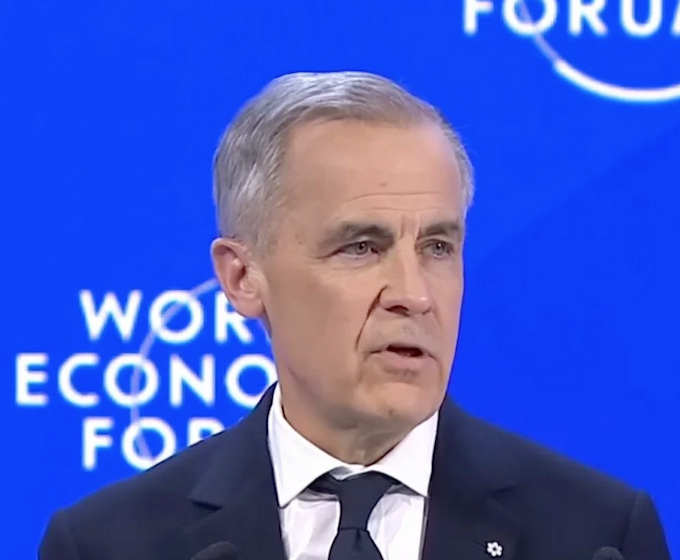
Canadian Prime Minister Mark Carney gave a speech at Davos this week that signals there may still be a leader in the West worth following.
“Middle powers must act together because if we’re not at the table, we’re on the menu,” he warned.
The Canadian PM was brutally honest about Western conduct in the world but shone a bright light on a better path forward.
At a time when the US has pivoted to a smash-and-grab deployment of hard power that now extends to its closest allies, Carney stepped up.
The speech wasn’t a rhetorical tour de force; it was better than that: it was a declaration by the leader of a major, middle ranked Western power that the snivelling compliance, the fawning and the keep-your-head-down approach that has typified the collective West’s response to Trumpism is at a strategic dead end.
We are at a moment which Carney defines as “a rupture in the world order”.
Nostalgia is not a strategy
“We know the old order is not coming back. We shouldn’t mourn it. Nostalgia is not a strategy,” Carney said.
At a time when the US is led by a criminal toddler who can’t stop whining about not getting the Nobel Peace Prize even as he attacks country after country, it is refreshing to encounter a leader who thinks and speaks like a statesman of the first rank.
“We are in the midst of a rupture, not a transition. Over the past two decades, a series of crises in finance, health, energy and geopolitics have laid bare the risks of extreme global integration.
“But more recently, great powers have begun using economic integration as weapons, tariffs as leverage, financial infrastructure as coercion, supply chains as vulnerabilities to be exploited,” Carney said.
A modern non-aligned movement
Carney did not reference the Non-Aligned Movement formed at the Belgrade Conference in September 1961 but it leapt to my mind when I heard him say:
“In a world of great power rivalry, the countries in between have a choice: compete with each other for favour or to combine to create a third path with impact.”
Carney also reaffirms the importance of the institutions that the West itself, including Canada, has severely weakened in recent years — WTO, UN and COP to name three. Russia, with its invasion of Ukraine, comes in a distant second in this regard.
With an assertive, aggressive US hell-bent on getting whatever it wants, Carney looks on the times we have entered with much-needed clarity. His call is for an alliance of middle powers.
In a word: collectivism.
The Non-Aligned Movement (NAM) and what Carney is proposing have similarities, particularly structurally, but also significant differences, particularly ideologically.
Not least Carney is a reformer and not at heart an anti-imperialist. He is the former head of both the Bank of England and the Bank of Canada and will not be seen in a Che Guevara t-shirt any time soon.
As with the NAM, however, Carney advocates collective leverage, resistance to client-state dependency and using internationalism to resist divide-and-rule by great powers.
“When we only negotiate bilaterally with a hegemon, we negotiate from weakness. We accept what is offered. We compete with each other to be the most accommodating. This is not sovereignty. It’s the ‘performance’ of sovereignty while accepting subordination.”
The giants who formed the Non-Aligned movement were Josip Broz Tito (Yugoslavia), Gamal Abdel Nasser (Egypt), Jawaharlal Nehru (India), Kwame Nkrumah (Ghana), and Sukarno (Indonesia). They gathered nations around the “Five Principles of Peaceful Coexistence”: mutual respect for territorial integrity and sovereignty, non-aggression, non-interference, equality and mutual benefit, peaceful coexistence.
In a nutshell: the polar opposite of the Western Rules-Based Order. Carney’s speech echoed many of the same sentiments.
“The powerful have their power. But we have something too — the capacity to stop pretending, to name reality, to build our strength at home and to act together.
“And it is a path wide open to any country willing to take it with us.”
Brilliant. But converting a speech into a movement that mobilises countries in an effective way requires commitment and resources we need to see emerge at pace.
In the 1960s and 70s, it was about small and middle powers navigating a course between two superpower blocs — a passage between Scylla (Soviet Union) and Charybdis (United States). Today we all must navigate the rough and rowdy world of the US, China and a resurgent Russia.
Canada’s astonishing resistance to the Empire
What is astonishing is that this time around, the impulse to rally together comes not from a socialist country like the former Yugoslavia or a “black Third World country” (in 1960s parlance) like Tanzania, but from the beating heart of the white-dominated Western world – from Canada, one of the capitals of the Western empire. My, how times have suddenly changed.
This should act as shock therapy to somnolent countries like Australia and New Zealand who cleave to a past that no longer exists. Carney has shown the power of looking at the world through untinted lenses (though Macron did look pretty cool in Davos in his blue sunnies).
A rare moment of honesty about Western conduct
I don’t recall a Western leader being so open about the ear-splitting hypocrisy and double-dealing of the West. Most impressively, Carney gives a clear signal of what needs to be done to survive in this world of jostling hegemons.
More submissive leaders like Christopher Luxon of New Zealand and Australia’s Anthony Albanese should take careful note because, as Carney says, we are at a turning point in the world.
Carney, who previously mumbled his way through issues like Venezuela and Gaza, made a valuable contribution to confronting the desolation of reality:
“First it means naming reality. Stop invoking ‘rules-based international order’ as though it still functions as advertised. Call it what it is: a system of intensifying great power rivalry where the most powerful pursue their interests using economic integration as a weapon of coercion.”
In time, this may open the door to Truth and Reconciliation. The genocide in Gaza is an example par excellence of the falsity of the rules-based order; Venezuela’s recent rape by the Americans, greeted with shuffling indifference by the West, traduced international law. The lawless bombing of Iran, the starvation of hundreds of thousands of Yemeni civilians in a blockade imposed by Saudi Arabia and armed by the US and UK are just a few of many such examples.
“We knew the story of the international rules-based order was partially false. That the strongest would exempt themselves when convenient. That trade rules were enforced asymmetrically. And we knew that international law applied with varying rigour depending on the identity of the accused or the victim,” Carney said.
Noting the standing ovation Carney received, the threat to Greenland has clearly acted on the Western countries as a shock therapy that the Gaza genocide, the bombing of Iran and the attack on Venezuela failed to deliver.
Carney stands on the shoulders of giants
I would point out that former leaders like prime minister Helen Clark of New Zealand have been arguing along these lines for years, advocating, for example, for a nuclear free Pacific and recommending “that we always pursue dialogue and engagement over confrontation.”
Warning that Trump was too unstable to be relied on, she told a conference in 2025 that New Zealand “should join forces with other countries across regions who want to be coalitions for action around these issues, not just little Western clubs.”
I’ll give the last word to the late Julius Nyerere, first President of Tanzania, from a 1970 speech to the Non-Aligned Movement. It expresses a worldview in accord with Carney’s speech but which is the polar opposite of 500 years of Western conduct from Christopher Columbus to Donald Trump:
“By non-alignment we are saying to the Big Powers that we also belong to this planet. We are asserting the right of small, or militarily weaker, nations to determine their own policies in their own interests, and to have an influence on world affairs which accords with the right of all peoples to live on earth as human beings equal with other human beings.
“And we are asserting the right of all peoples to freedom and self-determination; therefore expressing an outright opposition to colonialism and international domination of one people by another.”
Eugene Doyle is a writer based in Wellington. He has written extensively on the Middle East, as well as peace and security issues in the Asia Pacific region, and he contributes to Asia Pacific Report. He hosts the public policy platform solidarity.co.nz