
COMMENTARY: By Saige England
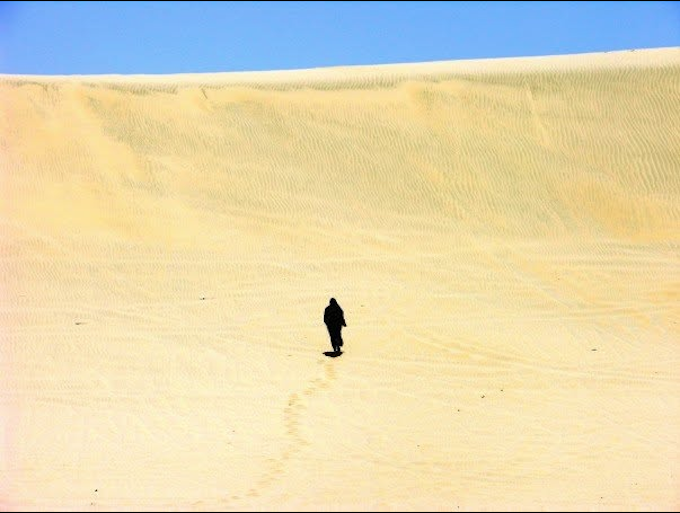
This is a photo of me in the desert in Saudi Arabia 19 years ago. Was I covered? You bet.
I recall receiving a letter from a white feminist friend who told me my feminism must have been skewed by my experience in the Middle East.
Actually I met so many feisty feminists in the Middle East and I found a Middle East very different to the one I’d seen on the mainstream media.
My Middle East was a Middle East of moons and stars and tents and light garments draped like tents. My Middle East was the Middle East of palaces in the desert and mysterious winds.
Were there things that were wrong there? Yes. Just as there are in the US. But I saw and experienced much that was good. I rose in my employment, I managed and supervised and I met other women who were managers and supervisors.
As one Italian woman said: “It is easier for me to rise as a woman here.” I found that too. I found work easily in Qatar. I found it difficult here in Aotearoa to rise, no matter how well I did in terms of qualifications and awards.
New Zealand is only free if you don’t write about certain matters. If you don’t rock the boat. If you aren’t too much — too pro the environment or too pro indigenous rights. I still write about those aspects of life.
Relatively speaking
There, in Qatar, I worked with women who were covered and women who were uncovered. Relatively speaking.
I met women who covered from choice. I met women who were forced to cover (and that is wrong). I met women who were conservative and who didn’t cover. I met feminists who covered. I met women who wore the veil and the abbaya because they were radical — it was a way of giving the finger to the US.
Speaking of the US — US military bases were everywhere. The US had invaded Iraq. The military wives often drank a lot.
I interviewed US soldiers and found them worrying. Their education had been conservative, fundamentalist, narrow.
Many US soldiers were bright but they supported the US nuclear bombing of Japan, they supported nuclear everything. They thought all Arabs and environmentalists were terrorists.
When I first arrived, the Twin Towers had been bombed and I’d heard lots of reports about Al Qaeda. I used to leap into taxis vowing that I was not American. I was told that “it is ok, lady, we aren’t like those crazies” (people who blow up buildings).
The people I met were peaceful hospitable people. The women I met wanted careers.
Issues were the same
One of my friends, an Aussie, was a psychologist. I asked her if the problems her female clients faced were different — did Western expat women have different issues to Qatari or Lebanese or Egyptian or Pakistani women? Nope. The issues were all the same: “Is my husband cheating on me?”, “Are my children OK?”
When I arrived in Qatar the divorce rate of the local population was 51 per cent. Many young women chose not to marry.
In Qatar and Bahrain women covered, or didn’t, by choice. Some told me they wore the garments because they were easy and affordable. They could dress up after uni but they could just grab the robe by day. Some wore the veil on a bad hair day. Oh, there were a raft of reasons.
What saddens and sickens me is that I’m often not believed about this. I’ve been accused of betraying the feminist cause. The kind of feminists who don’t ask other women what they want. Those kind of feminists tell me I compromised.
But I felt the compromise when I attended a tupperware party here where the whole room except me launched into racist jibes about Indians. Ye Gods, spare me.
Back here, a few years back, I befriended Fatin who came from Singapore and who lived here in Aotearoa while studying. Fatin was bright and so lovely, so open and kind and free. A poet. She read 30 books in a year. She loved the author, Elif Shafak, a favourite author of mine. We bonded.
But Fatin was often abused in Ōtautahi by people who told her she shouldn’t be wearing the veil or the robe. They felt sorry for her, they said. Fatin said she felt sorry for them for judging others.
‘No judgment’ . . . a favourite
“No judgement” was one of Fatin’s favourite sayings. I learned so much from her. Sadly, she had to leave because she couldn’t gain a residency visa.
Women wear clothing for all sorts of reasons. What concerns me far more than what we wear is unnecessary body surgery. I saw boob jobs and lip jobs, and jaw-broken jobs in the Middle East just as I see them in the West.
I see women manufacturing themselves as products to please men. It makes me sick. Don’t do it. Don’t. Be yourself.
I wore the robe and the veil that hot day in Saudi because it kept the sun and the hot dry wind off my face and body. Like so many women, I was naked underneath. I felt that warm wind caress me.
I loathe the men who make women wear what they don’t want to wear. I’ve always resisted that. I didn’t throw out my hippy skirt when my ex wanted me to, I kept it, cherished it, I sparkled and shone. But I’ve also felt shamed by women who tell me I shouldn’t bother using a towel to shield myself while getting dressed on the beach or while camping.
My choice sometimes is to cover. Sometimes the robe feels good. I like the feeling of having my own wee house and being safe underneath. That is my choice. If I lived differently or had different experiences or had never been abused in this Western world perhaps I would think differently but that is my experience.
I fight the predators in my own way. And I know that freedom is not here yet.
Western abuse insidious
The abuse in the West is insidious. It is often denied. We believe we are free but we are not free. There is another form of control.
Women are bombarded with social messages that tell us to straighten our noses or lighten our skin. They are everywhere.
They appear on my feed as they probably appear on yours.
I’ve aged in an age where I’ve watched young women pout and lie and become “influencers” selling all sorts of fake garbage and sadly, faking themselves. It isn’t good for their mental health. It isn’t good at all. Are they free? I don’t think so.
How do we unpick the social fabric of inequity especially when it tells us we are free.
Freedom is the freedom to choose. Freedom is the freedom to vote. Freedom is the freedom to use our voices and to wear what we want to wear. Freedom is the freedom and the choice not to turn ourselves into objects for the pleasure of others.
Freedom is the freedom to not be raped or abused or killed. Freedom is the freedom to love and learn. Freedom is the freedom to work — to work outside or inside and not be pressured to do both.
Women deserve freedom.
Saige England is an award-winning journalist and author of The Seasonwife, a novel exploring the brutal impacts of colonisation. She is also a contributor to Asia Pacific Report.