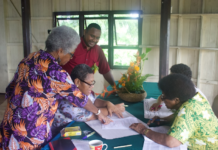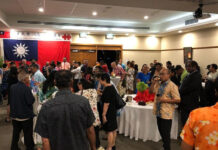





Last week a packed meeting in Lyttelton denounced the takeover attempt by DP World of the Lyttelton Port. This is a local, regional, national, and international issue as Saige England explains the implications in her second article about the issue.
COMMENTARY: By Saige England
Auckland rejected DP World.
Environmental campaigners and campaigners for protecting assets, and campaigners for workers rights, believe Christchurch needs to do the same.
This updated commentary on an important local, regional, national and international issue, includes environmental campaigner, Sara Campbell’s full speech. It also gives more background to the company toying with the port of Lyttelton.
- READ MORE: A tale of power being taken from the people and handed to predator companies — Saige England
- DP World back story: From ports to proxy armies – tracing the UAE’s regional footprint in Sudan, Yemen and the Horn
- ‘He is one of us’: Inside Jeffrey Epstein’s alleged conversations with Emirati billionaire
- Epstein flipped Israel’s Gaza-tested biometric scanners into Nigeria ports deal for UAE
- Dubai-based DP World replaces chief named in Epstein files
- Sultan took peep at Auckland Ports
Back in 2009 (a year after Jeffrey Epstein was convicted), when he was still mates with the convicted sexual abuser and human trafficker, DP World’s head, Sultan Ahmed bin Sulayem, was nosying around the port of Auckland.
A few years later, the former DP World Group chairman and CEO, Sultan Bin Sulayem, and by then, convicted sex offender Epstein, got down to some buddy boy business with the Zionist state of Israel.
“I am in Berlin with the Israeli defence minister, I have told him about you and Sheik Mohamed,” Bin Sulayem wrote to Epstein in March 2012. “He would like to meet you both.”
And in another email Epstein told Sultan bin Sulayem (DP World chairman and chief executive up until February this year) that he “loved the torture videos”.
Parasitic corporations
Corporations like this are parasites. These sharks circle and you don’t see their fins until it is too late.
Let their comms people and lawyers (on their mega pay scale) argue as much as they like, removing one person does not clean up this corporation’s reputation.
DP World has a poor history in Africa, and Queensland, so while it might make the right initial noises it will not in the long-term pay heed to Te Tiriti O Waitangi.
The Sultan resigned from the company in February 2026. But if this was a clean company it would not have a dirty history.
All these deals to take over public assets are dirty aren’t they? Deals to take over public assets take from the people, they don’t give to the people.
They represent short-term gain (for those at the top) for long-term pain.
Who will benefit in the long run? Not the people. Not the port. Not the whenua. Not the moana.
Spin propaganda
Big corporations pay huge salaries to communications people to spin propaganda. I could have worked in that field myself, could have earned a big salary spinning dirty stories and making them seem good.
I refuse to be bought because I believe that the only way to save our environment is to keep our assets in public ownership — owned by the people for the people.
We need legislation that removes the ability of any company to take control of the port.
We need legislation that removes the ability of any company to own our public assets.
Capitalism. Colonialism. The money trail leads to destruction.
This takeover bid by DP World for the Lyttelton Port was engineered when one of the worst players in the world, Epstein’s torture-loving mate, was at the company’s helm.
And the company promoted that man all the way to the top. It can’t possibly claim it did not have a clue.
Exploiting people
The company, like colonial companies of the past, controls ports, takes resources. This international company will argue that it does not, but it does exploit people.
Not the people at the top — of course not — it exploits the people on the ground. It pushes them out.
If this company comes to town people will be replaced by AI. It will claim that will make the workplace safer, because of automation. Goodbye jobs.
And as it avoids taxes by investing offshore in tax havens the public carries the burden of costs . . . hello rate hikes.
This is a local, regional, national, and international issue.
Here is Lyttelton local and environmental campaigner Sara Campbell speaking about the environmental risks of privatising our port.
“I don’t think I have a lot to add; the fundamentals of private ownership and DP World’s track record have already been covered . . . and the same system that treats workers as disposable — with low wages, unsafe conditions, and no say — is the same system that treats our water, our forests, and our air as disposable,” she says.
Aggressive profit-seeking
“It’s a system that puts aggressive profit-seeking ahead of the wellbeing of communities, workers, and the environment.”
Saige England: A tale of power being taken from the people and handed to predator companies
DP World has an appalling environmental record.
“For example, according to reports by the Global Initiative Against Transnational Organised Crime, the UAE — specifically the emirate of Dubai, the home base of DP World — acts as a major global transit corridor and hotspot for environmental crimes. It serves as a massive hub for illegal wildlife and flora trafficking.”
She points out that the drive to maximise shareholder profit strips away the ability of the public to lead healthy lives.
“The cost of living keeps climbing while oil companies, power companies, supermarkets, and banks make record profits. Often price-gouging in a crisis.”
Most of the profits are sent offshore to shareholders, she says.
”We spend a lot of time in politics asking how we break up duopolies and oligopolies that take so much from us.
Monopoly asset
“Well, our port is a monopoly asset. There’s no other port in our region this size. It’s not feasible to build another just to keep freight prices down.
“So if DP World takes over operations, their first priority will be shareholder profit.
”That means our freight prices go up. And when freight goes up, the price of almost everything goes up too.”
Campbell says easing the port isn’t just about one contract. It’s a gateway to even more privatisation.
“DP World’s own strategy is to acquire the whole supply chain. They call it ‘an end-to-end service’.”
But the reality is a privately owned foreign company seizing profit and control across our entire logistics network.
“By the time the lease is up, they’ll be so entrenched it’ll be almost impossible to operate without them. And that gives them even more power to lobby for the next contract.
Promises mean little
“Whatever promises DP World puts in the first contract don’t mean much to me,’ says Campbell.
“They’re far better resourced than we are to fight in court and once given a foothold their lobbying power increases over time.”
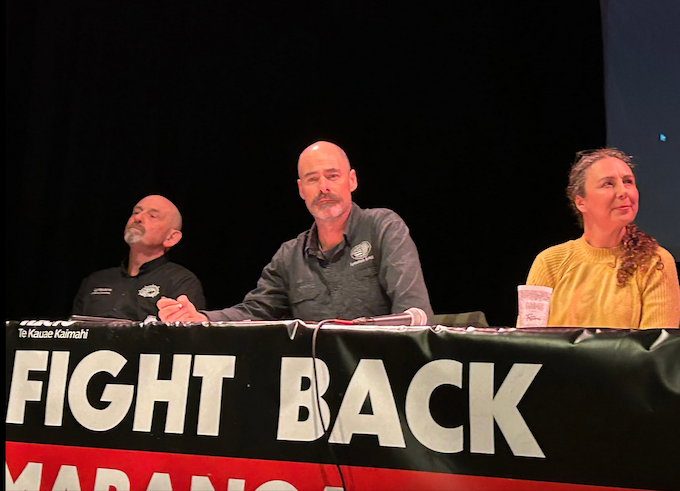
There will never be an easier time to stop DP World becoming entrenched in our country than now, Campbell says.
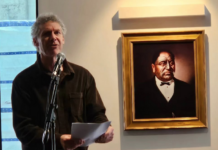
Like other speakers at the public meeting in Lyttelton organised by New Zealanders for a Democratic Economy, she expressed anger at the port management LPC and CCHL, saying: “who the hell do they think they are?”
“Can someone please remind them we own the port, not them. How dare they proceed with a seven-hectare land reclamation without our consent. A decision that has significant, negative impacts on the ecological health of our harbour. We couldn’t even hold our elected councillors accountable, because the decision didn’t cross the council table.
“Now, LPC is proposing a $800 million expansion with further land reclamation and I fear we will shut out of that decision too.”
She pointed out that the world is rapidly warming, that the last 11 years have been the hottest on record, and Aotearoa now has the highest proportion of threatened species in the world.
Immense pressure
“And right here in Whakaraupō, the ecology is under immense pressure. This harbour is home to our nationally vulnerable Hector’s dolphins.”
The people need to have the right to demonstrate their priorities.
“Priorities for our community, for our workers, and for the ecosystem — not for a corporate balance sheet.”
Campbell says she believes the Lyttelton deal can be stopped but it does not stop there.
“I believe we can change how the port is run. To a model where we’re actually at the table.
“Where mana whenua and the unions are strategic partners in decision making.”
Saige England is a humanitarian journalist and activist for community and the environment. She was present at the Lyttelton public meeting last week in support of community action. She is also a contributor to Asia Pacific Report.
Yesterday Marnie Ainsworth (from Keep Our Assets) and others made submissions to the Christchurch City Council.
- More action is being organised by New Zealanders for a Democratic Economy and Keep Our Assets