

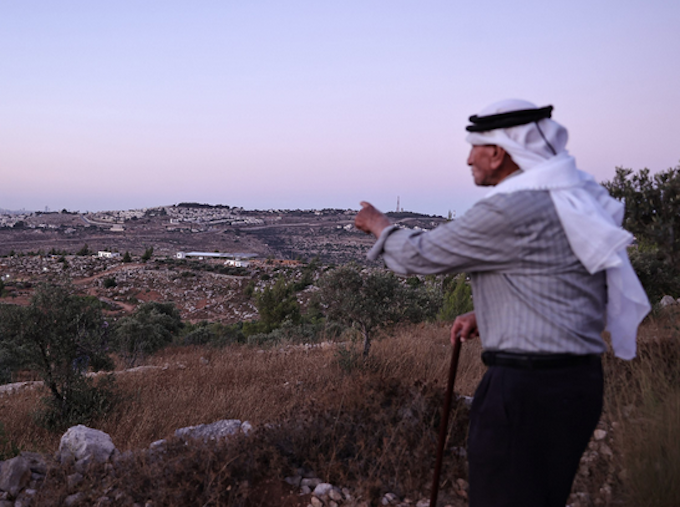
What is happening right now is [the] erasure of humans, trees and stones, and anything that is Palestinian, by settlers under the support of the military.
— Muntasir al-Maliki, a resident of Kufr Malik
Palestinian Bedouins lived for generations in the occupied West Bank village of Khirbet Zanuta (Zanuta), sustaining themselves through herding, farming and dairy production.
The village was designated as part of Area C under the 1995 Oslo II Accords, placing it under full Israeli military and administrative control.
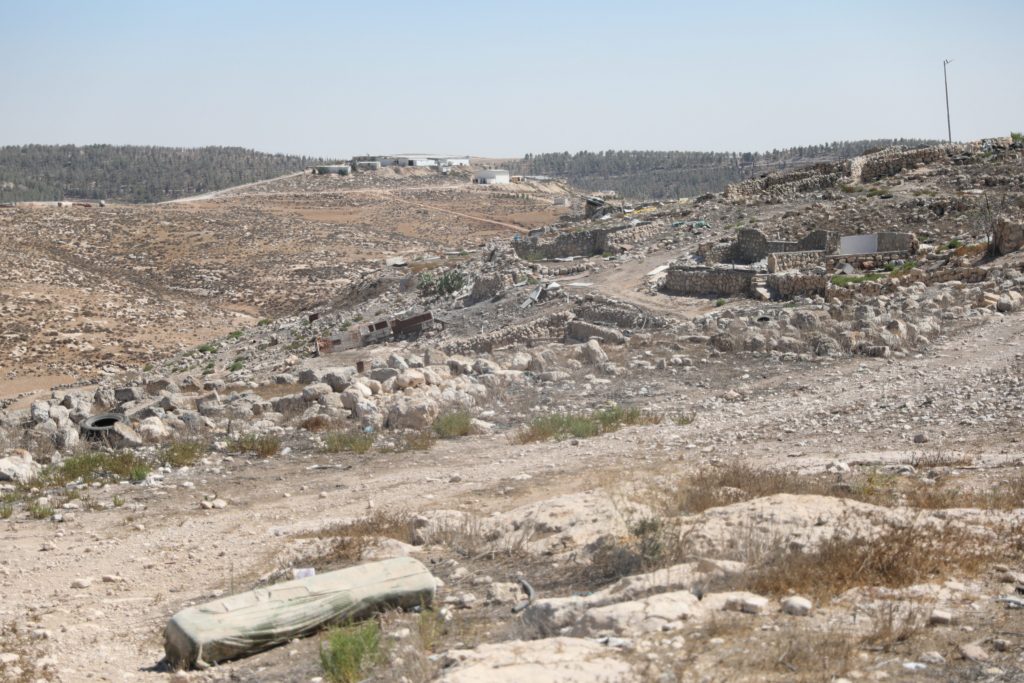
Today, Zanuta is being eaten away by Israeli outposts and settlements and destroyed by state-sponsored violence and terror.
- READ MORE: Amnesty International accuses Israel of ethnic cleansing in the West Bank
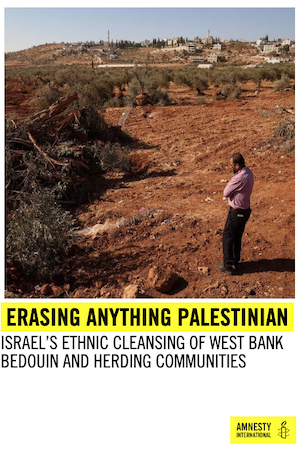
- Erasing anything Palestinian: Israel’s ethnic cleansing of the West Bank Bedouin amd herding communities
- Other Gaza genocide, West Bank reports
Just 1km from Zanuta, Israeli settlers established an illegal outpost known as Meitarim Farm in 2021.
The settlers soon began a sustained campaign of violent attacks and threats against Zanuta’s residents.
They set fire to the villagers’ tents and classrooms, broke into their homes, beat them with rifles, threw stones at them, smashed their solar panels and windows, emptied their water tanks and pumped sewage onto their farmland.
The story of Zanuta reflects the fate of dozens of Palestinian Bedouin and herding communities already displaced or at imminent risk of displacement in Area C.
This report lays bare the scale and severity of the ethnic cleansing campaign targeting these communities, carried out in a context of apartheid and unlawful occupation and against the backdrop of an ongoing genocide in the occupied Gaza Strip.
The report also demonstrates — contrary to what too many in the international community suggest — that the campaign is not the product of “rogue” settlers, settlers’ organisations or “extremist” government ministers.
In other words, settler violence is not an aberration but an integral part of an organised state policy.
The escalating violence in Zanuta followed decades of systematic discrimination by the Israeli authorities, including constant threats of home demolitions to force them to leave, a common practice adopted by Israel to enforce its system of apartheid.
Zanuta’s residents repeatedly reported settler attacks to the Israeli police, seeking protection, but no action was ever taken.
When the settlers from Meitarim Farm again raided the village on 21 October 2023, this time accompanied by Israeli forces, and threatened to harm residents if they did not leave, the community knew they had no choice but to flee.
In a rare move, in July 2024 and February 2025, Israel’s Supreme Court ordered the police and military to facilitate the community’s return and protect residents from attacks.
The Israeli police and military ignored both rulings. Every attempt by residents to return was met with continued settler violence and the acquiescence of Israeli forces.
Digital evidence, interviews and satellite imagery from 30 March 2025 confirm the outcome: Zanuta no longer exists — it has been forcibly depopulated and extensively destroyed.
Meanwhile, the settlers received state backing to intensify their violent campaign. In April 2025, two Israeli ministers — Bezalel Smotrich and Orit Strock — held an event at Meitarim Farm where they distributed 19 state-funded all-terrain vehicles (ATVs), cameras and night-vision equipment to settlers living in outposts in the Hebron area.
Finance Minister Bezalel Smotrich explained why:
“The heroic and pioneering settlers who live here are doing Zionism, and they need security… We are here to build with them and to settle the land…”
… while praising settler land seizures and emphasising the role of ATVs in taking over Palestinian grazing land.
The report demonstrates that the ethnic cleansing campaign in Area C is state-sanctioned, state-driven and state-implemented; it seeks to accelerate the Israeli government’s annexation agenda and settlement expansion through war crimes and crimes against humanity.
As such, the report’s conclusions demand that the international community fully confront and name the Israeli state-driven project, and act decisively to prevent the destruction of Palestinian communities and the annexation of the West Bank.
Amnesty International’s legal analysis
Zanuta is one of 117 predominantly Bedouin and herding Palestinian communities in the occupied West Bank that have faced either full or partial displacement due to settler attacks and related access restrictions between January 2023 and April 2026, according to the United Nations Office for the Coordination of Humanitarian Affairs (OCHA).
In total, approximately 5910 people were forced to leave their homes, leaving behind them vast, depopulated areas. Most of the affected communities lie in Area C, which comprises over 60 percent of the West Bank, and has been central to Israel’s territorial and demographic quest for domination for decades because of its natural resources, vital grazing and agricultural land and small Palestinian population.
In late December 2022, Benjamin Netanyahu’s Likud party formed Israel’s 37th government in coalition with two ultra nationalist and religious political parties.
While state-supported settler violence has been a growing concern over the past three decades for Palestinian communities in the West Bank, there has been an unprecedented surge in the scale and intensity of attacks since then.
Tactics became particularly aggressive after 7 October 2023 when Hamas and other Palestinian armed groups attacked southern Israel, killing approximately 1200 people, mostly civilians, and forcibly taking 251 others to the Gaza Strip where they were held as hostages and subjected to abuses.
Amnesty International found that these acts constituted war crimes and crimes against humanity.
In response, Israel launched a military offensive on the occupied Gaza Strip of unparalleled magnitude, scale and duration and inflicted catastrophic levels of destruction, displacement and starvation on Gaza’s civilian population, committing genocide against Palestinians in the Gaza Strip.
While most global attention focused on Gaza, Israel intensified its abusive policies and practices against Palestinians in the occupied West Bank, with government officials openly encouraging and supporting settler attacks.
Displacement and dispossession: war crimes and crimes against humanity
Ideologically motivated Israeli settlers have terrorised Palestinian communities through repeated raids on their homes and villages, beatings, death threats demanding they leave, persistent harassment, the destruction of property and village infrastructure, cutting off access to water and electricity, and theft of their livestock and belongings.
These practices deliberately intensified an already coercive environment aimed at forcibly displacing and dispossessing Palestinians, manifested in state policies of access restrictions, home demolitions and settlement expansion. Palestinians who have attempted to return have found their villages fenced off or destroyed, or have faced renewed settler attacks, harassment and intimidation, forcing them to flee again.
These settler attacks are the direct result of a state policy that integrated and enabled the settler movement’s vision of “Greater Israel”, an ideology that treats the area extending from the Mediterranean Sea to the Jordan River, including the entirety of the Occupied Palestinian Territory (OPT), as an integral part of Israel.
Senior Israeli officials in the 37th government have fully embraced this vision and explicitly encouraged, facilitated and condoned settler violence against Bedouin and herding communities as a deliberate tool of displacement with greater openness and force than their predecessors, as they pursued their goal of formally annexing the West Bank under Israeli law.
Since 1967, Israel has been enforcing its occupation through military orders and regulations.
The situation in the OPT, including in Area C of the West Bank, is therefore primarily governed by international humanitarian law (including the rules of the law of occupation); and international human rights law. The same international norms apply to occupied East Jerusalem, illegally annexed by Israel since 1967, despite Israel’s attempts to separate it from the rest of the West Bank through a regime of fragmentation and legal segregation.
In this report, Amnesty International presents conclusive evidence that these violations, perpetrated between January 2023 and December 2025, amount to the war crime of unlawful deportation and transfer and the crime against humanity of forcible transfer or deportation, committed as part of a policy to ethnically cleanse Area C of the occupied West Bank by forcibly displacing Palestinian Bedouin and herding communities and expanding illegal settlements at their expense.
Amnesty International uses the term ethnic cleansing in this report to describe a deliberate pattern of conduct aimed at permanently removing Palestinian Bedouin and herding communities from specific areas of the occupied West Bank, in particular Area C.
While ethnic cleansing is not recognised as an independent crime under international law, Amnesty International uses the term in line with the UN Commission of Experts on Former Yugoslavia’s definition, which describes it as “a purposeful policy designed by one ethnic or religious group to remove by violent and terror-inspiring means the civilian population of another ethnic or religious group from certain geographic areas”.
While this report covers the period between December 2022 and December 2025, these egregious crimes are ongoing and are part and parcel of Israel’s system of apartheid, as shown by Amnesty International’s continuous documentation and reporting of the situation on the ground.