


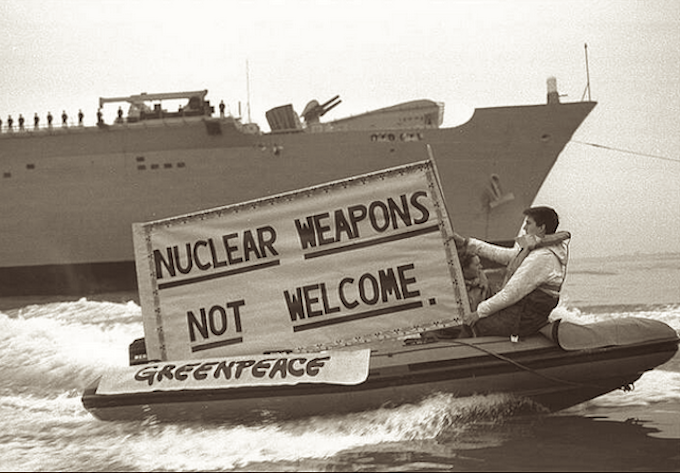
Prime Minister Christopher Luxon insists the government is not going to review New Zealand’s nuclear-free stance, and doing so would be detrimental to relations with other countries, according to a former defence minister.
However, the opposition is sceptical of the government’s commitment to the four-decade-old stance.
Defence Minister Chris Penk, speaking at a security summit in Singapore last week, said it would be helpful to have a conversation about nuclear propulsion, to the extent that it was different to nuclear weapons.
There was no policy along those lines, Penk said, but it would be “helpful” for the country to have “a conversation”, given Australia was slated to acquire three nuclear-powered submarines as part of the AUKUS deal.
“Traditionally the New Zealand public has been very sceptical about nuclear weapons, which might be an interesting conversation in terms of the extent to which that’s different to nuclear propulsion.”
New Zealand does not allow nuclear-propelled vessels into its waters, whether they carry weapons of the sort or not.
The Labour Party said the government needed to clarify its position. Coming after Christopher Luxon’s comments last week to the house supporting nuclear energy, the government seemed to be signalling a change of policy, Labour leader Chris Hipkins said.
‘Non-negotiable’
After becoming prime minister in 2023, Luxon said the nuclear ban was “non-negotiable”.
A spokesperson for Luxon at the weekend said that had not changed.
Asked on RNZ Morning Report on Tuesday if he thought it would be a “helpful” conversation to have, Luxon said “no”.
“Our nuclear-free position, I think, has had massive support across the country and it won’t be changing, and it certainly won’t be changing while I’m prime minister.”
Luxon suggested Penk “could have expressed himself better, but ultimately made the right point that there won’t be any change”.
Luxon said the question sometimes came up in relation to AUKUS, of which New Zealand had considered joining in a non-nuclear capacity.
“Australia doesn’t get its homegrown submarines until the mid-2040s and then it’s delivered through the 2050s and the 2060s,” Luxon noted.
‘No change, period’
Responding to a suggestion this meant a conversation would eventually be needed, Luxon said there was “no change to our nuclear-free position, period”.
ACT MP Cameron Luxton on Tuesday told RNZ’s First Up there were no plans to change New Zealand’s almost four-decade nuclear-free stance.
“Chris Penk’s made those comments and… the prime minister has quite clearly said that’s not on the table. And I think that’s a fair enough position,” he said.
“New Zealand has got a tradition of nuclear-free status. It’s not something we should be rubbing in the face of the world, but it is something that we should be respectful of that is a part of our tradition.”
The country has formally been a nuclear-free zone since the passing of the New Zealand Nuclear Free Zone, Disarmament, and Arms Control Act 1987. The closest it came to reversing course was when then-leader of the National Party, Don Brash, reportedly told US officials in 2004 the ban would be “gone by lunchtime” should his party be elected in 2005.
Former Defence Minister Wayne Mapp, who served under Prime Minister John Key, said any conversation was a “non-starter” and potentially even detrimental to our global relationships.
“Australia and New Zealand have already had a conversation on that,” he told Morning Report on Tuesday. “Australia does not expect to send its submarines into New Zealand ports. They know full well our policy.
“I recall from 2006 when John Key became our leader, one of the things we did as a party was to remove all doubt as to where National stood on this issue. And when we did that, our relationship — particularly with the United States — improved because they weren’t sort of niggling at us all the time to sort of review the policy.
“Once they knew where we stood we could then talk about the things we agreed on, not the things that we disagreed on.”
No nukes, no AUKUS — Labour
It was nothing new for the National Party, which had wanted to get rid of the nuclear-free policy for many years, Hipkins said.
“This is just the National Party doing what the National Party does. Don Brash said that if he’d been elected prime minister, nuclear free would be gone by lunchtime… this is just another example of that.”
Hipkins reaffirmed Labour’s position that New Zealand would not be part of AUKUS.
“It’s ultimately designed to bring nuclear power submarines into the Pacific — we don’t support that,” he said. “We don’t see that aligned with our strategic interests, and we don’t think New Zealand should be part of it.”
Pulling our weight
Penk said New Zealand was on track to meet its goal of doubling the defence budget to 2 percent of GDP. The war in Iran had highlighted the “perils of instability” and could lead the government to bring forward the timeline for reaching that goal, he said.
This came after US Secretary of War (formerly Secretary of Defense) Pete Hegseth accused New Zealand — among other nations — of “freeloading” off the US.
Luxon said he disagreed with Hegseth’s comments, and that New Zealand’s defence spending decisions were in its own interests and “not frankly for anyone else”.
Hipkins told Morning Report it backed the coalition government’s boost to defence spending.
“Most of what they’ve set out in the defence budget is stuff that Labour agrees with that largely builds on things that we were doing in government. We do have an aging defence force fleet of equipment. We do need to be doing more in that area.”
ACT’s Luxton backed the hike in military spending.
“We cannot continue to live down here in the beautiful South Pacific and not be aware of what risks and issues are developing in the world,” he told First Up.
“New Zealand needs to play our part, and that’s what an uplift in spending is doing… We’ve got a massive wet blue continent to keep an eye on, an EEZ that extends a long way out and covers a lot of the Pacific Ocean surface that we’ve got to monitor. So this is something that is not before time.”
‘Acting like partner’
He said as a partner in the ‘Five Eyes’ intelligence network, New Zealand needed to be “acting like a partner”.
“We are not descended from fearful people. We have played a proud part in New Zealand and the history of the world defending liberal values, freedoms and decency. And we have to do the same in our world today because it’s not just us today, it’s our nation’s future that we need to look after.”
Mapp questioned whether such a large increase in spending was desired or even necessary. Hegseth wanted nations to spend 3.5 percent of GDP.
“To be honest, a lot of nations in the Asia-Pacific are not going to reach 3.5 percent because circumstances do not warrant it. This particular administration in the United States, that is, how long are they going to be around for with that level of expectation?
“The Asia-Pacific is in a different set of circumstances to Europe, for instance, where they have a major ongoing war, Ukraine, and it obviously leads to a different set of expectations. Our situation is very different to that.”
He did however note New Zealand had a larger than usual area to patrol with only two frigates.
“A lot of the time that means we have zero frigates.”
Hipkins dismissed Hegseth’s demands.
“New Zealand should be judged based on the contribution it makes around the world, not how much we spend.”
Penk last week said replacement options for the two aging vessels were being looked into.
This story was first published on