



COMMENTARY: By David Robie, author of Eyes of Fire
The legacy of nuclear testing in the Pacific is unfinished business. From the 1997 disappearance of journalist Jean-Pascal Couraud to the 2025 return of the Rainbow Warrior, these stories are part of a continuous struggle for justice.
In the Pacific, the “Atomic Age” and the climate crisis are not competing issues, they are the same fight for habitability and truth. To face our future, we must first address the lingering shadows of the past.
In “French” Polynesia, there are concerns about the mysterious fate of former anti-nuclear investigative journalist Jean-Pascal Couraud, known as “JPK” (his byline), who was editor of the now closed Les Nouvelles de Tahiti newspaper.
Early in 2015, a judge upheld prosecution against three men accused of a kidnapping that led his death in Tahiti in 1997.
More than a decade earlier, JK’s family lodged an allegation of murder with the police following claims that he had been assassinated by a (now disbanded) local presidential militia. An investigating commission had alleged that three men, Rere Puputauki, Tino Mara and Tutu Manate, had abducted JK and dumped his body at sea.
- READ MORE: Other Eyes of Fire reports
- The Rainbow Warrior bombing 40 years on: re-energising for global peace
- Eyes of Fire website (Little Island Press)

Twenty two years later, the family are still waiting for justice, and fed up with France’s “investigation”. When the Rainbow Warrior bombing on 10 July 1985 is set against its broader political context in the Pacific, it can be seen that this event was much more than the dramatic, isolated episode against the Greenpeace flagship as portrayed by most New Zealand media.
An “Eyes of Fire” video project in 2015, which included more than 40 student journalists, also demonstrated the importance of a continuing interpretation of these events for the future of Aotearoa New Zealand and its citizens. The students looked back at the past, but were asking questions relevant to the present and future when they interrogated me and my Greenpeace colleagues involved in the Rongelap voyage.
My own baptism in French nuclear arrogance and perfidy was thanks to the late Swedish activist, researcher, and writer Bengt Danielsson, who was awarded the 1991 Right Livelihood Award for “exposing the tragic results… of French colonialism”. He and his wife Marie-Thérèse Danielsson wrote the classic and chilling books Moruroa, Mon Amour and Poisoned Reign.
In 2021, a French investigation team published a book and website that introduced new revelations about the nuclear testing programme and its health and environmental harm inflicted on Tahitians. The book, Toxique: Enquête sur les essais nucléaires français en Polynésie, by Sébastien Philippe and Tomas Statius, and the associated website Moruroa Files, were a forensic analysis of about 2,000 French government documents declassified in 2013.

Consistently lied about the tests
According to former Auckland University of Technology scholar Ena Manuireva, who was born in Mangareva (an atoll near the French nuclear testing sites of Moruroa and Fangataufa), these publications confirmed what Tahitian people already knew: “That since 1966, the French government has consistently lied about and concealed the deadly consequences of their nuclear tests, which they now seem to acknowledge, to the health of the populations and their environment.”
Following the third test after French nuclear bombs began in the Pacific, on 7 September 1966, local Tahitian lawmaker John Teariki challenged then French president Charles de Gaulle by saying: “No government has ever had the honesty or the cynical frankness to admit that its nuclear tests might be dangerous. No government has ever hesitated to make other peoples — preferably small, defenseless ones — bear the burden.”
“May you, Mr President, take back your troops, your bombs, and your planes.”
De Gaulle ignored the advice. And it took another 30 years and 190 further tests before France stopped its ruthless nuclear pollution in the Pacific.
France’s Atomic Energy Commission (CEA) was reported in early 2025 to have spent 90,000 euros in a big public relations campaign in a vain attempt to discredit the research in Toxique and the Moruroa Files, according to documents obtained by the investigative outlet Disclose.
The CEA published 5000 copies of its booklet, titled ‘Nuclear tests in French Polynesia: why, how and with what consequences’ and distributed them across Oceania.
The Rainbow Warrior bombing, with the death of photographer Fernando Pereira, was a terrible tragedy. But a greater tragedy remains in the horrendous legacy of Pacific nuclear testing for the people of Rongelap, the Marshall Islands and “French” Polynesia; associated military oppression in Kanaky New Caledonia; and lingering secrecy.
Nuclear powers have failed the Pacific
More than eight decades on, the “Pacific” nuclear powers have still failed to take full responsibility for the region and adequately compensate victims and survivors for the injustices of the past.
The Pacific Islands Forum (PIF), Melanesian Spearhead Group, other pan-Pacific agencies, and the Australian and New Zealand governments still have much work ahead. New Zealand and the PIF states should have vigorously supported the lawsuits of the Republic of the Marshall Islands in the International Court of Justice and the United States Federal Court last year. This was an opportunity lost.
New Zealand and the PIF states should now require full investigation of nuclear testing in French Polynesia and seek a more robust compensation programme than currently exists. New Zealand and the PIF states also need to take a less ambiguous position on decolonisation in the Pacific, give greater priority to that issue and seek a “re-energising” of the activities of the UN Special Committee on Decolonisation.
This is especially important in relation to “French” Polynesia, Kanaky New Caledonia and the end of the Bougainville transitional political autonomy period with a unilateral declaration of independence slated for 1 September 2027.
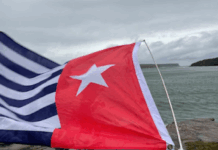
Decolonisation is also a critical issue that has a bearing on New Zealand’s relations with Indonesia, particularly over the six Melanesian provinces that make up the region known in the Pacific as “West Papua” and Indonesia’s growing politically motivated role in the region over climate change aid.
A massive new transmigration programme under current President Prabowo Subianto is taking place at the same time as Jakarta’s “ecocidal” deforestation regime intensifies in the Melanesian region with the destruction of millions of hectares of tropical rainforest.
“The wealth of West Papua — gas from Bintuni Bay, copper and gold from the Grasberg mine. Palm oil from Merauke — has been sucked out of our land for six decades, while our people are replaced with Javanese settlers loyal to Jakarta,” says a West Papuan leader, Benny Wenda.
Taking the lead
It is critically important that New Zealand and the PIF states take a lead from the Melanesian Spearhead Group — at least those states other than Fiji and Papua New Guinea, which have both been co-opted by Indonesian bribery through economic aid.
They should take a more pro-active stance on West Papuan human rights and socio-political development, with a view to encouraging a process of political self-determination and a new, more credible United Nations supervised vote replacing the 1968 “Act of No Choice”.
With regard to climate change issues, it is essential to address the lack of an officially recognised category for “climate refugee” under international law. It is also important to seek an international framework, convention, protocol and specific guidelines that can provide protection and assistance for people crossing international borders because of climate change.
The existing rights guaranteed refugees — specifically the right to international humanitarian assistance and the right of return — must be extended to “climate refugees” or climate migrants.
This issue should be acted on systematically and with a practical vision by the PIF with the Australian and New Zealand governments. Australia and New Zealand need to respond to Pacific Island States’ (PIS) concerns over climate change and global warming with a greater sense of urgency and resolve.
Regional and country specific climate change plans and policies are needed to deal with large numbers of Pacific refugees or climate-forced migrants, in the event of worsening climate-change scenarios in the future.
This is especially important for New Zealand, as a country with a significant Pacific population (442,632 — 8.9 percent, 2023 NZ Census) with island communities well integrated into the national infrastructure and as a country that is well placed to welcome more Pacific Islanders.
In April 2025, the New Zealand government announced plans to double defence spending as a share of GDP over the next eight years under its long-awaited Defence Capability Plan.
Trump-inspired global arms race
However, the priority appeared to be New Zealand joining a new Donald Trump-inspired global arms race while the country faced no threat, at the expense of the climate crisis, nuclear free and Pacific peace-making capacity that have forged the country’s global reputation.
Speculation was also rife about the possibility of New Zealand joining a second tier of the controversial AUKUS security pact between Australia, the UK and the US, which would raise geopolitical tensions with little benefit for the Pacific region.
As Marshall Islands Journal editor Giff Johnson has remarked, the people of Rongelap changed the course of history for Pacific nuclear justice by taking control of their destiny with the help of Greenpeace’s Rainbow Warrior.
However, the relocation of the islanders four decades ago has revealed that the legacy of nuclear tests remains unfinished business.
“In the current global turbulence, New Zealand needs to reemphasise the principles and values which drove its nuclear-free legislation and its advocacy for a nuclear-free South Pacific and global nuclear disarmament,” says former New Zealand prime minister Helen Clark.
“New Zealanders were clear — we did not want to be defended by nuclear weapons. We wanted our country to be a force for diplomacy and for dialogue, not for warmongering.”
“On the fateful last voyage,” reflects Greenpeace Aotearoa executive director Dr Russel Norman, “the crew of the Rainbow Warrior, look at us in black and white through the lens of time, and lay down the wero — the challenge. They faced down a nuclear threat to the habitability of the Pacific.
“Do we have the courage and wits to face down the biodiversity and climate crises facing humanity, crises that threaten the habitability of planet Earth?’
To Ngāti Kura kaumatua Dover Samuels, the Rainbow Warrior was “probably the biggest battleship that ever traversed the oceans of the world. But she wasn’t armed with guns, she was armed with peace”.
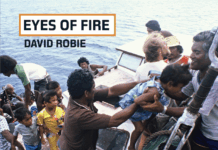
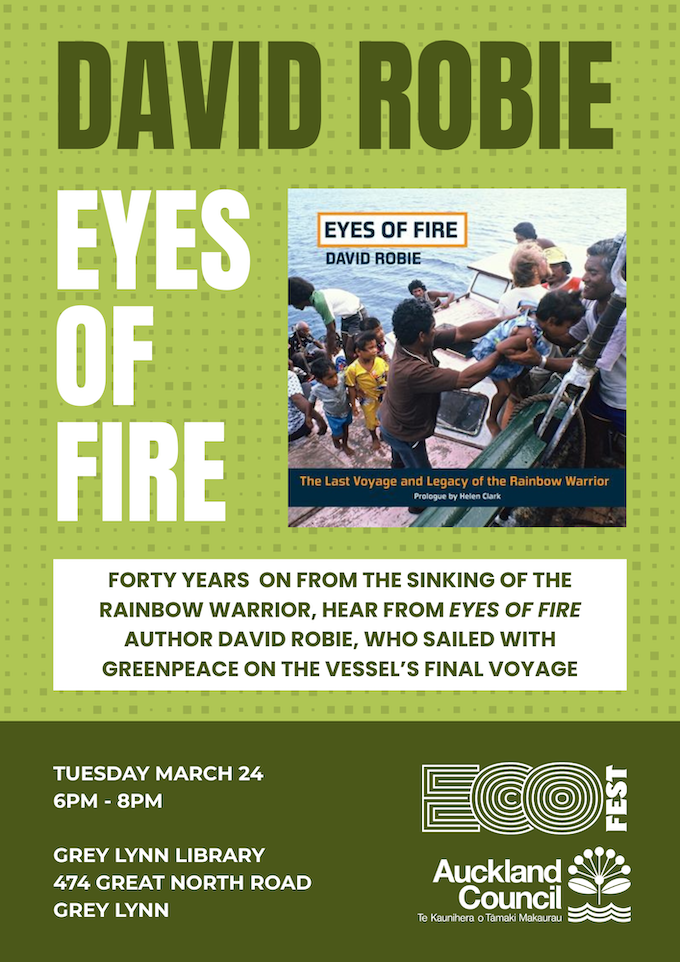
An edited extract from the final chapter of New Zealand journalist Dr David Robie’s recent book Eyes of Fire: The Last Voyage and Legacy of the Rainbow Warrior marking the 40th anniversary of the bombing. He sailed with the Greenpeace crew to Rongelap Atoll for the evacuation of the nuclear health-damaged community and remained on board for 11 weeks. This article was first published by Greenpeace Aotearoa.
- David is speaking about the Rainbow Warrior and nuclear justice tomorrow, 24 March 2026, at Grey Lynn Library, 6-8pm, as part of EcoFest.