




By Tiana Haxton, RNZ Pacific reporter
Pacific broadcasters say the future of storytelling will depend on how well traditional media adapts to the fast moving world of social media.
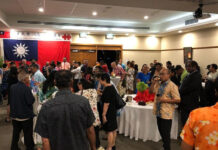
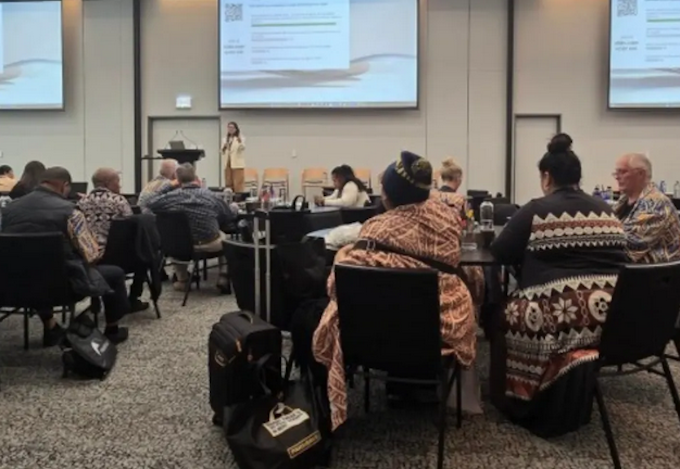
This topic is front and centre of a conference organised by PCBL/Pasifika TV, which brought together broadcasters, producers and media leaders from across the region to share ideas and strategies.
Held this week in Auckland, the conference explores how to “navigate the digital landscape” while maintaining cultural authenticity.
With audiences increasing their consumption of online content, many broadcasters say they need to rethink how they deliver news programmes.
While the opportunities are ever increasing, so too are the challenges for Pacific media to balance credibility and cultural sovereignty.
The founder of the Pacific Islands Film Festival in New York City, Stacey Young, says many organisations are still figuring out how to navigate the digital landscape.
Young said the region needs to work together to stay on top of technological advancements.
‘Fear of the unknown’
“So it is a lot of that education and a bit of a fear of the unknown, like, how much resources do we need in order to diversify and end up in these spaces?
“And the truth of the matter is, it’s not that many, but it does need to be strategic. So it does need to be a conversation and a coalesce brainstorming amongst all of the islands, because it, it sounds cliche, but we’re stronger together,” Young said.
Young said traditional media needs to ensure their content is also available online.
She said sharing Pacific content on social platforms keeps those stories circulating and reaches beyond the region.
“It’s very, very important. Like, we all do it, first thing in the morning, last thing at night, you’re scrolling and love it or hate it, that’s how people consume information… And the thirst for Pacific Island stories and Pacific Island creators is a huge demand right now,” she said.
For broadcasters on the ground in the Pacific, the challenge is making sure they reach their audiences on multiple platforms.
Cannot ignore platforms
The director of Fiji’s Mai TV, Stanley Simpson, said traditional media companies cannot ignore the platforms people are using.
“I think we’ve got to be (on) every space or platform where our audience is, you know, we can’t be just in the waves or the platforms that we’ve been in traditionally in the past. Where our people are going, we need to go there too,” Stanley Simpson said.
But not all broadcasters are having positive experiences posting online.
The managing director of Samoa Broadcasting Corporation, Faiesea Lei Sam Matafeo, said their comment sections can be a battlefield of negative debate.
Faiesea said Samoa is still adjusting to social media etiquette.
“You know, social media is it’s relatively new when compared to the rest of the world in Samoa, but sadly, I think it’s doing more harm than good right now. You know, our people are still trying to adjust to this freedom to express themselves, and sadly, it’s doing more harm than good,” Faiesea said.
Despite these challenges, she said traditional media organisations continue to adapt.
‘Something you can’t fight’
“We’ve come to realise that this is something you can’t fight. You know, social media is going to be there forever.
So we’re learning to adjust and to accept that it’s going to be part of life, so we have to shift all the contents that we have and so that it’s also available on social media,” Faiesea said.
She said social media did not rule out the role of traditional media, but it was a way for Pacific broadcasters to connect with audiences.
Navigating the digital landscape continues to be the main topic of discussion for the region’s media bosses meeting in Auckland.
This article is republished under a community partnership agreement with RNZ.