
By Coco Lance, RNZ Pacific digital journalist
As Waitangi Day commemorations continue drawing people from across Aotearoa and around the world to the Bay of Islands, Te Tii Marae has become a gathering point for Indigenous ocean leadership from across the Pacific.
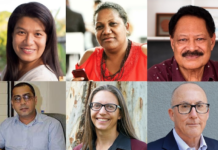
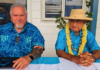
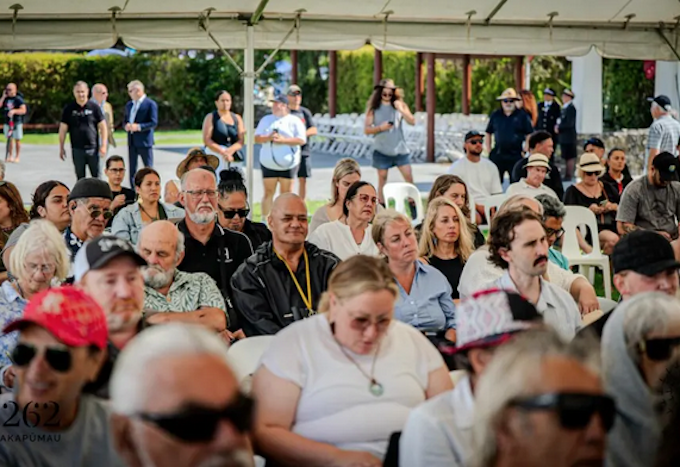
Taiātea: Gathering of the Oceans held its public forum yesterday, uniting more than 20 Indigenous leaders, marine scientists and researchers from Australia, Canada, Cook Islands, Hawai’i, Niue, Rapa Nui and Aotearoa.
The forum forms part of a wider 10-day wānanga taking place across Te Ika a Māui (North Island).
- READ MORE: Big Ka Lāhui Hawaiʻi delegation joins Māori in solidarity over Te Tiriti
- Other Waitangi reports
With a focus on the protection and restoration of Te Moana Nui a Kiwa, the Pacific Ocean, kōrero throughout the day centred on the exchange of knowledge, marine protection, ocean resilience and the accelerating impacts of climate change.
A key message remained prevalent throughout the day – the moana is not separate from the people, but a living ancestor, and a responsibility carried across generations.

‘Continue that path of conservation, preservation’
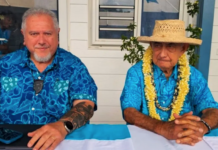
Hawaiʻi’s Solomon Pili Kaho’ohalahala, co-founder of One Oceania, a former politician, and a respected elder, framed his kōrero around the belief that there is no separation between human and nature — “we are all one”.
For Kaho’ohalahala, being present at Waitangi has been a powerful reminder of the links between past, present, and future.
“Waitangi is a very historical place for the Māori people,” he said. “It is where important decisions were made by your elders.
“So to be here in this place, for me, is significant.”

“We are talking about historical events that have happened to our people across Oceania, preserved by the elders who had visions to create treaties . . . decisions that were going to be impactful to the generations to follow,” Kaho’ohalahala said.
“It brings the relevancy of these conversations. They are what we need to negotiate and navigate the challenges we face in the present. The purpose for this is, ultimately, no different to the kupuna (Hawai’ian elder), that this was intended for the generations yet unborn,” he added.
Kaho’ohalahala also reflected on the enduring connections between indigenous communities across oceans.
“To be a part of this conversation from across the ocean that separates us, our connection by our culture and canoes is to help us understand that we are still all connected as the people of Oceania.
“But we need to be able to reiterate that, and understand why we need to emerge from that past to bring it to our relevancy to these times and issues, to continue that path of conservation, preservation, for those unborn.”

‘Our ocean … a living organism,’ advocate says
Cook Islands environmental advocate and Ocean Ancestors founder Louisa Castledine reiterated the responsibility of Indigenous peoples to protect the ocean and pass knowledge to future generations.
She said Waitangi was the perfect backdrop to encourage these discussions. While different cultures face individual challenges, there is a collective sense of unity.
“One of our key pillars is nurturing our future tamariki, and the ways of our peu tupuna, and nurturing stewardship and guardianship with them as our future leaders,” Castledine said.
“It’s about reclaiming how we perceive our ocean as being an ancestor, as a living organism, as whānau to us. We’re here at Waitangi to stand in solidarity of our shared ancestor and the responsibility we all have for its protection,” Castledine said.
She said people must be forward-thinking in how they collectively navigate environmental wellbeing.
“We all have a desire and a love for our moana, our indigenous knowledge systems of our oceans are critical to curating futures for our tamariki and mokopuna,” she said.
“We want to ensure that generations that come after us will continue to be able to feed generations beyond all of us. It’s about safeguarding their inheritance.”

Canadian representative Chief Anuk Danielle Shaw, elected chief councillor of the Wuikinuxv Nation, said the challenges and goals facing Indigenous peoples were often shared, despite the distances between them.
“This is [an] opportunity to learn about common challenges we may have, and how other nations and indigenous leaders are facing those challenges, and what successes they’ve been having,” she said.
“It just makes sense that we have a relationship, and that we build that relationship.”
She noted the central role of the marine environment for her people.
“It’s not lost on me that my people are ocean-going people as well. We rely on the marine environment.
“Our salmon is the foundation and the backbone of our livelihood and the livelihood of all other beings in which we live amongst. I’m a world away, and yet I’m still sitting within the Pacific Ocean.
“So the work I do at home and how we take care of our marine environment impacts the people of Aotearoa as well, and vice versa. And so it just makes sense that we have a relationship, and that we build that relationship, because traditionally we did,” she added.
Following the public forum, indigenous leaders will visit haukāinga in the Tūwharetoa and Whanganui regions for further knowledge exchanges and to discuss specific case studies.
This article is republished under a community partnership agreement with RNZ.