


COMMENTARY: By John Minto
Forough Amin in her opinion piece “The consequences of selective morality” (The Press, 28 April 2026) argues that the Palestine solidarity movement’s call for sanctions against Israel is “selective morality”. She says we should be calling out all human rights abuses everywhere — which in her case means Iran.
We agree with Amin’s basic premise that calls for action against countries abusing human rights should be consistent and comprehensive.
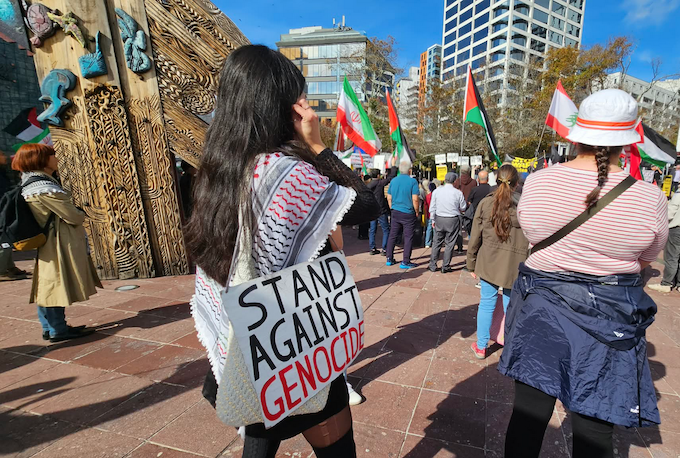
Our focus, given our organisations’ title, is however on Palestine. Israel’s genocide in Gaza is objectively the worst atrocity this century and one which all Western governments, such as ours, support. That genocide is in our name.
- READ MORE: Amnesty International calls on governments to stop predatory, anti-rights order from taking hold in pivotal moment for humanity
- Other reports in the Gaza genocide and US-Israel attacks on Iran
It is precisely because our government refuses to sanction Israel for the mass killing and starvation of Palestinians in Gaza and the pogroms conducted by Israeli settlers, with the support of the Israeli military, throughout the OPT (Occupied Palestinian Territory) that we must all speak up and demand accountability for Israel and from our government.
The complete avoidance of accountability by Israel is the single most important reason that it continues its brutal occupation in the OPT, its daily theft of Palestinian land and its refusal to allow Palestinian refugees to return to land from which they were ethnically cleansed by Israeli militias in 1948.
Our government operates a simple, easy to understand, double standard — it calls out and acts on human rights abuses in countries that the US sees as enemies, but refuses to call out or act on human rights abuses in countries the US sees as friends.
That is why the government has enacted comprehensive sanctions against Iran and Russia, but miserly measures against a small handful of racist Israeli settlers for the most egregious of war crimes.
Tight business restrictions
Regarding Iran, for example, our government has imposed tight business restrictions, targeted travel bans, asset freezes, import/export bans and suspension of bilateral engagements.
in October last year the government even re-imposed UN sanctions following Iran’s non-compliance with the Joint Comprehensive Plan of Action (JCPOA) on nuclear technology, ignoring the fact that the US pulled out of the JCPOA eight years ago.
New Zealand expects Iran, yet not the US, to keep following the trashed agreement.
So comprehensive and pervasive are the sanctions against Iran that the New Zealand Ministry of Foreign Affairs and Trade (MFAT) advises that “given the wide scope of the Regulations, and the penalties for non-compliance, it is recommended that anyone contemplating doing business with Iran obtain independent legal advice before engaging in business with people in Iran, or with entities that are incorporated in Iran or subject to its jurisdiction”.
The sanctions regime against Russia is similar in scope and designed to hold Russia to account for its invasion of Ukraine.
So, what did we do when the US and Israel twice launched massive air attacks against Iran, both times while the US was in negotiations with the Iranian leadership? Nothing.
Our Minister of Foreign Affairs issued a statement, not condemning the US and Israel, but condemning Iran for retaliating against US bases in the Gulf states. It would make great satire in a TV comedy but unfortunately its real.
No coup condemnation
Amin does not condemn the US-orchestrated overthrow of the first democratically-elected government in Iran in 1953 when Prime Minister Mohammad Mosaddegh was deposed in a coup to make way for the US-installed Shah of Iran — a lineage Amin wants to reinstate, albeit temporarily.
Needless to say, calls for democracy under the Shah were met with hideous brutality and widespread oppression of Iranian human rights activists.
It’s important to consider the feelings of New Zealanders who have community connections to overseas conflicts. It’s also important not to blame any community here for war crimes committed on the other side of the world.
Palestinian New Zealanders in particular deserve our support and empathy as they watch tens of thousands of their kinfolk, mostly women and children, being killed in Gaza — actions driven by the most hideous, genocidal rhetoric from Israeli political and military leaders.
The situation with Israel is similar to apartheid South Africa in the 1980s.
Western governments, especially New Zealand, stood with apartheid South Africa and resisted black South African calls for sanctions, until international civil society groups (including HART and CARE here) mobilised public opinion to demand action against that apartheid state.
All major human rights groups, such as Amnesty International and Human Rights Watch, along with human rights groups in Israel, describe the regime there as an apartheid state. It has a whole host of laws that discriminate against Palestinian citizens of Israel as well as Palestinians living under Israeli military occupation.
Two to one back sanctions
The government’s selective morality is in our sights. Already public surveys show that of New Zealanders who give an opinion, they are two to one supporting sanctions against Israel.
Let’s hope Auckland City Council votes to end procurement of goods and services from companies identified by the UN Human Rights Council as supporting Illegal Israeli settlements in the OPT. These settlements constitute a war crime under the Fourth Geneva Convention.
And if Amin can find any comparable human-rights-abusing companies the Auckland City Council is working with, then she should take that up with the council and would be guaranteed backing from our supporters.
John Minto was national co-chair of the Palestine Solidarity Network Aotearoa (PSNA). This article was first published by The Press and is republished with permission.