




By Kaya Selby, RNZ Pacific journalist
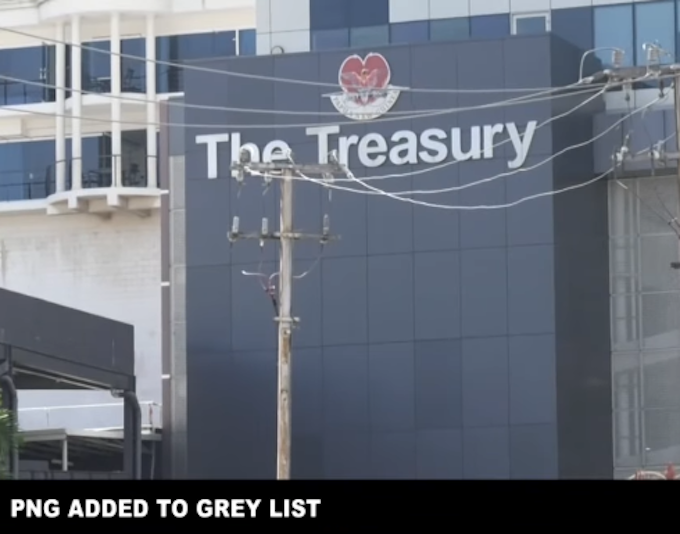
Papua New Guinea is under a close watch for money laundering, running a risk of being abandoned by global investors.
The Financial Action Task Force (FATF) has placed PNG on its “grey list” due to “strategic deficiencies” in government oversight.
The grey-list means that watchdog officials are monitoring closely, and that the government is time-bound to address their blind spots.
PNG is now one step away from the far more precarious “black list”, where other countries are compelled to stay away in order to protect the international financial system.
There are only three countries on the black list: North Korea, Iran, and Myanmar.
Prime Minister James Marape told local media outlet NBC that he accepted the conclusions of the FATF and welcomed their support.
“There is no point blaming the past. What has been identified, we will fix,” Marape said.
Need secure economy
“It is in our country’s interest to have a secure economy, not one with gaps that can be exploited.”
Marape said that investors could be assured the PNG government was doing all that is can ahead of elections in 2027.
“Our investors will not run away . . . Papua New Guinea will work its way out of the grey-list and towards a trusted, credible financial standing,”

But as many as 30 banks have publicly ruled out the possibility of investing in Papua LNG, an Exxon-backed project in the Gulf of Papua, as reported by AAP.
The project owners, seeking to produce six million tonnes of LNG per annum for a predominantly Asian market, have yet to make a final decision on whether to move forward.
Far-reaching consequences
A note from the International Monetary Fund (IMF) in November 2025 called PNG “a fragile state” noting an “unstable social and political environment”.
It’s a judgment of PNG’s institutions, weakened by conflict and poor governance, thus creating ideal conditions for money laundering and corruption to thrive.

Michael Kabuni, an anti-money laundering researcher at Australian National University, told RNZ Pacific the grey-listing sends a signal to overseas banks and investors that business in PNG is rife with danger.
“We were saying all along that PNG was going to be added to the grey list. The evidence points to it.”
PNG’s greatest vulnerability is the exposure of each MP, bureaucrat and public servant to bribes and corruption, Kabuni said.
The more powerful an individual, the more likely they are to be targeted by criminals, and the greater those incentives to bend the rules would be.
“There was the anti-corruption body that was set up in 2014 called the task force suite,” he noted.
“It did an impressive job in confiscating proceeds of crime, arresting, prosecuting and jailing those involved. But eventually they went after the Prime Minister, and that task force was disbanded.”
Kabuni noted that MPs are given 10 million kina (NZ$3.9 million) each year in the course of their work, but rarely is it all accounted for.
He said it was also common for less money to be allocated to “integrity agencies”, such as watchdogs and enforcement bodies, than they are actually budgeted.
“It’s a combination of factors, from political interference, whether it’s appointments or interference into the investigations, to capacity and resources,” he said.
In the case of Papua LNG, Kabuni said he “would think” that the bank boycott was motivated in large part by the grey-listing.
“Investors use the mutual evaluation reports as a risk matrix to determine whether this country is safe.”
“It’s going to be difficult to draw investors finances . . . we’ve never actually had an investor come in during the grey-list period.”
Risks for New Zealand
The Reserve Bank of New Zealand said banks were required to assess the associated risks with the countries that they dealt with.
“This may mean that transactions to or from Papua New Guinea may be subject to greater scrutiny,” it said.
Meanwhile, the Department of Internal Affairs said all customers from PNG are considered “high risk” under the Anti-Money Laundering and Countering Financing of Terrorism Act 2009.
“This could be a PNG company operating in New Zealand or a non-resident individual (such as a person on a temporary work visa),” a spokesperson said.
“As a result, an enhanced level of customer due diligence must always be applied.”
Anti-money laundering expert Kerry Grass told RNZ Pacific that businesses dealings with PNG were inherently risky.
“Trade-based money laundering (trading value for value) is not captured as an activity under the AML/CFT Act for international reporting obligations of trade,” Grass said.
Escaping obligations
“Hence I can trade you a shipping container of car parts for 1kg of Cocaine hidden in a container of coconuts. That type of international trading is escaping obligations of reporting under the AML/CFT Act if no wire transfer is relied on.”
In an ideal world, Grass said, customs officials would be able to manage risk based on knowledge of the source, but this could be disguised.
Efforts to stop ill-gotten gains from PNG to NZ would depend on their ability to decipher this information.
“I don’t think New Zealand is actually operating at a jurisdiction level where these controls or knowledge are actually down to that level,” she said.
This article is republished under a community partnership agreement with RNZ.