



Asia Pacific Report
Two New Zealand companies were condemned at a pro-Palestinian rally in Auckland today for their alleged complicity in Israel-US military industrial complex roles linked to Israel’s genocide in Gaza.
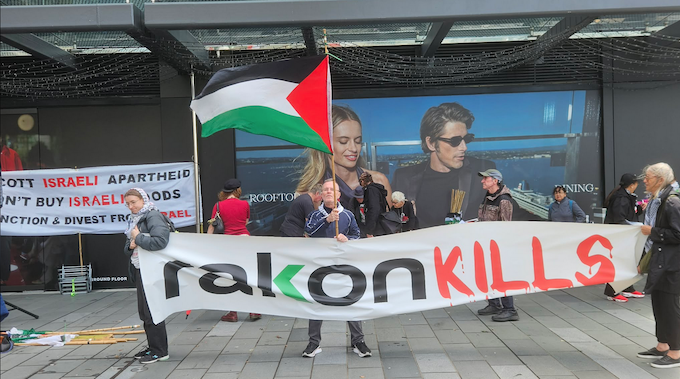
The rally in Auckland’s Te Komititanga Square was themed “NZ has blood on its hands” and speakers heavily criticised the conduct of Rocket Lab and Rakon with their alleged “opaque” link to IDF targeting during the more than two-year war on the besieged enclave.
Although a ceasefire was declared last October 10, critics have condemned Israel for repeatedly violating the truce, killing at least a further 463 Palestinians out of the total of more than 71,000, mainly women and children.
- READ MORE: ‘We kill enemies’ – spy firm Palantir secures top Australian security clearance
- Palestine protesters target NZ businesses ‘complicit’ with Israel’s Gaza genocide
- War in space: US assesses NZ’s ability to quickly launch satellites
- Other Gaza genocide reports
The rally was organised by the Palestine Solidarity Network of Aotearoa (PSNA) in the 120th week of demonstrations and focused discussion on New Zealand’s complicity.
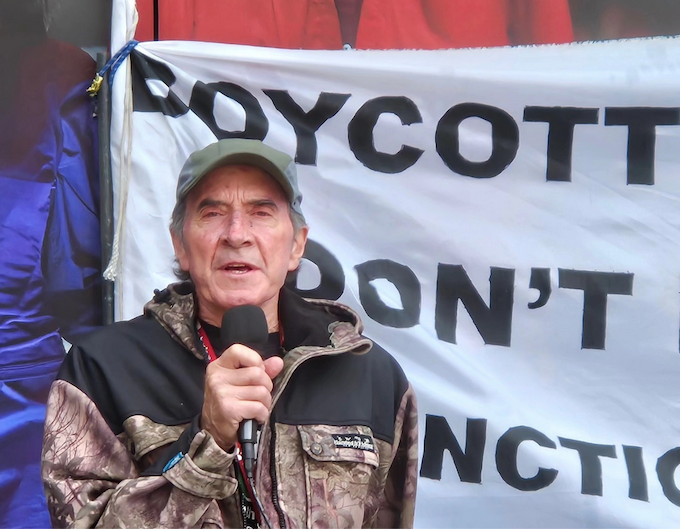
“I don’t want to ruin your day,” began PSNA organising committee member Brendan Corbett, “but as we gather here there is another group of people in a quiet Mt Wellington street staring at computer screens in the mission control office of a US Department of War contractor, Rocket Lab.”
He said they were launching spy satellites for Blacksky that ultimately fed data to Palantir, the notorious company that supplies AI-powered data, then to the IDF for the “targeted killing of Palestinians”.
“The US Department of War loves Rocket Lab so much they they have given them a US$2.4 billion contract shared with another American company to convert the rocket that they build at Warkworth into a hypersonic, 700 kg payload, missile.
“Rocket Lab have got the gall to call their rocket the ‘Hypersonic Accelerator Suborbited Test Electron’.
A first launch this year of the Electron due on Thursday was delayed by high winds.
“How the hell have we got to this stage that the US Department of War is active at this level in our community?” Corbett asked.
From ‘link to chain’
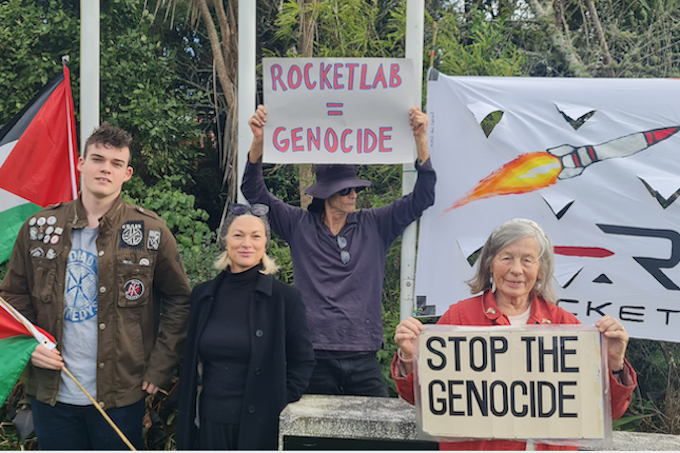
He said Rocket Lab had gone from being a “link in the Gaza kill chain” to now “being the chain”.
Corbett told the crowd to “go back a bit” — to 2006 — for background.
Rocket Lab was the product of some “clever New Zealand rocket tech enthusiasts” who had an idea for a cheap, small rocket delivery service taking satellites into orbit.
The company was “commercialised” and then sold to American interests.
“By reassuring sceptical iwi that Rocket Lab would never carry military payloads they got approval for a launch facility in Māhia, near Gisborne, and a tracking facility on Rēkohu, Chatham Island.
“Fast forward 20 years to April 2025, Peter Beck, the founder and major shareholder in Rocket Lab announced: ‘It’s an honour to be selected by the American Space Systems Command to partner in delivering the Victus Haze mission and demonstrate the kind of advanced technically responsive capabilities critical to evolving national security needs.'”
Victus Haze is an American military research programme experimenting with hypersonic space vehicles.
War in space?
The United States has been assessing New Zealand capability to help with rapid rocket and satellite launches if “war breaks out in space”.
After outlining Rocket Lab’s activities, including its production plant in Warkworth, Corbett said: “You get the picture. Rocket Lab has fully embedded itself in the US Department of War . . . and their share price is rocketing up.”
“War is still one hell of a racket.”
Corbett concluded by saying: “This open disregard that Rocket Lab has for the people of New Zealand, dragging us into complicity with genocide must be challenged and confronted.”

In a speech by Christchurch peace activist Will Alexander, read out by PSNA’s Leeann Wahanui-Peters, another company, world-leading technology outfit Rakon, and its “unsettling path its products may be taking” was criticised.
Rakon manufactures crystal oscillators as dual-use components — “the same technology that guides a civilian drone to capture a beautiful landscape can guide an Israeli drone to a journalist’s tent.”
Alexander referred to a statement from Rakon in May 2024: “Rakon does not design or manufacture weapons. We do not supply products to Israel for weapons, and we are not aware of our products being incorporated into weapons which are provided to Israel.”
He responded: “I am not alleging that Rakon ships directly to the Israeli military.”

Compelling scenario
However, his speech spelt out a compelling scenario of how a supply chain was “more opaque, and that is by design.”
His argument was that in Auckland “we have a company producing a critical component” that was likely to “enable airstrikes that have killed tens of thousands of Palestinians including journalists, destroyed hospitals, universities, and homes, and caused famine”.
Alexander said that while Rakon operated within the law, the situation posed a “profound ethical question”.
“As New Zealanders, we have a proud history of standing for peace, for nuclear-free principles, and for international law. We rightly feel horror when we see the mass killing in Gaza.
“But are we comfortable knowing that a critical piece of that war machine, however small and unseen, might have a ‘Made in New Zealand’ signature etched into its circuitry?”
Israel is on trial with the International Court of Justice (ICJ) for “plausible genocide” on a case brought by South Africa and supported by more than 30 countries and international organisations.
Prime Minister Benjamin Netanyahu and former Defence Minister Yoav Gallant are wanted on International Criminal Court (ICC) warrants for alleged war crimes and crimes against humanity.