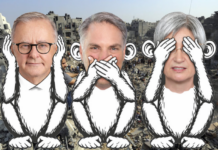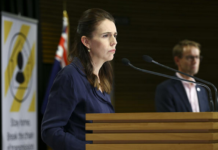

Australian Prime Minister Anthony Albanese last week announced a Royal Commission into the Bondi Beach Attack and antisemitism. Andrew Brown weighs the evidence on Australia’s “antisemitism crisis” for Michael West Media.
ANALYSIS: By Andrew Brown
Australia is being told it faces an unprecedented wave of antisemitism — a crisis requiring extraordinary measures, including a Royal Commission. But police data, court findings, and parliamentary evidence tell a very different story.
This is not a story about denying antisemitism. It is about how inflated claims are being used to silence criticism of Israel, criminalise protest, and narrow democratic space.
Australia is being told it faces a moral emergency so grave it justifies extraordinary measures.
- READ MORE: Albanese bows to relentless pressure for Bondi royal commission but scepticism remains
- Stop fuelling antisemitism! Jewish groups want Herzog to stay away
- Prime Minister calls Royal Commission, following Bondi terror attack
- Other Bondi royal commission reports
A sweeping wave of antisemitism, unprecedented in scale, is said to be engulfing the country, demanding heightened policing, vast public funding, and now a Commonwealth Royal Commission.
A manufactured narrative?
The claim has been repeated so often it has hardened into common sense. But when examined against evidence rather than repetition, the crisis begins to dissolve. What remains is not a surge in antisemitic violence, but the manufacture of a narrative
and its rapid elevation into state doctrine.
This is not denial of antisemitism. Antisemitism is real, dangerous, and must always be confronted where it occurs.
What is being challenged here is the scale, the framing, and the political use of the claim. When slogans replace evidence, the alleged crisis collapses.
Start with the numbers. Australians are repeatedly told there were around 1200 antisemitic incidents in New South Wales and more than 2000 nationally. These figures are treated as settled fact by politicians and the media.
They are nothing of the sort.
They are not police statistics. They are not court outcomes.
They are self-reported incident logs compiled by advocacy organisations using expansive definitions that collapse political speech into racial hatred. Protest slogans, Palestinian flags, stickers, online criticism of Israel, opposition to Zionism, and support for Boycott Divestment and Sanctions are all counted alongside genuinely hateful conduct.
Dissent counted as hate
Once dissent is counted as hate, the number grows and its meaning evaporates.
When these claims were tested against formal state processes, the picture changed radically. Evidence to the New South Wales Upper House antisemitism inquiry showed that only around 13 to 14 incidents met the threshold for potential criminal prosecution.
New South Wales Police did not dispute this.
From 1200 incidents to low double digit chargeable cases is not a rounding error. It is a categorical difference. If Australia were facing a genuine wave of antisemitic violence, police data and court proceedings would reflect it. They do not.
“Australia is told [of] an unprecedented wave of antisemitism, a crisis requiring extraordinary measures, including a Royal Commission. But police data, court findings, and parliamentary evidence tell a very different story”#auspol https://t.co/ooKp2MqJz0
— 💧Michael West (@MichaelWestBiz) January 10, 2026
Fake terror plots
The panic has been sustained by a series of high profile incidents that do not survive scrutiny.
In Sydney, the so called caravan plot and multiple graffiti and vehicle fire cases were initially framed as antisemitic attacks. Later reporting revealed hoaxes, staged events, or criminal activity unrelated to antisemitism as a social phenomenon.
Corrections arrived quietly, long after the alarm had done its work.
The Melbourne Synagogue fire was, we are told, the work of Iran, so it too cannot be seen as a result of local antisemitism.
More damning still was evidence from police inquiries that hundreds of antisemitic incident reports were generated by a single individual, identified as a Jewish teenager who made more than 500 calls alleging threats and attacks. These reports were logged, counted, and publicly relied upon as indicators of a statewide and national surge before being identified as false or self-generated.
This is not a footnote. It exposes a systemic failure.
A reporting framework that allows one person to materially inflate incident figures is not measuring social harm. It is manufacturing it. When that data is amplified by media and cited by politicians as “proof” of crisis, the error ceases to be technical. It becomes political.
Political amplification has been decisive. Senior leaders talked up early claims before facts were settled. Media followed. Initial allegations raced into headlines. Clarifications barely whispered.
Public memory retained the fear, not the correction.
What is unfolding follows a pattern of “manufacturing consent” described decades ago by Noam Chomsky who observed that modern democracies rarely suppress dissent through force. Instead, they manage perception by narrowing the range of acceptable opinion while preserving the appearance of open debate.
Australians are still permitted to speak. They are encouraged to condemn antisemitism in the abstract.
But questioning the scale of the alleged crisis, interrogating the numbers, or insisting on a distinction between hatred of Jews and criticism of Israel is treated as suspect. This is not censorship. It is calibration.
‘Fake protesters’ narrative
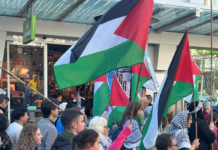
The consequences have been most visible in the treatment of protest. Australia has seen one of the largest sustained protest movements in its modern history, with weekly demonstrations in support of Palestine drawing tens of thousands.
Jewish Australians march openly.
Jewish speakers address crowds. Jewish banners appear alongside Palestinian ones. The focus is ceasefire and accountability.
Yet these protests are relentlessly framed as incubators of antisemitism.
The misrepresentation following the October 8 gathering near the Sydney Opera House was emblematic. Claims of genocidal chanting were broadcast nationally and internationally. Those present publicly disputed the account.
The disputed version was amplified. The disavowals were marginalised. A contested moment was frozen at its most inflammatory interpretation and reused as an origin myth.
Sydney Harbour Bridge propaganda
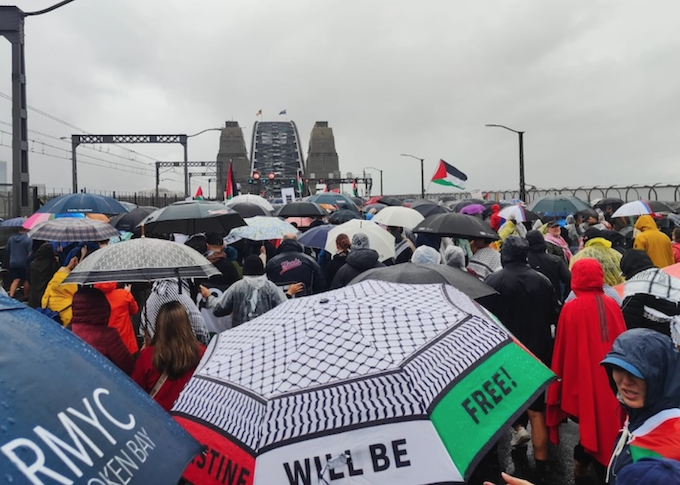
The fracture became impossible to ignore after the Harbour Bridge march, one of the largest demonstrations in Australian history. No violence. No arrests. Jewish Australians marching openly.
Yet the event was branded a hate march by the government’s antisemitism envoy.
If a peaceful protest of that scale can be declared hate without evidence, antisemitism is no longer being identified. It is being declared. And once it can be declared, it can be weaponised.
That weaponisation has a clear objective: to shut down criticism of Israel.
As Israel’s war in Gaza has intensified and the occupation of the West Bank has deepened, the international conversation has shifted toward allegations of genocide, apartheid, and war crimes.
Rather than answer those charges, Israel’s defenders have sought to redefine the debate itself. The problem is no longer what Israel is doing. The problem is those who are talking about it.
Criticism of Israel is reframed as antisemitism. Opposition to Zionism is reframed as racial hatred. Support for Palestinian rights is reframed as extremism. Pro-Palestinian protest is recast as a domestic security problem rather than a human rights movement responding to mass civilian harm.
The endgame
This brings us to the endgame. The government’s mandate for a Commonwealth Royal Commission into antisemitism has now been released. It does not ask whether a nationwide antisemitism wave exists. It assumes one.
From its opening premises, the mandate proceeds on the basis that antisemitism is prevalent across Australian society and institutions and that protest, education, and political expression warrant scrutiny. These are not hypotheses to be tested. They are conclusions already reached.
This is not a fact-finding exercise. It is an implementation exercise.
Many Jewish Australians reject this strategy and stand openly with Palestinians. The issue is not Jewish identity. It is the instrumentalisation of antisemitism claims to silence dissent, suppress protest, and shield a foreign state from accountability.
Antisemitism must always be confronted where it exists.
But evidence must precede power.
Anything less is theatre.
Andrew Brown is a Sydney businessman in the health products sector, former deputy mayor of Mosman and Palestine peace activist. This article was first published by Michael West Media and is republished by Asia Pacific Report with permission.