



OBITUARY: By Patrick Decloitre, RNZ Pacific correspondent French Pacific desk
Political leaders and institutions have paid tributes for Lionel Jospin, the “father” of the 1998 Nouméa Accord, who died at the weekend aged 88.
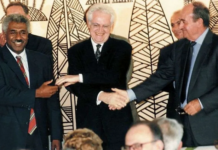
Jospin was a socialist prime minister who played a significant role in supervising the signature of the 1998 Accord, which paved the way for increased autonomy for the French Pacific territory.
Ten years after the signing of the 1988 Matignon-Oudinot agreements which contributed to restoring civil peace after half a decade of quasi civil war, the Nouméa agreement was more focused on furthering the process.
Its emphasis was to ensure a gradual transfer of more powers from Paris to Nouméa, the creation of a local “collegial” government, the setting up of three provinces (North, South and Loyalty islands) and the notion of “re-balancing” resources between the North of New Caledonia (mostly populated by the indigenous Kanak population) and the South of the main island, Grande Terre, where most of the economic power and population are based.
There was also the embryonic concept of a New Caledonia “citizenship”. One of the cornerstones of this re-balancing was the construction of the Koniambo nickel processing factory, in the North of the main island.
But the project is now dormant after its key financier, Glencore, decided to mothball the plant due to a mix of structural cost issues and the rise of other global nickel players, especially in Indonesia.
In 1988, the Matignon Accord was negotiated and signed by then French Socialist PM Michel Rocard.
Agreement signed
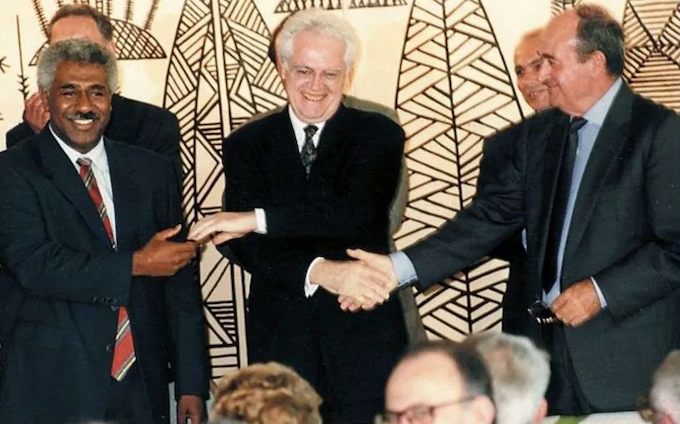
A decade later, it was under Jospin that the Nouméa agreement was signed between pro-France leader Jacques Lafleur and pro-independence umbrella leaders, including Roch Wamytan (Union Calédonienne).
The Nouméa Accord also designed a pathway and envisaged that a series of three referendums should be held to consult the local population on whether they wished for New Caledonia to become independent.
The three referendums were held between 2018 and 2021.
Although the pro-independence FLNKS called for a boycott of the third referendum in December 2021, the three results were deemed to have resulted in three refusals of the independence.
Since then, under the Accord, political stakeholders have attempted to meet in order to decide what to do under the new situation.
Since July 2025 and later in January 2026, negotiations took place and produced a series of the texts since referred to as “Bougival” and “Elysée-Oudinot”.
But the FLNKS has rejected the proposed agreements, saying this was a “lure” of independence and only purported to make New Caledonia a “State” within the French realm, with an associated “nationality” for people who were already French citizens.
Celebrated accord preamble
One of the most celebrated passages of the Nouméa Accord is its preamble, which officially recognises the “lights” and “shadows” of French colonisation.
The approval of the 1998 text came as a result of tense negotiations between the pro-independence FLNKS and, at the time, the pro-France RPCR was the only force defending the notion of New Caledonia remaining part of France.
RPCR has since split into several breakaway parties.
FLNKS has also split since the riots that broke out in May 2024, materialising a divide between the largest party Union Calédonienne (now regarded as more radical) and the moderate PALIKA and UPM pro-independence parties.
In 1998, some of Jospin’s key advisers were Christian Lataste and Alain Christnacht, who later served as High Commissioners of France in New Caledonia.
“He was someone who was negotiating, was discussing and who respected his interlocutors and the Kanak civilisation,” Nouméa Accord signatory Roch Wamytan told local public broadcaster NC la 1ère.
‘Obtaining solutions’
“He also had this method for obtaining solutions and a consensus, out of a contradictory debate”.
PALIKA party (still represented by one signatory, Paul Néaoutyine) also paid homage to Jospin, saying they would remember the late French leader as a “statesman”, a “man of his word” who managed to foster a “historic compromise”.
“Through the Nouméa Accord, he managed to see the realities of colonial history and open the way for emancipation,” the party stated in a release.
“The historic (Nouméa) accord was a major step in (New Caledonia’s) decolonisation and re-balancing process,” New Caledonia’s government said in an official release on Tuesday.
“It allowed to set the foundations of a common destiny between (New Caledonia’s communities, founded on the recognition of the Kanak identity and the sharing of skills”, the release went on, stressing the importance of a “climate of dialogue, respect and responsibility, which are essential for New Caledonia’s institutional and political construction”.
‘One of its greatest’ — Macron
In mainland France, tributes have also poured from all sides of the political spectrum.
French President Emmanuel Macron hailed “a great French destiny”.
“France is aware it has lost one of its greatest leaders,” former French President François Hollande wrote on social networks.
Manuel Valls, who was Overseas State Minister between December 2024 and late 2025, said as a young adviser in the late 1980s and later on, he had been inspired by both PMs Michel Rocard and Lionel Jospin when he was fostering negotiations and the resumption of talks between New Caledonia’s antagonist politicians in 2025.
The Nouméa Accord is still deemed valid until a new document is officially enshrined in the French Constitution.
Attempts to translate the Bougival-Elysée-Oudinot into a constitutional amendment are still underway in the coming days, this time through debates at the French National Assembly (Lower House), with a backdrop of parliamentary divisions and the notable absence of any conclusive majority.
In February 2026, the French Senate endorsed a Constitutional amendment bill to enshrine the project into the French Constitution.
But the text now required another endorsement from the Lower House, the National Assembly, and later another green light, this time from the National Assembly, then both Houses of the French Parliament (the Senate and the National Assembly, in a joint sitting of the French “Congress”.
This article is republished under a community partnership agreement with RNZ.