

SPECIAL REPORT: Reporters Without Borders
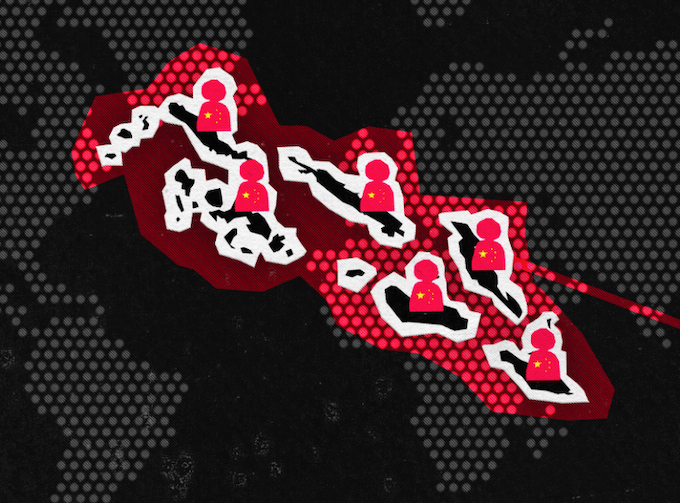
Since the Solomon Islands established diplomatic relations with China in 2019, the Pacific country has become a strategic arena for Beijing’s influence.
By capitalising on the economic fragility of the local media sector, China has stepped up conditional funding, editorial partnerships and influence programmes to disseminate its narratives.
Reporters Without Borders (RSF) calls on the Solomon Islands’ government to make the viability and independence of the media sector a priority.
One day in January 2024, Lloyd Loji, publisher of the Island Sun, one of the country’s leading dailies, reportedly received a call from a Chinese diplomat.
According to the investigative outlet In-depth Solomons, the diplomat expressed the embassy’s “concern” about an op-ed published that same day on the election of the new president of Taiwan and its implications for relations between China and Western countries.
At the end of the call, the Chinese diplomat explicitly asked the newspaper to relay articles he had sent, reflecting Beijing’s official position on regional affairs.
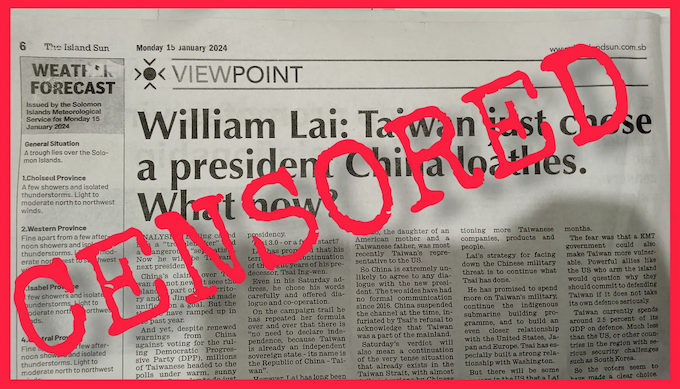
The Chinese diplomat did not stop at interfering in the editorial line of the Island Sun.
In-depth Solomons reports that he also emailed the owners and editors of the country’s main media outlets, urging them to adopt the Chinese narrative on the Taiwanese elections and sharing two articles he asked them to publish.
The Solomon Star, the other major daily of the Solomon Islands, duly published the articles supplied by the Chinese embassy. Both the Solomon Star and Island Sun depend on Chinese funding as the country’s media landscape is facing structural economic difficulties.
Economic precarity as Beijing’s gateway
With fewer than 700,000 inhabitants and a limited advertising market — which is increasingly dominated by social media companies — news organisations in this nation face structural economic hardship.
These vulnerabilities deepened during the covid-19 pandemic and the collapse of traditional press revenues which mostly consist of advertising, making external funding essential to survival, whether from Australia, China or the United States.
Unlike support from other foreign partners, Chinese assistance often comes with editorial conditions.
After 15 years as a journalist in the Solomon Islands, Priestley Habru — now a PhD candidate at the University of Adelaide — told RSF about the demands made by the Chinese embassy to Island Sun after he left the outlet. According to his network, after the diplomatic mission donated computers, the newsroom was instructed to “stop publishing articles on Taiwan’s President.”
An investigation by the Organised Crime and Corruption Reporting Project (OCCRP), an international investigative journalism network, also revealed that in 2022 the Solomon Star sought SI$1.15 million (about US$140,000) from China to modernise its infrastructure, pledging in return to promote Beijing’s image as the islands’ “most generous and trustworthy” partner.
Following revelations about attempts by Chinese diplomats to directly interfere with the Island Sun and the country’s leading media outlets in early 2024, Beijing appears to have adopted a more discreet approach.
Ofani Eremae, president of the Media Association of Solomon Islands (MASI), explained to RSF that several local outlets have signed agreements with Chinese state media to use the state media’s content — which is fully controlled by the Chinese authorities — free of charge.
In early 2026, CCTV+, China’s state-owned international video news service, also offered MASI and In-depth Solomons use of its raw video footage and live broadcast signals free of charge, and invited them to sign cooperation agreements. Both In-depth Solomons and MASI have not yet responded to the proposal.
“The authorities of the Solomon Islands must take immediate, concrete action to safeguard the country’s media landscape from undue influence by China and to ensure the conditions necessary for genuine editorial independence,” said Aleksandra Bielakowska, advocacy manager of RSF Asia-Pacific.
“This includes establishing transparent and sustainable financial support mechanisms that fully respect press freedom — because only a media environment free from political or economic coercion can allow newsrooms to operate with integrity and independence.”
All-expenses-paid trips to China
Since 2019, at least 30 of MASI’s 70 member journalists have been invited to China, sometimes more than once, according to Eremae.
These visits fully funded by Beijing are designed to showcase the country’s economic achievements, the workings of its media system, and, ultimately, to encourage participants to adopt and relay official Chinese discourse.
“The authorities’ aim is to show how advanced China is — a great country that has developed enormously in recent years — and to explain how their media operate,” Ofani Eremae said.
In June 2025, four journalists attended a two-week seminar in Beijing organised by the National Radio and Television Administration, a state body controlled by the Chinese Propaganda Department and responsible for ensuring that programmes align with the regime’s political line.
Eremae says he has received similar invitations, but he turned them down due to work commitments. Chinese influence also extends to institutions: according to Eremae, nearly 90 percent of officials in the government unit responsible for communication and press relations have taken at least one official trip to China since 2019.
A grave decline in press freedom
This rapprochement between China and the Solomon Islands has been accompanied by a marked deterioration in the media climate, particularly during the fourth term of former prime minister Manasseh Sogavare (2019–2024), accused of fostering hostility towards the press.
“The very close relationship Sogavare maintained with China influenced the way he dealt with the media,” Eremae explained.
After signing a controversial security agreement with Beijing in 2022 —which was never made public — journalists faced strict restrictions during an official Chinese visit. Weeks later, the government threatened to bar foreign reporters from entering the country after Australia’s public broadcaster, ABC, aired an investigation on Chinese influence in the country.
Sogavare, who repeatedly praised Chinese governance, also appeared to draw inspiration from its policy of controlling information.
This was evident in the reform of the status of the publicly owned media group Solomon Islands Broadcasting Corporation (SIBC) — the only shortwave radio broadcaster across the archipelago’s 900 islands — placing it under the direct authority of the Prime Minister’s Office.
The restructuring was accompanied by disturbing instructions to censor content critical of the government.
- China is the world’s biggest jailer of journalists, with 121 currently detained, and ranks 178th out of 180 countries and territories in the 2025 RSF World Press Freedom Index.
Republished from Reporters Without Borders by Pacific Media Watch.