


Asia Pacific Report
The United States and Fiji have filed separate declarations of intervention in South Africa’s genocide case against Israel at the International Court of Justice (ICJ), alleging the country is committing genocide in Gaza.
While the US explicitly rejects the allegation that Israel is committing genocide, Fiji raises issues about how the 1948 Genocide Convention should be interpreted.
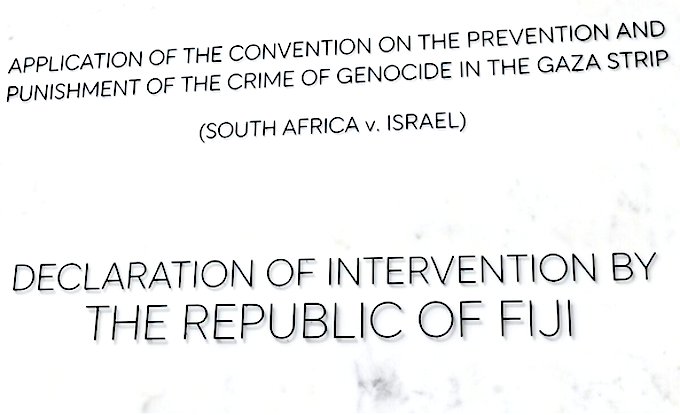
The 34-page Fiji declaration was filed on March 12 and is signed by Ambassador Ilaitia Tamata, Fiji’s Permanent Representative of Fiji to the United Nations and other international organisations in Geneva, reports The Fiji Times.
- READ MORE: Fiji files intervention in Gaza genocide case at ICJ
- Israel’s genocide in Gaza: Whatever happened to South Africa’s case at the ICJ?
- Palestine will continue to seek justice against Israel at ICC and ICJ, says The Hague ambassador
- More Gaza genocide lawsuit reports
In the declaration, Fiji said it was exercising its right under Article 63(2) of the ICJ Statute to intervene as a party to the Convention, arguing that the case raises important questions about how it should be interpreted.
The filing confirms that Fiji has appointed its Permanent Representative to Israel, Ambassador Filipo Tarakinikini, as agent for the proceedings.
The Fiji filing was made alongside separate interventions by Namibia and Hungary, according to a press release issued by the court on Friday, reports Middle East Eye.
All four states submitted declarations under Article 63 of the ICJ statute, which allows countries that are parties to a treaty under dispute to intervene in order to present their interpretation of that treaty.
Iceland, Netherlands also file
Earlier on Thursday, Iceland and the Netherlands also filed declarations under Article 63.
South Africa filed the case in December 2023, accusing Israel of breaching the Genocide Convention through its military campaign in Gaza following the Hamas-led attacks of October 7 that year.
Pretoria argues that Israel’s conduct — including mass killings, destruction of infrastructure and the imposition of conditions of life threatening the survival of Palestinians in Gaza — amounts to genocide.
Israel denies the accusation and claims its war is justified by considerations of self-defence.
The US submission on Thursday stands out among most interventions for directly defending Israel against the accusation brought by South Africa. Taking sides in a case is highly unconventional under Article 63 submissions.
“It’s very unusual for an intervening state (US) to use language like that,” explained Professor Gerhard Kemp, a scholar of international law.
“States normally stick to the legal issues, which can even be helpful for both sides. But terms like ‘false’ or ‘wrong’ don’t really move the needle,” he told Middle East Eye.
“They are probably aimed at a different audience.”
US argues genocide claim ‘false’
In its declaration, Washington argues that allegations that Israel has committed genocide in Gaza are “false” and urges the court to apply a strict legal threshold when determining genocidal intent.
It says, uncontroversially, that genocide can only be established where there is clear proof of specific intent to destroy a protected group.
Israel’s genocide in Gaza: Whatever happened to South Africa’s case at the ICJ?
That intent should only be inferred when it is the only reasonable explanation for the conduct in question, it says.
The submission argues that the ICJ must be fully convinced before determining an act is genocide, due to the exceptional gravity of the crime. It also says civilian casualties and destruction during armed conflict do not by themselves prove genocidal intent.
“The United States submits that the Court should maintain its standard for inferring intent. Lowering the standard risks broadening the application of the term ‘genocide’ such that it no longer carries its original weight and meaning, and invites attempts to misuse the Genocide Convention as a gateway for bringing extraneous disputes before the Court,” the US claimed.
Hungary and Fiji’s submissions similarly advance legal arguments that align closely with Israel’s position in the case.
Narrow interpretation
Hungary’s declaration calls for a narrow interpretation of genocide and emphasises that civilian casualties and destruction during armed conflict do not in themselves demonstrate genocidal intent.
Fiji’s intervention likewise urges the court to apply an extremely high evidentiary threshold for genocide, and cautions against relying heavily on reports by international organisations or non-governmental groups when assessing allegations.
By contrast, Namibia’s declaration focuses on a broader interpretation of the Genocide Convention and emphasises how genocidal intent may be inferred from patterns of conduct and cumulative evidence.
Namibia argues that acts such as the denial of humanitarian aid, repeated displacement and deprivation of basic necessities could fall within the Convention’s prohibition on deliberately inflicting conditions of life calculated to bring about the destruction of a protected group.
Its submission also stresses that genocide can be committed through omissions, including a refusal to allow or facilitate life-saving humanitarian assistance to civilians under a state’s control.
Third-state interventions
The new filings add to a rapidly expanding list of states seeking to intervene in the proceedings.
Since April 2024, similar interventions have been submitted by Colombia, Libya, Mexico, Palestine, Spain, Turkey, Chile, the Maldives, Bolivia, Ireland, Cuba, Belize, Brazil, the Comoros, Belgium and Paraguay in support of the South African argument.
Palestine and Belize have also sought to intervene under Article 62 of the court’s statute, which allows states to apply to participate in proceedings if they believe they have a legal interest that could be affected by the court’s decision.
Under Article 63, intervening states do not become parties to the dispute. Instead, they are permitted to present their interpretation of the treaty at issue — in this case the 1948 Genocide Convention.
The interpretation adopted by the court in its eventual judgment will also be binding on those states.
The case has become one of the most closely watched disputes ever heard by the ICJ and has drawn an unusually large number of third-state interventions, which have reached 22.
The court has already ordered Israel in legally binding provisional measures to take steps to prevent acts that could violate the Genocide Convention and to allow humanitarian aid into Gaza.
Israel ignores court orders
Israel has repeatedly ignored the orders.
A final ruling on whether Israel has breached the Convention is expected in 2028. But it could take longer, depending on the length of hearings and the two parties’ adherence to deadlines.
On Thursday, Israel was scheduled to submit its counter-memorial, or arguments in response to South Africa’s accusations, after several deadline extensions by the court.
The court has yet to announce that Israel has filed its evidence, however.
During its devastating onslaught, Israel has so far killed more than 74,000 Palestinians in Gaza, most of them women and children. It has also destroyed most of the enclave’s homes, hospitals, schools and other infrastructure, rendering it largely uninhabitable for its 2.3 million civilians.
A UN commission of inquiry concluded last September that Israel has committed genocide in Gaza since 7 October 2023.
The UN report’s authors, including legal experts Navi Pillay and Chris Sidoti, told Middle East Eye that the report used evidence and a similar methodology in its analysis to that which will be used by the ICJ.