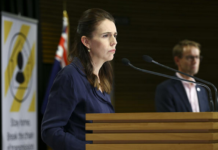




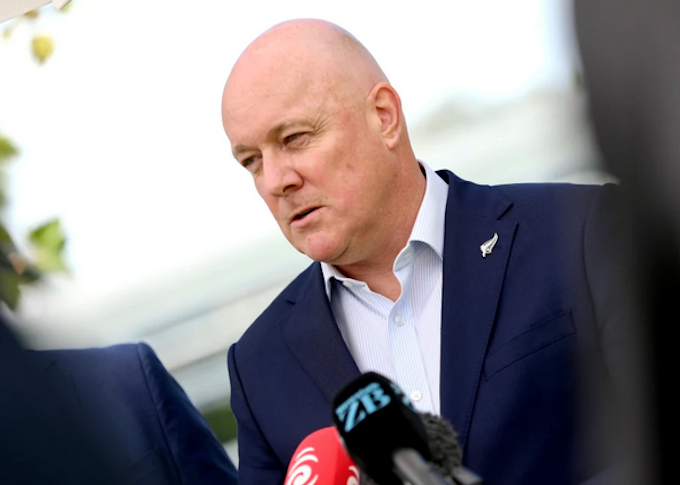
Prime Minister Christopher Luxon says New Zealand’s stance on the United States and Israeli bombing of Iran mirrors that of Australia.
Australian Prime Minister Anthony Albanese said the government supported the United States acting to stop Iran acquiring nuclear weapons.
A statement by Luxon and Foreign Minister Winston Peters yesterday “acknowledges” the strikes.
- READ MORE: Trump says Iran attacks to continue until ‘all objectives’ achieved
- World leaders react cautiously to U.S. and Israeli strikes on Iran
- Critics say weak NZ response over US-Israel attacks on Iran a ‘disgrace’
- UN’s Guterres condemns US-Israeli strikes, retaliatory attacks by Iran
- Other US-Israel attack on Iran reports
Asked on RNZ’s Morning Report whether New Zealand supported the attacks, Luxon repeatedly refused to say the word, but said it condemned the Iranian regime as evil and as having claimed countless lives.
“We think Iran has been repressing its own people. We think it’s been arming proxies and terrorist organisations. We think it has been developing its ballistic and nuclear programmes and years of diplomacy hasn’t actually paid any fruits,” he said.
“We understand fully why the Americans and Israelis have undertaken the independent action that they have taken to make sure Iran can’t threaten people.”
Pressed on whether the strikes were legally right, Luxon said it would be up to the US and Israel to explain the legal basis for their attacks.
NZ should back international rules
Former Prime Minister Helen Cark has called the government’s stance a “disgrace” and says New Zealand should support a rules-based international order.
Luxon said what was disgraceful was the repressive Iranian regime which had killed thousands of its own people who had taken to the streets calling for freedoms.
“Iran has been a destabilising force. It has supported armed proxies throughout the region. It has seen tens of thousands of people murdered by own government, who were asking for freedom and rights.”
Australia and Canada have openly supported the strikes on Iran.
United Nations Secretary-General Antonio Guterres called for “genuine dialogue and negotiations” after the US and Israel military strikes across Iran, calling the attacks a grave threat to “international peace and security”.
In a statement on Sunday, Luxon and Foreign Affairs Minister and Winston Peters said New Zealand had consistently condemned Iran’s nuclear programme and its “destabilising activities” in the region and “acknowledged” the strikes.
“Iran has, for decades, defied the will and expectations of the international community. The legitimacy of a government rests on the support of its people. The Iranian regime has long since lost that support,” they said.

“In this context, we acknowledge that the actions taken overnight by the US and Israel were designed to prevent Iran from continuing to threaten international peace and security.”
Luxon and Peters condemned in the “strongest terms Iran’s indiscriminate retaliatory attacks” on neighbouring states.
The statement also said “we call for a resumption of negotiations and adherence to international law.”
Call out illegal strike
Clark told Morning Report said the statement was a disgrace.
“What was wrong with it was it didn’t call out the illegal strike against Iran in the middle of diplomatic negotiations “which were going quite well and further talks were scheduled,” she said.
“The whole point of international law is to put rules around when force is legitimate.”
“A strike is justified if there is an imminent threat of attack, which clearly there was not.”
She said the initial strikes by the US and Israel violated international law.
“The New Zealand government seems only interested in the Iranian retaliation and not looking at the reason for the retaliation, which was the attack by the United States and Israel,” she said.
“I think it’s consistent with a steady drift in New Zealand foreign policy to realign strongly with the United States, which at this particular time seems even more questionable as a strategy.”
“We’re not putting a stake in the ground in defence of the international rule of law.”
This article is republished under a community partnership agreement with RNZ.