




Mexican President Claudia Sheinbaum’s support for resettling Palestinian children orphaned by Israel’s genocide in Gaza barely rates a mention, reports Towards Democracy.
COMMENTARY: By Jeremy Rose
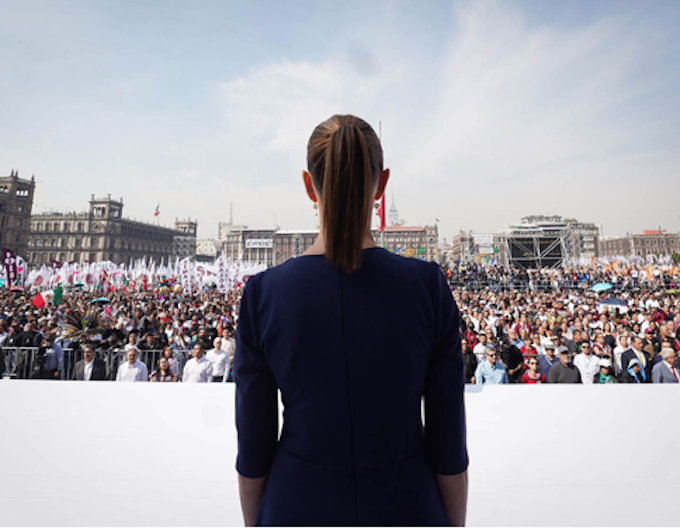
At the beginning of last month, Mexican President Claudia Sheinbaum stood in front of an estimated 600,000 supporters in Zócalo Square and reflected on the achievements of her first year in office and the seven years since the Morena Party, which she heads, came to power.
It was quite a list: 13 million people lifted out of poverty; the minimum wage increased by 125 percent; Indigenous and Afro-Mexican communities allocated budgets to run their own affairs; a locally produced people’s electric car about to roll off production lines; a new fast rail system crossing the country; a national park spanning 5.7 million hectares across Mexico, Belize, and Guatemala; a 37 percent drop in homicides — and on it went.
Sheinbaum is Mexico’s first woman president, its first Jewish president, and a climate scientist who was part of the 2007 Nobel Peace Prize–winning Intergovernmental Panel on Climate Change team.
In short, she has a story to tell, but it’s not one our media pays enough attention to.
That speech — where she declared the end of neoliberalism in Mexico — barely rated a mention in the world’s English-language press.
The grope that trumped the anti-Trump
In fact, Sheinbaum’s extraordinarily popular first year in office — El País reports she has an approval rating of over 70% — has been largely ignored by the English-language media, with three notable exceptions: when she was groped by a man on the streets of Mexico City last November, it made front-page news around the globe; a much-hyped series of “Gen Z” protests; and her dignified, and at times witty, responses to bellicose threats to Mexico’s sovereignty from the US president — which have seen her labelled the anti-Trump.
So why the lack of interest? Some possibilities, none of them edifying, spring to mind: if it doesn’t involve violence, Latin America rarely rates a mention in the media; Sheinbaum is a woman; and she’s leftwing.
But for each of those, there’s at least one counter-example that suggests this isn’t always the case.
Argentina’s right-wing libertarian president, Javier Milei, is widely reported on despite coming from a country with little over a third of Mexico’s population and GDP. Milei is a poster boy for right-leaning pundits from Auckland to London.
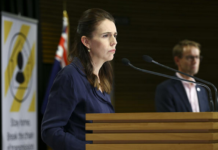
Former New Zealand prime minister Jacinda Ardern — leader of a country of just five million people compared to Mexico’s 130 million — was widely reported on while in office, and with the recent publication of her memoir has been the subject of more feature articles in recent months than Sheinbaum has generated in a year in office.
And finally, and perhaps most interestingly, there was the saturation coverage of Zoran Mamdani’s run and eventual victory in the New York mayoral election.
Sheinbaum’s successful campaign to become the equivalent of mayor of Mexico City — with a population significantly larger than New York’s — in 2018 was barely reported, despite running on a similarly leftwing, if notably more ambitious, platform.
Mamdani’s campaign and victory were newsworthy but, on any metric, less significant than Sheinbaum’s time in office.
World’s most popular leader
She is arguably the world’s most popular leader, delivering on promises more far-reaching and consequential than anything on offer in the Big Apple.
A promise by Mamdani to arrest Israeli Prime Minister Benjamin Netanyahu should he visit New York — something he almost certainly cannot deliver on — was widely reported, while Sheinbaum’s support for resettling Palestinian children orphaned by Israel’s genocide in Gaza barely rated a mention. (Mexico has also joined South Africa’s International Court of Justice genocide case against Israel.)
The contrast between the saturation coverage of Mamdani and the paucity of coverage of Sheinbaum holds true for both conservative and liberal media.
The Wall Street Journal ran 50-plus editorials and op-eds criticising Mamdani in the run-up to his election but just three or four on Sheinbaum in her first year in office, all focusing on her alleged failure to tackle violence and the cartels. (In fact, homicides are down, though still extremely high.)
Even Jacobin magazine, one of the few US outlets to provide in-depth coverage of Mexico’s so-called “Fourth Transformation,” has given far more coverage to Mamdani, with a recent podcast declaring New York the epicentre of global socialism.
Whatever the explanation for the scant coverage of Sheinbaum, the achievements and popularity of the Morena movement are worth talking about.
The Donroe Doctrine’s threat to Mexico
There’s little doubt we’ll be hearing more about Mexico over the coming months, but the focus will almost certainly be on the threat from the north, not the achievements and promise of the Fourth Transformation.
After the illegal abduction of Venezuelan President Nicolás Maduro on January 3, President Trump turned his sights on Mexico, declaring Sheinbaum to be a “tremendous woman, she’s a very brave woman, but Mexico is run by the cartels”.
Having designated the Sinaloa and Jalisco New Generation cartels as terrorist organisations at the beginning of his second term in office, Trump had already signalled the possibility of military intervention in Mexico.
Sheinbaum’s response to both the Venezuelan intervention and the implied threat to Mexican sovereignty was resolute and principled:
“We categorically reject intervention in the internal affairs of other countries. The history of Latin America is clear and compelling: intervention has never brought democracy, never generated well-being, nor lasting stability.
“Only the people can build their own future, decide their path, exercise sovereignty over their natural resources, and freely define their form of government.”
Trump has other ideas, recently declaring that the US military could attack the cartels without congressional approval.
“I don’t think we’re necessarily going to ask for a declaration of war,” he said. “I think we’re just gonna kill people that are bringing drugs into our country. We’re going to kill them. They’re going to be, like, dead.”
Trump has dubbed the new era the Donroe Doctrine — a reference to his regime’s embrace of the Monroe Doctrine, named for President James Monroe, who declared the Western Hemisphere an area of US influence in the 1820s.
200 years of brutal interventions
It was the beginning of more than 200 years of brutal interventions by the US state, including a war on Mexico that resulted in the US taking over approximately 1.36 million sq km of Mexican territory — about 55 percent of the country.
Last year Trump hung a portrait of the country’s 11th president James Polk in the White House. Polk was responsible for the Mexican-American war of 1846-1848 which ended with the ceding of California, Arizona, New Mexico, Nevada, Utah, and parts of Colorado and Wyoming to the USA, in exchange for $15 million.
Trump has pointed to the portrait and told visitors: “He got a lot of land.”
His play on words with the Donroe Doctrine is characteristically narcissistic but also painfully accurate. It is the geopolitics of a gangster state.
In a world reeling from the criminal actions of that gangster state — from its continued bankrolling of genocide, to the extrajudicial killing of alleged drug smugglers, to SS-like round-ups of “foreigners” on its city streets, to threats to take over the sovereign territory of an ally — Mexico and its president, Claudia Sheinbaum, are a beacon of hope.
There is plenty I haven’t even touched on:
- The election of an Indigenous lawyer, Hugo Aguilar Ortiz, as head of the Supreme Court;
- The construction of 1.1 million affordable homes over the next six years, generating hundreds of thousands of jobs;
- The launch of SaberesMX, a free national online platform designed to democratise access to knowledge and provide lifelong learning opportunities across Mexico; and
- Sheinbaum’s daily morning press conferences, where she speaks directly to the nation.
If past experience is anything to go by, the mainstream media’s ignoring of Morena’s successes is unlikely to end any time soon.
The good news is that there are alternatives. Mexico Solidarity Media is a great source of original articles, translations from local media, and podcasts, and Substack writer and former Boston Globe and LA Times journalist Alisa Valdes-Rodriguez regularly writes about Mexico from a progressive perspective.
Jeremy Rose is a Wellington-based journalist and broadcaster and his Towards Democracy blog is at Substack. This article was first published at Towards Democracy and is republished with permission.