






By Monika Singh of Wansolwara News
Pacific media are facing one of their most challenging reporting environments in their history, marked by governance issues, political instability, geopolitical pressures and escalating climate threats, while simultaneously grappling with declining revenue streams and threats to their financial survival.
This is highlighted in the inaugural edition of the Pacific Media academic journal, by co-editors, associate professor and head of the University of the South Pacific (USP) Journalism Programme, Dr Shailendra Singh, and co-founder of The Australia Today, Dr Amit Sarwal.
In their editorial, Dr Singh and Dr Sarwal say Pacific media systems — already vulnerable due to their small scale — continue to be hit by the collapse of traditional advertising models that once kept legacy media afloat.
They point out that although small and geographically isolated, the regional media have not been spared the ravages of digital disruption, which continues to pose a threat to the media’s traditional advertising-based revenue model. This was compounded by losses from the covid-19 pandemic.

These issues, and more, re-surfaced at the 2024 Pacific International Media Conference in Suva, Fiji. The conference, the first of its kind in 20 years, was hosted by the USP’s School of Pacific Arts, Communication and Education (Journalism), in partnership with the Pacific Islands News Association (PINA), the United States Embassy in Suva and Asia Pacific Media Network.
Selected blind peer reviewed conference papers published in Pacific Media highlight how Pacific news reporting is becoming increasingly complex and contentious, even as newsrooms face unprecedented financial and editorial pressures.
A key question explored at the conference, and a recurring theme in the journal, is how Pacific media are responding to and reporting on the overlapping challenges in the region, which have compounded the long-standing struggles to achieve sustainable development.
In his paper, Frontline media faultlines: How critical journalism can survive against the odds, the journal’s production and managing editor, veteran Pacific journalist and educator Dr David Robie warned that Pacific media face a “plethora of emerging and entrenched problems” — from collapsing business models to the rise of fake news, leadership failures, and political corruption.
Despite reporting on these issues for decades, little progress has been made even as new challenges emerge.
In The History of the Pacific Islands News Association (PINA) 1972–2023, Marsali Mackinnon and Kalafi Moala, while paying tribute to the region’s media pioneers, explore enduring questions about the state of Pacific media, especially in the context of digital disruption and revenue losses. They ask whether the industry has lost its vitality and if journalists and media workers still uphold core values like freedom of speech and impartial reporting.

The article, based on their forthcoming book chronicling PINA’s 50-year history, looks at the challenges facing Pacific media — economic, political, technological, and cultural pressures — and examines whether the principles established by postcolonial pioneers in the 1970s have been compromised.
Another paper, Women’s political empowerment in the Asia-Pacific region: The role of social media, by associate professor Baljeet Singh, Dr Singh, Nitika Nand and Shasnil Chand, examines how social media positively influences women’s political empowerment across 20 Asia-Pacific countries. Based on their findings, the authors recommend that regional governments and development partners prioritise improved connectivity and online access in deprived areas as a key strategy to empower women and strengthen their participation in politics and political leadership.
In his paper, Reporting the nuclear Pacific: Facing new geopolitical challenges, journalist and researcher Nic Maclellan revisits the Pacific’s nuclear testing legacy, highlighting the crucial role of journalists in preserving survivors’ stories. He argues that the nuclear threat in the Pacific is far from over and has re-emerged in new forms, requiring sustained media attention and critical reporting.
In his commentary, Behind the Mic: How Sashi Singh’s Talking Point helped shape Fiji’s political landscape, Sashimendra Singh reflects on the impact of his Sydney-based podcast in the lead-up to Fiji’s 2022 General Election. The former Fiji-based broadcaster interviewed key political figures, including Prime Minister Sitiveni Rabuka and the three Deputy Prime Ministers, while they were still in opposition.
Singh’s podcast tackled issues that Fiji’s suppressed national media were reluctant to address and went on to attract a large following. The article demonstrates the growing importance of diaspora media and new media technologies, showing how social media can positively circumvent censorship imposed by national authorities.
In The “Coconut Wireless”: Ways that community news endures and spreads in a news desert, Krista Rados and Brett Oppegaard address the concept of “news deserts” in the Pacific — areas where communities urgently need local information but lack trustworthy sources. This paper highlights the enduring strengths of social media in fostering journalism in remote, sparsely populated, and underdeveloped communities.
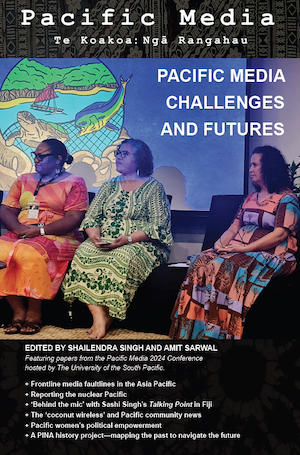
Pacific Media, launched last year, succeeds the long-running Pacific Journalism Review, which began at the University of Papua New Guinea in 1994 and was archived after 30 years of publication. PJR is now a public database for research.
The journal is designed by Del Abcede and the series editor is Khairiah A Rahman.
This inaugural edition is a collaboration between USP, the Asia Pacific Media Network (APMN), and Tuwhera Open Access platform, aimed at documenting the rapid transformations shaping journalism in the region — and how Pacific media can navigate an increasingly turbulent future.
Some other key papers include:
- Weaponising the partisan WhatsApp group: The circulation of disinformation and artificial intelligence (AI) content in the 2024 Indonesian presidential election by Mochamad Achir Taher. The paper examines the spread of disinformation partisan messages within a politically aligned WhatsApp group during Indonesia’s 2024 Presidential Election. The study finds that presidential candidates used social media platforms to distribute biased and misleading content to influence voters.
- Blood on the Tracks: Countering symbolic violence — A case study in reciprocal investigative journalism practice by Bonita Mason. In this paper, she examines a six-year investigation by Australian journalist and First Nations man Allan Clarke into the suspicious death of First Nations teenager Mark Haines. Haines’s family never accepted police claims of suicide. On the 25th anniversary of the death, Clarke, moved by the injustices suffered by the dead man’s family, reignited the investigation.
- Your weather: Digital weather producer WeatherWatch NZ and its Pacific coverage by Melissa Beattie. The paper situates WeatherWatch within the broader digital journalism landscape and then examines its Pacific-focused weekly forecasts in Melanesia and Polynesia.
This article was first published by Wansolwara News and is republished by Asia Pacific Report as a collaboration between the University of the South Pacific and Asia Pacific Media Network.